
Big Green, NY DEC File Separate Lawsuits to Block Constitution Pipe
 Well, you knew this was going to happen. Last week, a group of disgusting Big Green groups and the New York State Attorney General both filed separate lawsuits in the U.S. Court of Appeals for the Second Circuit (2nd Circuit), challenging the Federal Energy Regulatory Commission’s (FERC) decision to resurrect the Constitution Pipeline under the existing (but dormant) docket. NY AG Tish James, representing the Department of Environmental Conservation (DEC), argues that a brand new review should be done by the state to evaluate the project for compliance with the federal Clean Water Act. You may recall that NY previously lost its right to evaluate the Constitution project by stretching out its review for years, causing FERC to overrule NY (see Victory! FERC Overrules NY DEC to Allow Constitution Pipeline). Read More “Big Green, NY DEC File Separate Lawsuits to Block Constitution Pipe”
 It seems that not all of the judges who sit on the U.S. Court of Appeals for the Fourth Circuit (4th Circuit) are clowns, the way the three judges who oversee cases dealing with the Mountain Valley Pipeline (MVP) Southgate project are (see
  In April, MDN reported that anti-fossil fuel fanatics had not yet given up on trying to block construction of the Williams Northeast Supply Enhancement (NESE) pipeline, a $1 billion+ project designed to increase Transco pipeline capacity and flows of Marcellus gas heading into New York City and other northeastern markets. Even though there was an official groundbreaking ceremony at Brooklyn’s Floyd Bennett Field in New York City in April, antis are still doing their best to block this project. They pinned one of their last hopes on a relatively obscure state agency in New Jersey, pressuring it to refuse to issue a license for the project (see
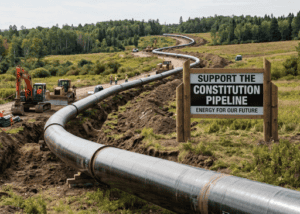 This is a critical moment for reliable, affordable energy in the Northeast, and your voice can make a difference. The Federal Energy Regulatory Commission (FERC) is currently accepting public comments on the Constitution Pipeline, representing an important step toward finally advancing this long-delayed project and a key opportunity for supporters to be heard. If you support building the Constitution Pipeline, please take a few minutes to submit a brief comment to FERC by May 4, 2026, because your input truly matters. We have instructions below on how to file a comment (it takes just a couple of minutes).
  Connecticut gubernatorial candidate Betsy McCaughey (Republican) has sued New York Governor Kathy Hochul (Democrat), alleging a violation of the Interstate Commerce Clause for blocking the Constitution Pipeline. McCaughey claims Hochul’s actions prevent cheaper Marcellus Shale natural gas from reaching New England, thereby increasing Connecticut’s electricity rates. McCaughey, who lives in Greenwich, claims legal standing to sue as a consumer and ratepayer. The lawsuit, filed in U.S. District Court, aims to force New York to allow construction of the pipeline, which she argues would provide Connecticut residents with more affordable energy. Do-nothing Governor Ned Lamont (lifer Democrat, running for a third term) dismissed the suit as a political stunt.
 As we report in today’s lead story, Williams held a groundbreaking ceremony for the Transco Northeast Supply Enhancement (NESE) project in New York City yesterday (see Groundbreaking Ceremony for NESE Pipe in NYC an All-Star Event). One of the speakers at the event, the master of ceremonies, was Williams CEO Chad Zamarin. One of the comments he made at the event that deserves its own post here on MDN was news about the Constitution Pipeline project, a 124-mile greenfield pipeline from the Marcellus gas fields of Susquehanna County, PA, to Schoharie County, NY, to move Marcellus gas into New York State and New England.
  As we reported last week, anti-fossil fuel fanatics haven’t given up on trying to block construction of the Williams Northeast Supply Enhancement (NESE) pipeline, a $1 billion+ project designed to increase Transco pipeline capacity and flows of Marcellus gas heading into New York City and other northeastern markets (see
  We spotted an interesting article that posits Williams’ strategy is to expand its mighty Transco natural gas pipeline system by increasing the capacity of existing infrastructure rather than building new pipelines. The Transcontinental Gas Pipe Line (Transco) is the largest-volume, highest-capacity interstate natural gas transmission system in the U.S. It spans roughly 10,000 miles (with 60+ compressor stations) from the Gulf Coast (Texas/Louisiana) to New York City. The Williams strategy of expanding Transco rather than building new pipes minimizes disruption to communities and the environment while meeting growing demand from residential, commercial, industrial, and power generation sectors.
  Williams Companies is breaking ground tomorrow on the Northeast Supply Enhancement (NESE) pipeline in Brooklyn — the first new pipeline in New York in over a decade — signaling a broader national natural gas infrastructure boom. Driven by AI data center power demand, LNG export growth, and population expansion, the U.S. is tracking over 150 pipeline projects representing roughly 150 Bcf (billion cubic feet) of daily capacity.
 Anti-fossil fuel fanatics haven’t given up on trying to block construction of the Williams Northeast Supply Enhancement (NESE) pipeline, a $1 billion+ project designed to increase Transco pipeline capacity and flows of Marcellus gas heading into New York City and other northeastern markets. Last November, the states of New York and New Jersey issued federal Clean Water Act permits for their respective states, allowing NESE to be built (see
  Williams is addressing the surging energy needs of data centers by deploying modular natural gas-fired power units. In fact, the company has a 6-gigawatt (GW) project backlog by the early 2030s. Williams executive Jaclyn Presnal highlights that modularization provides essential “speed to power” and extreme reliability through built-in redundancy, outperforming traditional large-scale plants for phased projects. These initiatives incorporate batteries to manage AI-driven loads and leverage pipeline expansions, such as the Transco Power Express (see