About MDN

  • |

    MDN Weekly Update – Sept 11, 2011: Remembering 9/11, Shale Gas Exports

    MDN enjoyed the last two weeks of August off, so this is the first weekly update since returning. Thank you for the kind notes received of both “have a great break” and “welcome back.” My wife and I recently observed our 25th wedding anniversary, so we thought we would celebrate with a cruise. Our cruise left the Port of New York on Saturday, August 27, just as Hurricane Irene was starting to arrive. I’ll spare you the details, but let’s just say we now know what it feels like to ride a roller coaster for 24 hours straight as you sail through the edge of a hurricane!

    Not long after returning, the area where we live—Binghamton, NY—felt the effects of Tropical Storm Lee. It brought the worst flooding in our recorded history—over 10 inches of rain in a 24 hour period. We have friends who have lost almost everything they own from flood damage. Fortunately we’re fine, but there are thousands of hurting people in this area. Perhaps you might say a prayer, and if you are so inclined, make a donation to the American Red Cross Disaster Relief Fund. The Red Cross has been out here in force to help. A fine organization.

    And I can’t let the 10th anniversary of the attacks on our great country pass without a few words. I once worked for a company with offices in New York. That company was holding a conference at the top of 1 WTC on that fateful day. I personally knew and had worked with some of the people who died an unspeakable death on 9/11. People that I called “friend.” I pause today to remember and reflect on their lives and the lives of all those lost ten years ago today. I recommend a Michael W. Smith YouTube video of his song, “There She Stands” as a fitting way to remember and reflect.

    I hope you’ll forgive this personal digression, but amidst the hurting, and the remembering, I find my emotions quite raw. It’s important to remember that in the rough and tumble of our debate over shale gas drilling and hydraulic fracturing, that there are people on the other side of the aisle. People with feelings. You know I strongly support drilling and so am willing to take the arrows that come my way. I have to remind myself sometimes that I need to keep a civil tongue in what is increasingly an uncivil debate. And so I encourage people on both sides of the debate today to remember to be civil. Those on the other side of this debate are not your enemy. Our country has plenty of enemies, and our friends and neighbors who think differently about drilling in the Marcellus and Utica Shales are not among them.


    Below are the results of the poll which has been posted for the past three weeks.

    Poll resultsHydraulic fracturing should be regulated by:

    Federal government (13%, 41 Votes)
    State governments (52%, 166 Votes)
    Both should have a role (35%, 111 Votes)

    Total Voters: 318

    Should U.S. Shale Gas be Exported?

    This past week MDN highlighted a story about exporting shale gas (see here). Dominion Resources has made application with the U.S. Department of Energy to export natural gas, much of which comes from the Marcellus. If Dominion and the other requests to export now on the books at the DOE are approved, some 12 percent of our natural gas supplies would be exported overseas. Those in favor of exporting will say “it’s about time we start exporting again” and that it will boost the U.S. economy by providing jobs and help reverse the long trend that we as a nation are net importers instead of net exporters. Another argument in favor is that we have a surplus right now—more gas is available than we can reasonably use here at home, so why not export it? Supporters will also say that the free market should determine whether or not the gas stays here or goes overseas. All strong arguments to be sure.

    On the other side, critics of drilling point out that one of the main arguments used to “sell” the concept of drilling is that it will provide abundant and cheap gas here at home—a source of cheap energy for the next two or three generations—and that we can finally wean ourselves from imported oil from countries not friendly toward the U.S. And if we start exporting a large portion of our supplies, that means less supply at home and higher prices. Critics will say “it’s the almighty buck” that companies want and that they don’t care about the citizen’s of their own country.

    Let’s be clear, profit is what drives companies and seeking profit is not evil or bad. If you think so, go live in Cuba. See what that worker’s paradise is like. But MDN also believes that it may be wise to keep tight control over how much gas gets exported. Yes, companies need to make a profit—let’s not deny them that! But on the other hand, let’s not get the gas and immediately sell it to someone else. I’d rather see our auto industry convert to NG cars and trucks, and more home heating converted, and electrical power plants, etc. With an abundant and cheap supply of natural gas here at home, it will happen. But not if we sell it overseas and hike the prices here at home. It’s a fine line and what MDN has called “a thorny issue.” How much fiddling can and should we do with the free market?

    So MDN’s poll question this week: Should the U.S. allow shale gas to be exported? Register your vote along the right side of any page on the site.

    Below are the most recent “top 5” lists and the calendar of Marcellus related events for the next two weeks.

    Happy reading,
    Jim Willis, Editor

    Read More “MDN Weekly Update – Sept 11, 2011: Remembering 9/11, Shale Gas Exports”

  • |

    MDN Weekly Update – Aug 21, 2011: MDN on Vacation until Labor Day

    Happy Labor DayTo the relief of those who oppose drilling, and the dismay of those who support it, MDN will take a vacation break for the next two weeks, starting August 22nd. We will not publish daily articles during that time. We will resume publishing on Tuesday, September 6th.

    The current poll will be left open during that time, so if you haven’t yet voted, please be sure to do so. The poll asks, Who should regulate hydraulic fracturing? Register your vote along the right side of any page on the site.

    Below are the most recent “top 5” lists and the calendar of Marcellus related events through September 10th.

    Happy Labor Day!
    Jim Willis, Editor

    Five Most Viewed Stories This Past Week (Aug 14 – Aug 20)

    1. Shale Gas Drillers Spread STDs Says PA Democrat Legislator (8/17/11)
    2. The Mighty Marcellus Roars in PA – Production Up 55% in 6 Months (8/17/11)
    3. New Interstate Pipelines Mean Thousands of Jobs in PA (8/15/11)
    4. Major Discovery – Chesapeake Energy Strikes Oil (and Gas) in Ohio’s Utica Shale (7/29/11)
    5. Fracking Creates an Oil Boom – Now More Oil than Gas Rigs (8/18/11)

    Five Most Viewed Stories Last 30 Days (Jul 21 – Aug 20)

    1. Major Discovery – Chesapeake Energy Strikes Oil (and Gas) in Ohio’s Utica Shale (7/29/11)
    2. Chesapeake, 14 Other Energy Companies Have Drilling Permits for Utica Shale in Ohio (4/18/11)
    3. Chesapeake Energy CEO Aubrey McClendon Talks to Jim Cramer About the Utica Shale in Eastern Ohio (8/2/11) 
    4. Chesapeake Energy Slated to Start Drilling in the Utica Shale in Columbiana County, OH this Fall(8/1/11)
    5. How Much Should Landowners be Paid for Marcellus Pipelines on Their Property? (7/28/11)

    Read More “MDN Weekly Update – Aug 21, 2011: MDN on Vacation until Labor Day”

  • |

    MDN Weekly Update – Aug 14, 2011: Who Should Regulate Fracking?

    Poll resultsIt seems the New York Times does not enjoy the same reputation it once did—at least with MDN readers. The results of last week’s poll, which asked:

    With respect to shale gas drilling, is the New York Times a reliable source of information?

    No (81%, 173 Votes)
    Yes (16%, 35 Votes)
    Not sure (3%, 6 Votes)

    Total Voters: 214

    Who Should Regulate Fracking?

    In early May, the federal Department of Energy (DOE), under the direction of DOE Secretary Steven Chu, assembled a panel of seven experts to create a list of industry “best practices” for shale gas drillers (see MDN story here). Known as the Shale Gas Subcommittee of the Secretary of Energy Advisory Board (SEAB), the group was charged with producing an initial report in 90 days that will identify immediate steps “to improve the safety and environmental performance of hydraulic fracturing.” That first report was released this past week (see MDN story here).

    In MDN’s reporting, we stated that it is an inescapable conclusion the only way the recommendations in the report could be fully implemented would be if the federal government takes over regulation of hydraulic fracturing, which has been the mantra of anti-drillers for a number of years. MDN makes no bones: We are against the federal government taking on oversight of oil and gas drilling. Why? It’s best left to the individual states, which is their constitutional right and duty, to oversee drilling in their own states. They know their state the best, and are equipped to handle it. Just say “no” to the feds!

    However, some MDN readers have taken issue with our conclusion that the recommendations of this report would mean a federal government takeover of oil and gas drilling regulatory oversight. We can argue the finer points, but the larger issue, and this week’s poll question, is this: Who should regulate hydraulic fracturing? Is it best done by the federal government? The individual state governments? Or perhaps a blend of both? Register your vote along the right side of any page on the site.

    An editorial note: Starting August 22nd and going through September 5th, MDN will be on holiday and will not publish. We will return on September 6th.

    Below are the most recent “top 5” lists and the calendar of Marcellus related events for the balance of August.

    Happy reading!
    Jim Willis, Editor

    Read More “MDN Weekly Update – Aug 14, 2011: Who Should Regulate Fracking?”

  • |

    MDN Weekly Update – Aug 7, 2011: MDN Classified Ads – Reserve an Ad Now (Limited Number)

    Poll resultsThe results of last week’s poll, which asked:
    Should those who support drilling boycott businesses in municipalities that ban drilling until the ban is lifted?

    Yes (76%, 151 Votes)
    No (23%, 45 Votes)
    Not sure (1%, 3 Votes)

    Total Voters: 199

    Regardless of your opinion and whether or not you support or would engage in a boycott, this past week we had proof positive that even the threat of a boycott works. Last week’s poll was inspired by the West Virginia Independent Oil & Gas Association’s (WVIOGA) response to a recently enacted drilling ban in the city of New Martinsville, WV (see this MDN article). City council members enacted the ban in early July. On Friday, August 5, council members voted to overturn the ban that was only a month old (see this article). Why? Because of WVIOGA’s threat to boycott businesses in the city. Perhaps more municipalities that have banned drilling should feel the heat from those who support it…

    Classified Ads Coming to MDN!

    For generations, the lowly classified ad has been an effective way for those with something to sell (product or service) to reach those with an interest in buying. MDN wants to make it easy for sellers and buyers to find each other, so we’ve introduced a Classifieds section on the website. MDN has a dedicated and growing community of readers. Currently there are 24,000 unique individuals who visit the site some 38,000 times each month! In addition, there are almost 1,400 people who subscribe to MDN’s daily email alert. Both sellers and buyers can now take advantage of reaching the MDN audience.

    Here’s how MDN Classifieds works: Those with something to sell/an offer, including job listings, land leases and products & services for either landowners or the drilling industry, simply fill out a form on this page. MDN will review the ad and respond to confirm details and make arrangements for payment. When the ad is released, it will run for 30 days, reaching a potential audience of 24,000 people highly interested in Marcellus and Utica Shale gas. In addition, MDN will produce a special, dedicated email once per week with a list of all classifieds and email it to daily email subscriber list of 1,400 people. Your ad will be emailed 4x during its 30-day run.

    You supply a brief, 40-word version of your ad that will display on the main Classifieds page and in the weekly email. But when readers click on your ad headline, they will go to your special, dedicated page on MDN where you can supply as many words as you like.

    The cost? Just $75 per ad per month. Please note: MDN will limit the number of ads to 100 maximum so it’s always easy to quickly scan the list.

    A very special offer: The official launch of the service will be September 6. However, if you want to reserve a spot now, your ad will begin running immediately and you will not be charged for the time between now and September 6. All ads must be pre-paid.

    For more details and a sample ad, visit the MDN Classifieds page: //marcellusdrilling.com/classifieds/.

    Current Poll – The NYT Vendetta Continues

    The New York Times started running “hit pieces” against the natural gas drilling industry earlier this year. The ongoing series is penned by Ian Urbina. What has become apparent is that Mr. Urbina has an anti-drilling ax to grind. Some of his earlier reporting was refuted by the Times’ own public editor, pointing out his so-called source for one story was a government agency intern (see this MDN story). But that doesn’t seem to matter to the managing editors at the Times. This past week we saw yet another drive-by hit piece penned by Mr. Urbina (see this MDN story).

    A publication (and “brand”) like the New York Times has built a storied and well-deserved reputation based on its high standards going back for generations. However, in recent years it seems that the Times has swayed from reporting into advocacy—from impartial publication of record to propagandist rag. But for many, the aura of the once-great Gray Lady persists. It is inconceivable that what they now read in the Times may not be the truth.

    So MDN wants to know what you think. Is the Times a good and reliable source of information about the shale gas drilling industry? Can we believe what they (and Mr. Urbina) publish? Or do you think that perhaps the Times is  not such a reliable source, as it once was. This week’s poll question asks:

    With respect to shale gas drilling, is the New York Times a reliable source of information?

    Register your vote along the right side of any page on the site.

    Below are the most recent “top 5” lists and the calendar of Marcellus related events for the next few weeks.

    Happy reading!
    Jim Willis, Editor

    Read More “MDN Weekly Update – Aug 7, 2011: MDN Classified Ads – Reserve an Ad Now (Limited Number)”

  • |

    MDN Weekly Update – Jul 31, 2011: Boycotting Cities and Towns that Ban Drilling

    Poll resultsFirst, the results of last week’s poll, which asked:

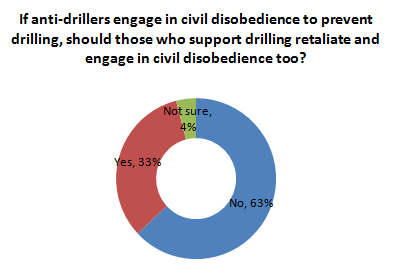
    If anti-drillers engage in civil disobedience to prevent drilling, should those who support drilling retaliate and engage in civil disobedience too?

    No (63%, 143 Votes)
    Yes (33%, 76 Votes)
    Not sure (4%, 8 Votes)

    Total Voters: 227

    Current Poll – No Stomach for Civil Disobedience, but How About a Boycott?

    Two weeks ago MDN wrote about a civil disobedience training meeting on the shores of Keuka Lake, NY and mused what if the shoe was on the other foot. Would those who support drilling be willing to engage in civil disobedience against those who civil disobediently try to obstruct legal and lawful drilling? It seems the answer, at least from the MDN audience, is a resounding “no”. Breaking laws, even if it’s in response to those already breaking them, is not in the DNA of most who support drilling.

    So this week MDN further muses, what about a boycott instead? On Friday, MDN covered a story about drillers in West Virginia who are growing weary of municipalities in that state enacting Marcellus Shale drilling bans, citing concerns over water supplies (see this MDN article). The West Virginia Independent Oil & Gas Association said they’re not interested in doing business with the businesses of municipalities that ban drilling. A boycott breaks no laws and only changes purchasing behavior. It puts pressure on businesses who in turn fund the political campaigns of local politicians who are enacting the bans. That is, it hits them where it hurts—in the pocketbook.

    So what if not only drillers, but landowners and those who support drilling, were to join in and stop doing business (as much as possible) with businesses in municipalities that ban drilling? That’s the question MDN asks in this week’s poll:

    Should those who support drilling boycott businesses in municipalities that ban drilling until the ban is lifted?

    Register your vote along the right side of any page on the site.

    Below are the most recent “top 5” lists and the calendar of Marcellus related events for the next few weeks.

    Happy reading!
    Jim Willis, Editor

    Read More “MDN Weekly Update – Jul 31, 2011: Boycotting Cities and Towns that Ban Drilling”

  • |

    MDN Weekly Update – Jul 24, 2011: Civil Disobedience Kerfuffle

    Poll resultsFirst, the results of last week’s poll, which asked:
    If fueling stations were widely available, which type of vehicle would you PREFER to drive?

    Natural Gas (72%, 131 Votes)
    Stay w/Gasoline (12%, 22 Votes)
    Electric (10%, 18 Votes)
    Electric/Gasoline Hybrid (6%, 12 Votes)

    Total Voters: 183

    Current Poll – MDN Hits a Nerve

    This past Wednesday, MDN published a copy of an email we received advertising an upcoming “organizer and action training” session on Keuka Lake, NY (see MDN article here). The stated purpose of the session is to teach participants to engage in non-violent civil disobedience in an attempt to “ban fracking and stand strong against all fossil fuel extraction.” That particular MDN article garnered the most views and the comments of any article this past week. My purpose in publishing the email was to point out the philosophy or ideology that is at the core of the anti-drilling movement: A philosophy that says a select minority of people claim to know better than the rest of us what kind of energy we should have in this country—“sustainable” energy (solar, wind) rather than nasty ol’ fossil fuels that will get used up in a couple of hundred of years.

    And it hit a nerve. Out came the usual arguments: I’m not attending because of a philosophy, but because my property values will be destroyed! Drilling causes air pollution! Water will be poisoned! Huge corporations are raping the countryside! That is, all arguments that I maintain these people don’t REALLY believe in their heart of hearts, but use as a way to scare other people into the viewpoint that all drilling should be banned. Because I dare to say such things, I’ve been called a shill for the industry (which I am not), I’ve been called naïve (which I may be), I’ve been called lots of things. No matter. It is what I believe to be true. Yes, some people are concerned about those things, but I believe if we could have a calm and courteous discussion about their specific objections, and pull out some facts, those objections would ultimately not stand up to scrutiny. And so what’s left is the core ideology: sustainable energy vs. fossil fuels. That is what this debate is about.

    Many commenters on the article focused on my headline about civil disobedience training camp, saying I’m trying to make out those who attend as dopers and malcontents and not the educated, erudite, smarter-than-the-rest of us crowd they really are. I made no such statements, nor did I even imply it. I know many people on the anti-drilling side that I like and respect. They are smart and savvy and good people. So chill out! I’m not saying you’re bad people—I’m saying your thinking on this topic is incorrect and inaccurate.

    For me, the good news about the very existence of this civil disobedience training camp is this: The anti-drilling side has finally accepted that Marcellus Shale drilling is coming to New York, and sooner rather than later. If they didn’t believe that, why this camp? The bad news, for everyone, is that the fight is “going local.” You can expect contentious town board meetings and hard-fought local elections in the coming few years as the vocal minority attempts to persuade local officials to ban or greatly curtail drilling in their communities. It’s just a fact. It’s coming.

    In thinking about all of this civil disobedience stuff, which is a proud American tradition (Boston Tea Party anyone?), I thought, let’s put the shoe on the other metaphorical foot with this week’s poll. What if landowners, who want to lease their land for Marcellus Shale drilling and cannot, having suffered economic harm for more than three years now, decided to engage in civil disobedience? And what if the many small businesses that would benefit from the drilling industry but can’t because of moratoriums, zoning ordinances and perhaps civil disobedience decided to engage in civil disobedience themselves? And what if the thousands who are unemployed and could have jobs in this industry (but don’t), decided to engage in civil disobedience? What if all of them joined together and said “enough is enough” and it’s time to retaliate against those who continue to promote the moratorium or who actively try to stop drilling by using civil disobedience to do it?

    Seems to me one of the hotbeds of opposition to drilling is Ithaca, NY. Professors and even students from Cornell University are being paid large sums of money by anti-drilling organizations to produce so-called studies, and to go on the speaking lecture tour, predicting the environmental and economic disasters that await us when and if drilling should begin. So what if all of the landowners and others who support drilling were to descend on Cornell University—and shut the place down for a few hours? Non-violent of course. All very “civil.” Maybe even a sit-in at one of Prof. Ingrafea’s classes complete with chant: hey-hey-ho-ho-Ingrafea’s-got-to-go.

    Or in Pennsylvania, which is not immune to civil disobedience and where drilling already happens but is now being threatened…should those who support drilling march to the offices of anti-drilling organizations and shut them down for an hour or two, the way anti-drillers have tried to do in Harrisburg with pro-drilling organizations? Carry a bullhorn along and demand to meet with those in charge? Stomp their feet and intimidate the way those who oppose drilling do when they engage in their protests?

    But of course, it’s all just a muse—just a daydream. It won’t happen. But, what if it did?

    So this week’s poll question asks:

    If anti-drillers engage in civil disobedience to prevent drilling, should those who support drilling retaliate and engage in civil disobedience too?

    Register your vote along the right side of any page on the site.

    Below are the most recent “top 5” lists and the calendar of Marcellus related events for the next few weeks.

    Thanks for reading MDN!
    Jim Willis, Editor

    Read More “MDN Weekly Update – Jul 24, 2011: Civil Disobedience Kerfuffle”

  • |

    MDN Weekly Update – Jul 17, 2011

    Poll resultsThe same poll has been live for the past two weeks and has garnered more votes than any other poll MDN has run previously:

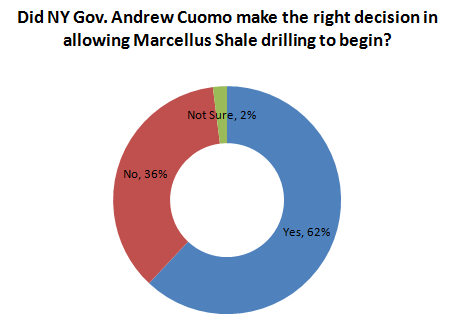
    Did NY Gov. Andrew Cuomo make the right decision in allowing Marcellus Shale drilling to begin?

    Yes (62%, 287 Votes)
    No (36%, 169 Votes)
    Not sure (2%, 8 Votes)

    Total Voters: 464

    Not every voter in the poll lives in New York State. Perhaps the majority do not. There’s no way for me to know exactly. But still, the results (for those of us who favor safe drilling) are encouraging. A poll taken of only New York residents by Siena College (results released this past week) show that New Yorkers are pretty evenly split in their opinion of whether or not hydraulic fracturing is safe (see MDN’s coverage here).

    Current Poll

    On Friday of this past week, MDN highlighted a story of a grocery store chain that has built a new compressed natural gas (CNG) filling station for a small fleet of 10 new trucks they own with plans to expand that fleet. The same company also built a CNG filling station for the public, located in the Pittsburgh area. The interesting thing about that story was the price of the natural gas at the pump: $1.85 for the equivalent amount of a gallon of gasoline. The current national average for a gallon of gas is $3.67 (it was $2.72 just one year ago). At $1.85 for CNG, that’s half the cost of gasoline. And that’s the power of shale gas.

    But it seems automobile manufacturers are more interested (at this point) in creating electric vehicles. There are a number of 100 percent electric vehicles available now, and even more hybrid vehicles—part electric, part gasoline. Only Honda makes a CNG car that’s commercially available, although there are a number of CNG trucks being manufactured.

    MDN started musing, what if fueling or charging stations were not an issue? What would people actually prefer to drive? Electric? CNG? Hybrid? Stick with gas? So this week’s poll asks the question, “If fueling stations were widely available, which type of vehicle would you PREFER to drive?” The poll can be found on the right side of any page on the site.

    Below are the most recent “top 5” lists and the calendar of Marcellus related events for the next few weeks.

    Thank you for reading MDN!
    Jim Willis, Editor

    Read More “MDN Weekly Update – Jul 17, 2011”

  • |

    MDN Weekly Update – Jul 3, 2011

    imageI’ve run the same poll for the past two weeks and am encouraged by the results. The question was:

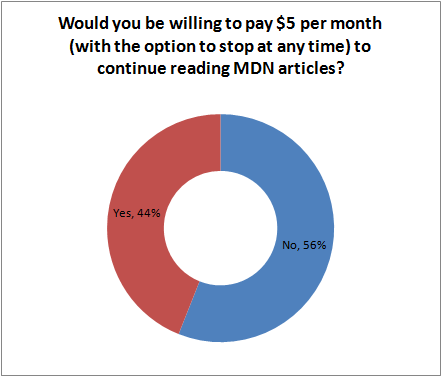
    Would you be willing to pay $5 per month (with the option to stop at any time) to continue reading MDN articles?

    No (56%, 142 Votes)
    Yes (44%, 113 Votes)

    Total Voters: 255

    So will Marcellus Drilling News continue? Yes! Will I immediately starting charging $5 per month to read it? Not just yet. I’m still working out what I believe is the best way forward. I’ve heard privately via emails and phone calls from quite a few readers who have encouraged me to continue the service with some great ideas on how to do it and earn a little bit to offset the costs. MDN likely will continue on as a blend of free and paid. Stay tuned—I’ll make an announcement soon.

    Current Poll

    It’s been a big week here in New York State (where MDN is written). The word has come down from Albany that drilling in the Marcellus Shale will finally begin. When? Still anyone’s guess, but as MDN has predicated before, I believe the first horizontally hydraulically fractured Marcellus well will not be sunk until 2012. The DEC Commissioner, Joe Martens, said the same thing in a recent media comment.

    We still have a few months of public comments on the new draft rules which are due to be released to the public on July 8. Hopefully no more theatrical public meetings will be staged before a final version of the new drilling rules are issued. Early indications are that the new rules, while strict, will not be too onerous to prevent drillers from coming to the state. So, good news for landowners!

    This week’s poll asks the question, “Did NY Gov. Andrew Cuomo make the right decision in allowing Marcellus Shale drilling to begin?” The poll can be found on the right side of any page on the site.

    Below are the most recent “top 5” lists and the calendar of Marcellus related events for the next few weeks.

    Wishing you a happy Fourth of July,
    Jim Willis, Editor

    Read More “MDN Weekly Update – Jul 3, 2011”

  • |

    MDN Weekly Update – Jun 26, 2011

    Poll resultsIt’s been a few weeks since the last “weekly” update. First, a recap of the previous poll I was running. Thank you to those who voted in that poll. Here are the results:

    When do you think Marcellus Shale drilling in New York State will begin?

    2011 (19%, 58 Votes)
    2012 (35%, 109 Votes)
    2013 (16%, 51 Votes)
    Never (30%, 94 votes)

    Total Voters: 312

    Here is the relatively good news about the poll (for those who support safe drilling anyway): Put another way, 70% of you think drilling in the Marcellus Shale will happen in New York, while only 30% think it will never happen. I think there’s wisdom in the crowd’s view.

    Current Poll

    After a lot of thought, earlier this week I posted an appeal and a poll which is still running. That appeal was for your feedback and asks the question, is MDN worth your support? (See MDN Needs Your Feedback to Continue Publishing.) In that post I said the following:

    So I have a question for the 18,000 of you who visit this site each month: Is MDN worth a small subscription fee to you, to continue to the service? Please think carefully about it, and please be completely truthful. Perhaps the things I do on this site are “nice” and maybe “interesting” but not really vital or “necessary” for most people with an interest in the drilling issue. If that’s the case, I’m wasting my time and can find other things to do with it.

    Here’s the deal, think carefully about the question I’m asking, and then please click on your answer in the poll (found on the right side of any page). The question: Would you be willing to pay $5 per month to continue reading MDN? Your answer is anonymous—I won’t know who you are. If enough people say yes, MDN will continue and I’ll ask you to subscribe using a credit card (or Paypal account) and it will be charged $5 per month with the option to cancel at any time. If there’s little response, or if the vast majority say no, time to fold the tent and move on.

    The early results have been encouraging. Thanks to those who have already voted. I’m going to leave this poll open for one more week. The good news is that is I’m leaning toward continuing MDN and introducing a paid option. I’m working on the details now. In the meantime, please keep reading MDN, and if you haven’t already done so, please vote in the poll. Either answer is fine (yes it’s worth $5 a month, or no it isn’t)! I need honest and true feedback about the value of this service.

    Below you’ll find the “top 5” lists and this week’s calendar listings.

    Happy reading,
    Jim Willis, Editor

    Read More “MDN Weekly Update – Jun 26, 2011”

  • MDN Needs Your Feedback to Continue Publishing

    $5Periodically someone will email me privately, or leave a comment on an article, and ask if the MDN website is sponsored by a drilling company or pro-drilling group of some kind. My answer, which is the truth, is always the same: No! I receive no compensation of any kind whatsoever, either in money or trade or services, for what I write on this site. Zippo. Nada.

    There are those who don’t believe me. I’m not sure how I can convince you, but I am telling the truth. I think, if you read this site long enough, you’ll know that I always attempt tell the truth. I share my opinions, and from time to time I even own up to some mistakes.

    Read More “MDN Needs Your Feedback to Continue Publishing”

  • MDN Weekly Update – Jun 5, 2011

    poll resultsThank you to those who voted in last week’s online poll. Here are the results:

    Do you think burning fossil fuels like natural gas causes dangerously high levels of global warming?

    No (67%, 133 Votes)
    Yes (26%, 52 Votes)
    I don’t know (7%, 15 Votes)

    Total Voters: 200

    This Week’s Poll

    I have made no secret that I think New York’s Commissioner of the DEC, the man in charge of the agency that oversees all oil and gas drilling in NY—Joe Martens—is mostly on the side of anti-drilling. I’m told to “tone it down Jim, don’t rock the boat, we have to work with this guy” with regard to Martens—yet I have to call them like I see them. For years as president of the Open Space Institute his job, his life’s mission, has been to take as much land out of circulation from any kind of development (including drilling) as possible. And his on-the-record statements as recently as last year (prior to his job at the DEC) have Mr. Martens stating he wants to go very, very slow with regard to allowing drilling in New York (see MDN’s original profile of him here). His more recent statements showing his go-slow approach led me to predict that Marcellus drilling in New York will not begin until 2012 at the earliest (see MDN’s prediction here).

    Mr. Martens is clearly dragging his feet with regard to release of the new draft Marcellus drilling regulations. But his boss, Gov. Andrew Cuomo, gave him a little motivation this past week—telling the DEC to have the new draft regulations ready by July 1st (see the MDN story here). A “kick in the pants” if you will. Ouch. Can’t have made Mr. Martens very happy. As strongly as he opposes drilling (in my opinion), he also wants to keep his job and make the boss happy. If indeed the new draft regulations are ready in early July, does that move the timetable up and might drilling permits be issued sooner rather than later? A good question. I would like to know what you think. So this week’s poll question:

    When do you think Marcellus Shale drilling in New York State will begin?

    Will it be this year? Next year? Never? Please note: This is not when you hope it will begin, but when you think it actually will begin. Go to any page on the website and click to vote on the right-hand side of the page in this week’s poll. I’ll report the results next week.

    Below you’ll find the “top 5” lists and this week’s calendar listings.

    Happy reading,
    Jim Willis, Editor

    Read More “MDN Weekly Update – Jun 5, 2011”

  • MDN Weekly Update – May 29, 2011

    poll resultsThank you to those who voted in last week’s online poll. Here are the results:

    Should Marcellus Shale pipeline companies be granted public utility status (i.e. eminent domain)?

    No (74%, 151 Votes)
    Yes (23%, 47 Votes)
    Not sure (3%, 6 Votes)

    Total Voters: 204

    This Week’s Poll

    This week I wade into waters few dare to go: the global warming (or climate change or whatever you want to call it) debate. I do so because of the interest in the story I posted this past week about the Cornell study recently published by Profs. Howarth, Ingraffea and Santoro. That study says, among other things, that using shale gas—not only burning it, but also the process of drilling it and transporting it—is a bigger contributor to greenhouse gases in the atmosphere than mining and burning coal. A writer on the Council on Foreign Relations website pointed out new findings from the Department of Energy that refutes the methodology and resulting conclusions from the Howarth study.

    Many who oppose drilling for Marcellus Shale gas do so because of their philosophical viewpoint, a viewpoint that believes (oversimplification here) that burning fossil fuels are bad because they cause an increase in greenhouse gases in the atmosphere resulting in an increase in the average temperature on the earth with potentially catastrophic effects. That line of thinking or viewpoint is represented in the work by Howarth et al. Those who hold that viewpoint generally support alternative sources of energy like wind and solar and believe that humans should, more or less, be forced to change to those sources of energy.

    There are others, MDN among them, who do not believe man is contributing in any meaningful way to an increase in global warming—at least not to the extent that it endangers anyone or anything on planet earth. Can and does air pollution exist? Of course. Do carbon-based fuels contribute to said pollution? Yes. But is mankind’s burning of carbon-based fossil fuels leading to doomsday for life on earth because of greenhouse gases? No. Not in my opinion. And not in the opinion of many scientists and experts.

    Maybe you think man does contribute to the “problem” of global warming, but man’s contribution is not dangerous. Maybe you think all fossil fuel use should end asap. Maybe you think using natural gas, because of lower carbon emissions than oil and coal is the best solution for now, but not for the long-term. People come down on all sides of the debate. I’ve tried to word the poll this week to get at the root philosophy or belief that may or may not lead people to support or oppose drilling. It’s not a perfect question, but hopefully will do the trick.

    Do you think burning fossil fuels like natural gas causes dangerously high levels of global warming?

    If you believe there is a direct connection between burning fossil fuels and dangerously high global warming, my guess is that you oppose drilling for shale gas. You may have other reasons to oppose drilling (impact on water supplies, etc.). But fundamentally, if you believe the planet is endangered by carbon, my guess is you don’t want drilling. Am I right?

    Go to any page on the website and click to vote on the right-hand side of the page in this week’s poll. I’ll report the results next week.

    Below you’ll find the “top 5” lists and this week’s calendar listings.

    Happy reading,
    Jim Willis, Editor

    Read More “MDN Weekly Update – May 29, 2011”

  • MDN Weekly Update – May 22, 2011

    poll resultsThank you to those who voted in last week’s online poll. Here are the results:

    Should the federal EPA regulate hydraulic fracturing?

    No (52%, 131 Votes)
    Yes (44%, 111 Votes)
    I don’t know (4%, 10 Votes)

    Total Voters: 252

    This Week’s Poll

    Eminent domain is one of the strongest powers granted to government, and in some cases delegated by government to private companies. It is the right to seize a piece of property and use it for the common good. The owner of the private property seized or used in this way is given “fair and just” compensation by the government or organization. The power of eminent domain is used to secure land for roads and highways, run electrical lines above (and below) ground, for railroads, water and sewer lines and for other purposes. It’s also used for natural gas pipelines installed by public utilities like your local electric and gas company to deliver gas to your house (if you live in an urban area). In order for a company to use the power of eminent domain, it first must be designated as a public utility. That is, it’s a private company, but serving the general public. There are commissions set up in individual states to regulate and control these private companies that serve the public—public utility commissions.

    The Pennsylvania Public Utility Commission (PUG) this past week rendered a decision that will, in all likelihood, lead to designating a private company (Laser Northeast Gathering) as a public utility. Laser is building pipelines for gathering gas from Marcellus Shale wells in Northeastern PA. If Laser is designated as a public utility, it will have the power of eminent domain, meaning they can run their gas pipelines wherever they want (within reason). By all accounts Laser is an excellent and responsible company.

    The question at hand is, should gathering pipelines from gas wells be granted the status of public utility? Some would say running a pipeline from a well is different than running, say, an interstate pipeline. Those who oppose gas drilling would likely oppose a pipeline running under their property. Should they be forced to allow it? On the other hand, should a pipeline company have to go miles out of the way to lay a pipeline if there’s only one or two property owners who won’t allow it under their land? Isn’t there a greater public good? It’s a tough issue. MDN has already commented which side we come down on (read the story here). How about you?

    Should Marcellus Shale pipeline companies be granted public utility status (i.e. eminent domain)? Go to any page on the website and click to vote on the right-hand side of the page in this week’s poll. I’ll report the results next week.

    Below you’ll find the “top 5” lists and this week’s calendar listings.

    Happy reading,
    Jim Willis, Editor

    Read More “MDN Weekly Update – May 22, 2011”

  • MDN Weekly Update – May 15, 2011

    Thank you to all of you who voted in last week’s (and MDN’s first-ever) online poll. Here are the results from 403 MDN readers:

    imageAre You in Favor of Shale Gas Drilling?
    Yes – with safeguards in place (69%, 278 Votes)
    No – can’t be done safely (26%, 103 Votes)
    Not sure – still forming an opinion (5%, 22 Votes)

    Total Voters: 403

    This Week’s Poll

    I’ve made no bones about the fact that I believe the federal Environmental Protection Agency (EPA) is “out of bounds” in trying to regulate hydraulic fracturing. It is my opinion that regulation of gas drilling is best left to the individual states. Others will argue that water crosses boundaries in the form of rivers and streams and aquifers, and therefore a federal role is important to protect water supplies. I’m interested in knowing what you think. So this week’s question, as plainly and succinctly as I can ask it (no hidden agendas, no attempt to manipulate the outcome for those who like to needle me) is: Should the federal EPA regulate hydraulic fracturing? Go to any page on the website and click to vote on the right-hand side of the page. I’ll report the results next week.

    Below you’ll find the “top 5” lists and this week’s calendar listings.

    Happy reading,
    Jim Willis, Editor

    Read More “MDN Weekly Update – May 15, 2011”

  • MDN Weekly Update – May 8, 2011

    opinion pollMDN is pleased to announce a new site feature this week: The Weekly Poll. I’ve been around websites, building them and maintaining them, since the mid-1990s. I’ve seen polls come and polls go—most of the time they are useless. So why try a poll on MDN? Seems to me with a monthly reading audience that now exceeds 18,000 people (“uniques” as it’s called in biz), MDN has a great core of people that represent a healthy cross-section of those interested in this important topic. I think it would be good to regularly understand what people are thinking on a given drilling-related issue of the day. My intent is to drill down (pun intended) into specific issues and “take the temperature” of MDN readers.

    For this first question, we’ll keep it simple: Are you in favor of shale gas drilling? Just go to any page on the MDN website and along the right-hand side of the page you’ll see “Weekly Poll”. Check an answer and click the Vote button.

    Once you’ve voted you’ll see the results of all votes by both percentage and actual number of votes cast. Every time you return to the MDN site, or even click to view a new page, the numbers will automatically update. You can only vote once for a given poll. When a new poll is posted, you’ll be able to vote for that poll once. How does MDN keep track of whether or not you’ve voted? A cookie (or little snip of code) is placed in your web browser’s cache. You may or may not realize it, but almost every website you visit does the same thing. A cookie is nothing to fear, and it’s completely anonymous—MDN is not tracking who you are, what other websites you visit, etc. The cookie only says, “hey, this person has already voted for this poll” and that’s it.

    It is possible to “game” the poll and try to influence the results by deleting your cookies and re-voting again and again. I guess if you’re up for that, you have a lot of time on your hands and a very small existence. Hopefully we can be adults and appreciate the outcome, no matter what it is, for any given opinion poll. And a further comment: The poll is in no way scientific. It is only intended to be a reflection of those who are visiting and reading the MDN website.

    So, for those who subscribe to the daily email, and for those who just happen by and read this posting, please vote! I’ll report on the results the following week when I post a new question.

    Below you’ll find the “top 5” lists and this week’s calendar listings.

    Happy reading,
    Jim Willis, Editor

    Read More “MDN Weekly Update – May 8, 2011”

  • MDN Weekly Update – Apr 24, 2011

    The Truman ShowComing soon to a fire hall, museum, legion hall, university or television set near you: The Calvin Tillman Show. For those new to the drilling debate, Calvin Tillman is, or rather was, mayor of the small town of DISH, Texas which sits smack in the middle of the Barnett Shale deposit. Mr. Tillman has made a cottage industry of touring the country, including the Marcellus Shale region, and accusing gas drilling companies of poisoning the good citizens of the USA wherever they drill. His evidence? Well, er, let’s not bother with evidence. It’s the accusations that matter! And the children! His children! Other people’s children! Headaches, nose bleeds, asthma…the list goes on. Problem is, there’s never any evidence that ties drilling activities in the DISH region with said ailments, even though a number of environmental tests have been performed.

    Mr. Tillman and fellow Texan Tim Ruggiero, a landowner who claims he too was adversely affected by gas drilling, founded an organization in 2010 called ShaleTest.org. The organization’s stated aim according to their website: “ShaleTest.org is a non-profit organization that will collect environmental data, and provide environmental testing to lower income families and neighborhoods that are effected by natural gas exploration.”

    In the spring of this year, ShaleTest.org became affiliated with (ie funded by) the larger organization Earthworks, an organization whose goal is to stop mining and energy extraction of every kind on the planet. Apparently Earthworks has showered its largesse on the good Mr. Tillman who can now devote himself full-time to traveling the country and bashing the drilling industry.

    Before Mr. Tillman co-founded ShaleTest.org, MDN had the pleasure of hearing him in person when he made an anti-gas campaign stop in Binghamton, NY in February 2010. You can read about that meeting here.

    If you would like to hear Mr. Tillman in person when he visits the Northeast, you can find his current speaking itinerary here.

    Below you’ll find the “top 5” lists and this week’s calendar listings.

    Happy reading,
    Jim Willis, Editor

    Read More “MDN Weekly Update – Apr 24, 2011”