
Energy Companies | Energy Services | EQT Corp | Halliburton | Patterson-UTI | West Virginia | Wetzel County
EQT Sets New U.S. Onshore Record for Deepest & Longest Shale Well
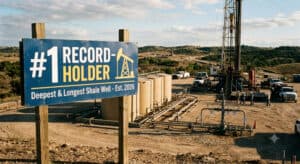 EQT Corporation, the largest driller in the Marcellus/Utica (based on M-U production), recently achieved two records with the same Marcellus well. EQT drilled not only the “deepest” shale well in the continental U.S. (by “measured depth”), but also the longest horizontal shale well (by lateral length). EQT’s Longwell 9H well, located in Wetzel County, West Virginia (near the Pennsylvania border), eclipses a record set by Expand Energy in 2025 in Marshall County, WV. Read More “EQT Sets New U.S. Onshore Record for Deepest & Longest Shale Well”
 Halliburton, the world’s second-largest OFS (oilfield services) company, issued its first quarter 2026 update yesterday. CEO Jeff Miller said, “In North America, I see clear signs that we are in the early innings of a recovery.” Cool. Of course, he’s talking about oil drilling, mostly. While the update and earnings conference call did not specifically mention the Marcellus/Utica, they did include information highly relevant to our region. In particular, the company prominently mentioned its electric fracking “e-fleets” and said that the current low price of natural gas represents a significant opportunity for drillers to save money by using it instead of diesel to power fracking equipment.
 Two of the world’s largest three oilfield services (OFS) companies, Halliburton and Baker Hughes, provided updates this week for their second-quarter performance and operations. Both companies said essentially the same thing. Drilling is slowing down in U.S. shale, but offshore drilling in other parts of the world is still going strong and makes up for the slowdown here at home.
 It’s earnings season, the time when publicly traded companies publish their latest quarterly (and in this case, annual) financial statements–for 4Q22 and all of 2022. Three of the biggest oilfield services (OFS) companies in the world–SLB (formerly Schlumberger), Halliburton, and Baker Hughes–have now issued their quarterly updates. And all three have a common theme: Expect more drilling internationally in 2023, especially in the Middle East and Latin America, but expect about the same amount of drilling (or less) in the U.S. this year.
 Halliburton, the world’s second-largest oilfield services (OFS) company and the world’s largest vendor of fracking services, issued its third quarter update yesterday. Halliburton reported adjusted net income per diluted share of $0.60/share, more than double from the same period last year. Halliburton boosted sales by more than one-third to $5.4 billion, led by North America. Unlike the world’s largest OFS company, SLB (formerly Schlumberger), Halliburton has sold off its Russian operations and no longer does work in that country. SLB continues to work in Russia.
 The world’s (and North America’s) largest oilfield services companies, including Schlumberger, Halliburton, and Baker Hughes, are all saying the same thing: Drillers are getting ready to drill more this year. Some sub-sectors of the drilling market, like completions, are already “sold out” according to Halliburton. Good luck to drillers who want to add more completions crews right now. Prices are going up for fracking fleets and other services offered by OFS companies.
 Yesterday Halliburton was the first of the big three oilfield services companies (Baker Hughes and Schlumberger being the other two) to release second-quarter numbers. While on paper the company lost $1.7 billion due to an impairment charge, Halliburton actually made $456 million in free cash flow–after axing workers and cutting dividend payments. But the big news (for us) from yesterday’s 2Q update was a comment by Halliburton CEO Jeff Miller that the company will look to markets outside the U.S. to grow in the future.
 In mid-March as the twin blows of the coronavirus pandemic and the Saudis and Russians decided to tank oil prices, Halliburton, the second-largest oilfield services company on the planet, announced it would furlough 3,500 workers for 60 days (see
  And so it begins. We’ve seen it before during oil and gas “down cycles.” Some of the first companies to lay off workers are the oilfield services (OFS) companies. Companies like Halliburton. It’s a yo-yo. Lay off a bunch of people (hundreds or thousands), and in a few years when things turn around, hire back a bunch. Some pejoratively call it boom and bust. We’re entering another serious down cycle with impending layoffs. Yesterday Halliburton announced a new twist. Instead of laying off thousands, the company will “furlough” some 3,500 workers. Here’s how it works…
 Moody’s Investor Service is sounding the alarm with respect to oilfield services (OFS) companies and debt. In a publication for Moody’s clients issued earlier this week, analysts said OFS companies don’t have the means to pay back towering debt in the short term, and “limited options” when it comes to raising equity to improve liquidity. What it means is this: Companies like Schlumberger, Halliburton, and Baker Hughes a GE Company are heading for rough waters. However, the biggies, like the three we’ve mentioned, will probably be OK. But their smaller competitors, according to Moody’s, may not be OK.
 The average worker who works for producers (i.e. drillers) in the Pennsylvania Marcellus makes among the highest average salaries of any industry in the state. Looking at six of the state’s top Marcellus drillers, the average worker made $113,610 last year! That’s an average taken from workers at CNX Resources, Range Resources, Chesapeake Energy, Southwestern Energy, EQT and Cabot Oil & Gas. We hasten to add not “all workers” but “average” or “median” workers–meaning there are people who make below that number and people who make well above that number. It also means the majority of Marcellus workers in those companies made at least $100,000 per year. Those working for oilfield services (OFS) companies like Halliburton, Baker Hughes and others didn’t fare quite as well, making an average of $52,000-$80,000 per year. Still, hey, it ain’t bad money! Here’s a look at the average wage for top Marcellus drillers and the OFS companies that serve them…
 In March, Mark McCollum, who had been Chief Financial Officer (CFO) of Halliburton, the world’s second largest oilfield services company, left to become the CEO of Weatherford, the world’s fourth largest oilfield services company (see
 Schlumberger is the world’s largest oilfield services (OFS) company. Weatherford International is the world’s fourth largest OFS company. They both have operations in the Marcellus/Utica region. We’ve posted a number of stories about Weatherford’s financial troubles–and seemingly inevitable march toward bankruptcy (
 In a “hasty” and “rare” operations call last Friday, Halliburton, the world’s second largest oilfield services (OFS) company, offered up some interesting comments. The call was apparently an attempt to blunt the coming news that the company will likely miss analyst’s expectations for profit/loss and dividends, due to rising costs and weak demand in international markets. Top brass at Halliburton wisely know that “he who gets there with the bad news first, wins.” However, the call was wide-ranging and included some good news: After trimming 35,000 jobs over the past couple of years, Halli is adding back 2,000 jobs. That’s better than a sharp stick in the eye. CEO Dave Lesar also had this rather bizarre statement on the call, in his ebullience over the drilling comeback in North America: “This diverse and exciting market has created a surge of activity and supports my thesis that the animal spirits are back in U.S. land.” OoooKay. We’ll go with it. Animal spirits. Here’s the news coming from last week’s hasty Halliburton homily…