
Ex-DEP Chief Wants Shale to Recycle PA Conventional Brine for Free
 A Pennsylvania House committee held a hearing on Monday about spreading brine from conventional oil and gas wells on township dirt roads. Former Department of Environmental Protection (DEP) Secretary David Hess testified and proposed a fix aimed squarely at Marcellus drillers: make the shale industry recycle all brine from Pennsylvania’s conventional wells, “at no cost to conventional well owners.” Shale isn’t the problem here, but it could end up with the bill. Read More “Ex-DEP Chief Wants Shale to Recycle PA Conventional Brine for Free”
 The radical green groups trying to ban new Marcellus/Utica drilling in Pennsylvania through the back door haven’t gone away. They push shale well “setbacks” out to as much as a mile. Yesterday (Oct. 7), a coalition led by the Clean Air Council and Environmental Integrity Project (EIP) marked the two-year anniversary of its rulemaking petition and pushed in Harrisburg, calling on the Shapiro administration to act. The Department of Environmental Protection (DEP) still plans to deliver its recommendation to the Environmental Quality Board (EQB) by the end of this year. The antis are making noise. We need to make more.
  CNX Resources has decided to walk straight into the anti-drilling movement’s favorite scare story. Two weeks ago, the Pittsburgh driller announced it will bolt continuous, real-time radiation monitoring onto its Radical Transparency program — the first-in-the-nation public-private data deal it signed with PA Gov. Josh Shapiro and the Dept. of Environmental Protection (DEP) in November 2023. Ambient gamma radiation detectors will run around the clock at unconventional well pads and certain produced water facilities, with the raw numbers going to CNX, DEP, and the public at the same time. CNX will also start publishing the radiation surveys it already runs on every truckload of waste leaving its sites. None of this is required by law. That’s the whole point.
  How long does it take a rig hand to pull on coveralls, lace up steel-toed boots, and grab a hard hat? According to Precision Drilling’s own expert, about 2.6 to 4.1 minutes per shift. According to the workers’ lawyers, a lot longer. After 15 years, two trips to the Third Circuit and one to the U.S. Supreme Court, the two sides have split the difference, and it will cost Precision $1.9 million. On Monday (Sept. 22), both sides filed a joint brief in Williamsport federal court asking Judge Matthew Brann to approve the deal. It covers 1,006 hourly rig workers, some of whom worked Precision rigs right here in the Marcellus. The dollars are small. The legal rule the case left behind for Pennsylvania is not.
  The Pennsylvania Farm Bureau (PFB) is one of the good guys. Probably 99% of the time, MDN is right there cheering PFB on — for private property rights, for sensible regulation, for keeping Harrisburg off the farmer’s back. But yesterday PFB released a 23-page paper making the case for a “temporary, limited moratorium” on large-scale data center development in Pennsylvania. This is the other 1%. We think PFB is wrong on this one, and we’ll tell you why. Politely. Friends are allowed to disagree.
  Remember Synapse Energy Economics? That’s the Massachusetts consulting outfit that, back in 2023, was paid by two Big Green groups to produce a “report” claiming Pennsylvania’s RGGI carbon tax would lower your electric bill (see
  West Virginia has sued the Pennsylvania Public Utility Commission in federal court, arguing that two Pennsylvania laws — Act 40 of 2017 and Act 114 of 2020 — built a wall around the state’s “alternative energy credit” market and locked out every power producer outside Pennsylvania’s borders. West Virginia Attorney General JB McCuskey filed the 54-page complaint on September 3 in the U.S. District Court for the Middle District of Pennsylvania, and here’s the kicker: the PUC’s own annual report, published seven months earlier, told the legislature that these very rules needed a second look.
  Pennsylvania’s utility regulators just told the General Assembly what Marcellus drillers have been saying for two years: the electricity business is about to get very busy, and natural gas is going to be the one doing the heavy lifting. On Tuesday, September 1, the Pennsylvania Public Utility Commission (PUC) released its annual Electric Power Outlook for Pennsylvania, this one covering 2025 through 2030. The report is required by state law — the PUC has to collect demand forecasts from the state’s 11 electric distribution companies (EDCs, the utilities that run the poles and wires to your house) and hand a summary to the Legislature and the Governor every September. Usually it’s a snoozer. Not this year.
 Yesterday, the Pennsylvania Independent Fiscal Office (IFO) released its quarterly Natural Gas Production Report covering April through June 2026 (full copy below). Three numbers, all pointing in the same direction: PA drillers spudded (started drilling) 89 new horizontal wells in 2Q26, down 16 wells (-15.2%) from the 105 spudded in 2Q25. Production volume was 1,925 billion cubic feet (Bcf), down 32 Bcf (-1.6%) from 1,957 Bcf in 2Q25 — the lowest quarterly volume since 4Q24. And the average Pennsylvania spot hub price was $2.11 per MMBtu, down 27 cents (-11.3%) from last year’s $2.38.
  A second poll of Pennsylvania voters on data centers landed this week, and the headlines say what you’d expect: six in ten are opposed. Dig into the crosstabs — the detailed tables showing how each group answered — and you find something the coverage skipped entirely. A majority of Pennsylvania Republicans support building data centers. Fifty-one percent for, 42% against (take note, Stacy Garrity). The Philadelphia Inquirer, teaming up with the New York Times and Siena University, surveyed 760 likely Pennsylvania voters from August 17-21. The topline: 62% oppose the construction of AI data centers, 33% support them.
 Quinnipiac University released a new poll of Pennsylvania registered voters on July 15, and one question in it should worry everyone who makes a living from Marcellus gas. Asked whether they would support or oppose building an AI data center in their community, 74% of Pennsylvania voters said “oppose,” 16% said “support,” and 10% offered no opinion. That’s a jump from Quinnipiac’s February 25 poll, when the split was 68% opposed and 20% in favor. The opposition is bipartisan — 64% of Republicans, 82% of Democrats, and 77% of independents all said no thanks. Three-quarters of voters (76%) say they’re following data center news either very closely (26%) or somewhat closely (50%). And Gov. Josh Shapiro isn’t getting credit either: just 24% approve of how he’s handling data centers in Pennsylvania, while 34% disapprove and a whopping 42% have no opinion. The survey polled 895 registered voters July 9-13, with a margin of error of +/- 4.3 percentage points.
  Peregrine Energy Partners, the Dallas-based royalty buyer we’ve been tracking since 2019, is back in the Marcellus/Utica with its checkbook open. Yesterday (Aug. 4), the company announced it closed five separate mineral and royalty deals — two of them right here in the M-U — totaling roughly 3,680 net royalty acres and interests in more than 1,240 producing wells. The first Appalachian deal is a cash-flowing overriding royalty portfolio in Susquehanna County, PA, covering about 936 gross acres and 86 producing horizontal Coterra Energy (now Devon Energy) wells, with more than 50 DUCs and PUDs behind them in both the Upper and Lower Marcellus.
 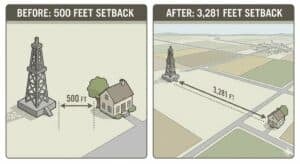 Every so often the antis tell you exactly what they’re up to, and you just have to sit back and enjoy it. On Saturday, Inside Climate News ran a story on the ongoing campaign by the Environmental Integrity Project (EIP), Clean Air Council, and their friends to jack up setbacks — the required distance between a well pad and the nearest building — from the current 500 feet to distances that would end new shale drilling in Pennsylvania. The new twist? They’ve hitched the campaign to the data center boom. More data centers means more gas, and more gas means (in their telling) more danger, so hurry up and pass the rules. It’s the same petition MDN has been tracking since 2024, dressed in a 2026 outfit.
  Last year, we reported on a Pennsylvania Supreme Court decision issued in the case of Commonwealth of Pennsylvania, Pennsylvania Game Commission v. Thomas E. Proctor Heirs Trust (see