
PA NatGas 1Q26: Production Even, Drilling Up 7%, Spot Price Up 41%
 Yesterday, the Pennsylvania Independent Fiscal Office (IFO) released its latest quarterly Natural Gas Production Report for January through March 2026 (full copy below). There were 101 new horizontal wells spudded (drilled) in 1Q26, an increase of 7 wells (+7%) compared to 1Q25. Natural gas production volume was 1,928 billion cubic feet (Bcf) in 1Q26, down less than 1/10th of a percent from 1,943 Bcf produced in 1Q25 (down 15 Bcf, -0.8%). The average Pennsylvania spot hub price was $5.22, a huge increase of $1.53 (+41%) from the prior year’s $3.69. Read More “PA NatGas 1Q26: Production Even, Drilling Up 7%, Spot Price Up 41%”
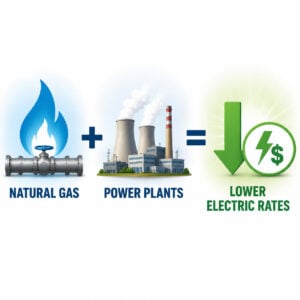 Pennsylvania families face rising electricity bills despite the state’s abundant energy resources. In an excellent op-ed, Bradford County Commissioner Doug McLinko explains that local utilities like Penelec and PECO don’t control electricity costs—they only deliver power. Prices are set by PJM Interconnection’s regional market, where costs are soaring as baseload power plants retire while demand from manufacturing, data centers, and AI surges. Pennsylvania produces massive natural gas from the Marcellus Shale but lacks sufficient modern power plants to convert it into electricity.
 Pennsylvania Republican gubernatorial candidate Stacy Garrity (currently the State Treasurer) yesterday called for a “total pause” on Pennsylvania A.I. data center development, arguing communities need time to update zoning, protect neighborhoods and farmland, strengthen noise rules, and secure transparency on water, energy, health, infrastructure, taxpayer, and ratepayer impacts. While we have expressed similar sentiment that common-sense guidelines are needed for data centers regarding water, noise, and energy use, we strongly disagree with a total statewide (and indefinite) “pause” on new projects. It sends the exact WRONG signal to the tech industry — that both Republicans and Democrats in the state are now blocking data centers in the Keystone State. Pausing or blocking data centers jeopardizes $92 billion worth of private investment in the state.
  Pennsylvania Governor Josh Shapiro introduced new “Responsible Infrastructure Development (GRID) Standards” for data center developers yesterday. These standards aim to tie tax breaks to sustainability and transparency, addressing concerns about energy affordability, pollution, noise, and overall quality of life. Under Shapiro’s GRID plan, data center developers seeking tax exemptions would need to demonstrate that they meet requirements to protect energy affordability, promote transparency and community engagement, support workforce development, and safeguard the environment. Projects would also be required to incorporate so-called clean energy sources and adhere to strict efficiency and environmental protection measures.
  Sen. Jarrett Coleman (R-Bucks/Lehigh) and Rep. Jamie Walsh (R-Luzerne) have introduced legislation in Pennsylvania to address the rapid expansion of data centers. Their proposed bills aim to repeal a 2021 tax exemption that incentivizes data centers to locate in the state. The bills would also empower municipalities to implement an 18-month moratorium on data center development applications. With all due respect, these two Republicans have lost their way and are out of their minds.
 In March, the Pennsylvania Department of Environmental Protection (DEP) released the results of a two-year study that found radium levels in landfill wastewater (leachate) from landfills with drill cuttings do NOT pose a risk to human health (see
  Last November, the Pennsylvania Public Utility Commission (PUC) approved a Tentative Order by a 3-2 vote, proposing a statewide model tariff (tax) to manage the growing impact of large-load customers, such as AI data centers, on the electric grid (see
  New research by the Commonwealth Foundation finds that Pennsylvania’s foolish pursuit of joining the Regional Greenhouse Gas Initiative (RGGI), a carbon tax scheme, led to a loss of $5 to $8 billion in energy sector investment over six years, stalling power projects and reducing electricity generation capacity. The state’s attempt to join RGGI, initiated by executive order under then-Governor Tom Wolf, was ultimately overturned by the courts and (eventually) by legislative action, citing it as an unconstitutional tax. Meanwhile, neighboring Ohio, not part of RGGI, saw an increase in energy projects, highlighting the differing regulatory environments.
  Yet another rankly hypocritical move by the Democrats in the Pennsylvania legislature. Yesterday, every single Democrat in the PA House voted in lockstep (as they typically do, under the leadership’s complete control) to pass House Bill (HB) 2076, titled “Advancing Geothermal Energy Development.” The Dems were assisted by 16 Republicans who were (charitably) hoodwinked. No matter. The bill won’t pass in the Senate. But why point out this vote? Because the “advanced” geothermal energy that the House wants to promote and regulate uses the very same drilling rigs and fracking as is used to drill in the Marcellus shale, revealing the hypocritical lies of the Democrat left in demonizing fracking. But there’s another reason we’re highlighting this news: The environmental left (including House Democrats) is seeking to increase drilling setbacks in the state from 500 feet to 3,281 feet (and, in some cases, 5,280 feet). Do the House Dems realize the new setbacks would not only ban ALL shale fracking in the state but also all geothermal fracking?
  In December, the Pennsylvania Environmental Quality Board (EQB) accepted a petition by radical green groups, including the Clean Air Council and Environmental Integrity Project, to “study” the issue of increasing setbacks for shale drilling so far that it would ban ALL new Marcellus/Utica drilling in the Keystone State, which is no exaggeration (see
  Once again, Pennsylvania Governor Josh Shapiro is attacking the energy industry, this time setting his sights on utility companies that he falsely claims are “unfairly increasing their rates and needlessly raising costs for Pennsylvanians.” Shapiro has hired a radical National Resources Defense Council (NRDC) attorney to serve as his lapdog (Special Counsel for Energy Affordability) to attack utility companies, forcing them into bankruptcy, particularly by pressuring them to use unreliable renewables instead of cheaper fossil fuels.
  In March, the Trump administration announced “South Mon,” a $17 billion natural gas-fueled facility in southwestern Pennsylvania intended to expand domestic energy production (see
  Yesterday, the Pennsylvania Department of Environmental Protection (DEP) informed the House Environmental and Natural Resource Protection Committee that it remains uncertain about the final contents of its plan to reduce methane emissions from oil and gas operations, which is due to the EPA in January 2027. That is, they don’t have a clue. This cluelessness follows an extensive public comment period on a proposed plan for onerous regulations (developed during the dark Biden years) that aims to satisfy federal obligations primarily through general permits and references to federal standards.
  Here we go again with SSDD (same stuff, different day). We’re referring to the bullying talk coming from Pennsylvania Governor Josh Shapiro and his threats to pull the Keystone State out of the PJM grid, the largest electric grid in the U.S., covering all or parts of 13 states plus the D.C. swamp. Shapiro first made this same threat more than a year ago, in January 2025 (see