Next NEPA Data Center Land Rush? PPL JV Eyes 29% of Fell Twp.
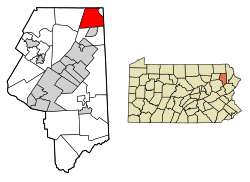
Over the past seven months, MDN has told you about landowners in Salem Township (Luzerne County) getting rich by selling their land for AI data centers, at prices reaching $250,000 to $300,000 per acre. Now the land rush appears to be spreading about 50 miles northeast, to the “Upvalley” area of Lackawanna County, above Scranton. Invitium Energy, a joint venture (JV) between utility owner PPL Corp. and Blackstone Infrastructure, is under agreement to buy about 2,800 acres in Fell Township. That is nearly 29% of the entire township! All told, Invitium has deals to buy close to 7,200 acres across five northern Lackawanna County municipalities. The plan? Build big natural gas-fired power plants, possibly with data centers sitting right next door. Read More “Next NEPA Data Center Land Rush? PPL JV Eyes 29% of Fell Twp.”
 Norway’s Equinor — the company we all used to call Statoil — announced Monday it is buying a majority interest in the Lackawanna Energy Center (LEC), the big Marcellus-fired power plant in Jessup, PA, just outside Scranton. Equinor is paying $940 million for 87.71% of the Class A shares in the 1,483-megawatt plant, buying them from funds managed by Global Infrastructure Partners (GIP), which is now part of BlackRock. Invenergy, which built LEC and has run it since day one, stays on as operator. MDN has followed this plant since it was nothing but a proposal and a pile of angry town council meetings (see
  Devon Energy and Williams spent the last week of July doing something that doesn’t show up on a reserve report: teaching northeastern Pennsylvania teenagers how the gas business actually works. Then, on July 30, the Pennsylvania Chamber Foundation named both companies “Greatest Places to Intern in PA.” Six days later, Devon CEO Clay Gaspar told analysts he’s fielding “no shortage of incoming phone calls” about which assets he might sell — with the Marcellus at the top of everybody’s list. Which raises a question nobody on Wall Street is asking: who inherits the workforce machine?
  Pennsylvania has become a hotspot for data center proposals, prompting community backlash, writes Penn State law professor Michael Helbing, whose hometown is Archbald, PA, a suburb of Scranton. You may recall that last week we wrote about another Scranton suburb (virtually next door to Archbald, see the map) by the name of Olyphant, and how the leaders of that borough had developed zoning regulations to protect residents yet allow data center projects to proceed (see
  We are encouraged by recent developments in two Pennsylvania townships, one in northeast PA, the other in southwest PA, with respect to moving forward with data center projects. We get it. People are up in arms, some feeling as though data centers are being “forced” on them by less-than-transparent builders. Noise. Lights. Water usage. All are concerns. However, as we’ve stated many times, reasonable people can work together, sort through the issues, and move these projects along. That’s what we’re seeing in Olyphant, PA, a suburb of Scranton in Lackawanna County, and in South Strabane Township in Washington County.
  U.S. Secretary of the Interior Doug Burgum visited Lackawanna College yesterday to observe how students are trained for energy-focused careers in natural gas, petroleum, and robotics. He emphasized that these students will contribute to the growth of key industries, creating significant career opportunities. Burgum, joined by Congressmen Rob Bresnahan and Dan Meuser, commended the college’s programs and shale industry-donated equipment, highlighting their role in an American renaissance driven by energy, innovation, and manufacturing. He also discussed how data centers, or “AI manufacturing,” could utilize Pennsylvania’s Marcellus Shale natural gas to generate electricity, bringing economic benefits and lowered utility costs, drawing parallels to his experience in North Dakota.
  Although there are legitimate concerns over data centers locating in populated communities (noise, water use, etc.), make no mistake: The anti-data center movement is nothing more than the anti-fracking movement in new clothes (see
  In early September, MDN told you that UGI Corporation, one of PA’s largest utility companies, plans to store trailers of LNG in the parking lot of a storage facility near Scranton, PA, and is seeking a zoning variance to do so (see
  UGI, a diversified energy company with midstream (pipeline) operations in the Marcellus and one of PA’s largest utility companies, wants to store trailers of LNG in the parking lot of a storage facility near Scranton, PA, and is seeking a zoning variance to do so. UGI needs extra supplies of natural gas to inject into its utility system during peak periods in the winter months. The company says it will be a temporary situation.
  The weather has been fantastic for those of us living in the northeastern U.S. over the past few weeks. Clear blue skies (when they aren’t clouded with wildfire smoke from Canada), really warm temperatures, and absolutely no rain to spoil outdoor activities. Here in the Binghamton, NY area, we went from a surplus of rain and swollen rivers and lakes just a month ago to a rain deficit today. Lawns and fields and beginning to turn brown. Hey, we’re not complaining! But we do need some rain. The lack of rain in the Susquehanna River Basin has triggered water withdrawal restrictions for 42 oil and gas drillers and four other large water users (46 in all) by the Susquehanna River Basin Commission (SRBC). In many cases, the SRBC order is to “cease withdrawal.”
 For the past seven years a privately-owned dump near Scranton, the Keystone Sanitary Landfill, has sought to expand in order to accept more garbage. The dump is also authorized to accept Marcellus Shale drill cuttings–rock and soil leftover after drilling. Yesterday the Pennsylvania Dept. of Environmental Protection (DEP) announced after seven years of study, hearings, meetings, and whatever else the DEP does to fiddle away the time, they have finally approved Keystone’s request to expand.
 MDN has been writing about a privately-owned dump near Scranton, the Keystone Sanitary Landfill, for the past decade (
 It might help anti-fossil fuel radicals if they at least got a few of their facts right. Facts are typically missing from their hysterical proclamations. Case in point: An anti addressed the Ransom Township board earlier this week (Scranton, PA suburb) to try and convince the board to pass a resolution against trucks hauling LNG from traveling through the community on the way to Interstate 81. Her wild claims were false.