
Shell Asks Court to Toss Big Green Cracker Suit: DEP Already Acted
 Shell Chemical Appalachia wants a federal judge in Pittsburgh to throw out a lawsuit Philadelphia-based Big Green group Clean Air Council filed more than three years ago over air emissions at Shell’s ethane cracker plant in Monaca (Beaver County), PA. Shell’s main argument is simple: the PA Department of Environmental Protection (DEP) has already gone after Shell for the very same violations, not once but twice, collecting nearly $25 million in penalties and “community” payments. Federal law, says Shell, doesn’t let a private group pile on when the state is already on the case. Shell also argues the Council never showed that a single member was actually harmed. Shell filed its motion last Friday, Oct. 9, and the Council has agreed to pause the case while the judge decides. Read More “Shell Asks Court to Toss Big Green Cracker Suit: DEP Already Acted”
 Back in April, we told you the PA Department of Environmental Protection (DEP) had once again extended the three “temporary” air permits for Shell’s ethane cracker plant in Monaca (Beaver County) while the agency slogs through Shell’s full Title V permit application (see
  The U.S. Chemical Safety and Hazard Investigation Board (CSB) last Wednesday, Sept. 16, released its final report on the June 4, 2025, explosion and fire at Shell Polymers Monaca, the ethane cracker plant in Beaver County, PA (see
  Round and round she goes. Yesterday Shell Energy North America (SENA) announced it is doing two deals at once: selling the 609-megawatt (MW) Rhode Island State Energy Center (RISEC) near Providence to Constellation Energy for $715 million, and buying the 169-MW Hunlock Creek Energy Center in Luzerne County, Pennsylvania, from Castleton Commodities International (CCI). Shell has owned the Rhode Island plant for all of about 20 months. CCI has owned Hunlock Creek for two years. Both deals are expected to close in the first quarter of 2027, pending the usual regulatory blessings.
  Shell Chemical Appalachia signed a consent order and agreement (COA) with the Pennsylvania Dept. of Environmental Protection (DEP) last Friday, Sept. 4, agreeing to hand over $15 million to settle three years’ worth of air, storage tank, and water violations at its Monaca (Beaver County) ethane cracker. Half of it — $7.5 million — is an actual civil penalty. The other half is a “contribution” to a brand-new community fund. If that arrangement sounds familiar, it should. It’s the same two-bucket structure the Shapiro administration used to squeeze nearly $10 million out of Shell back in May 2023.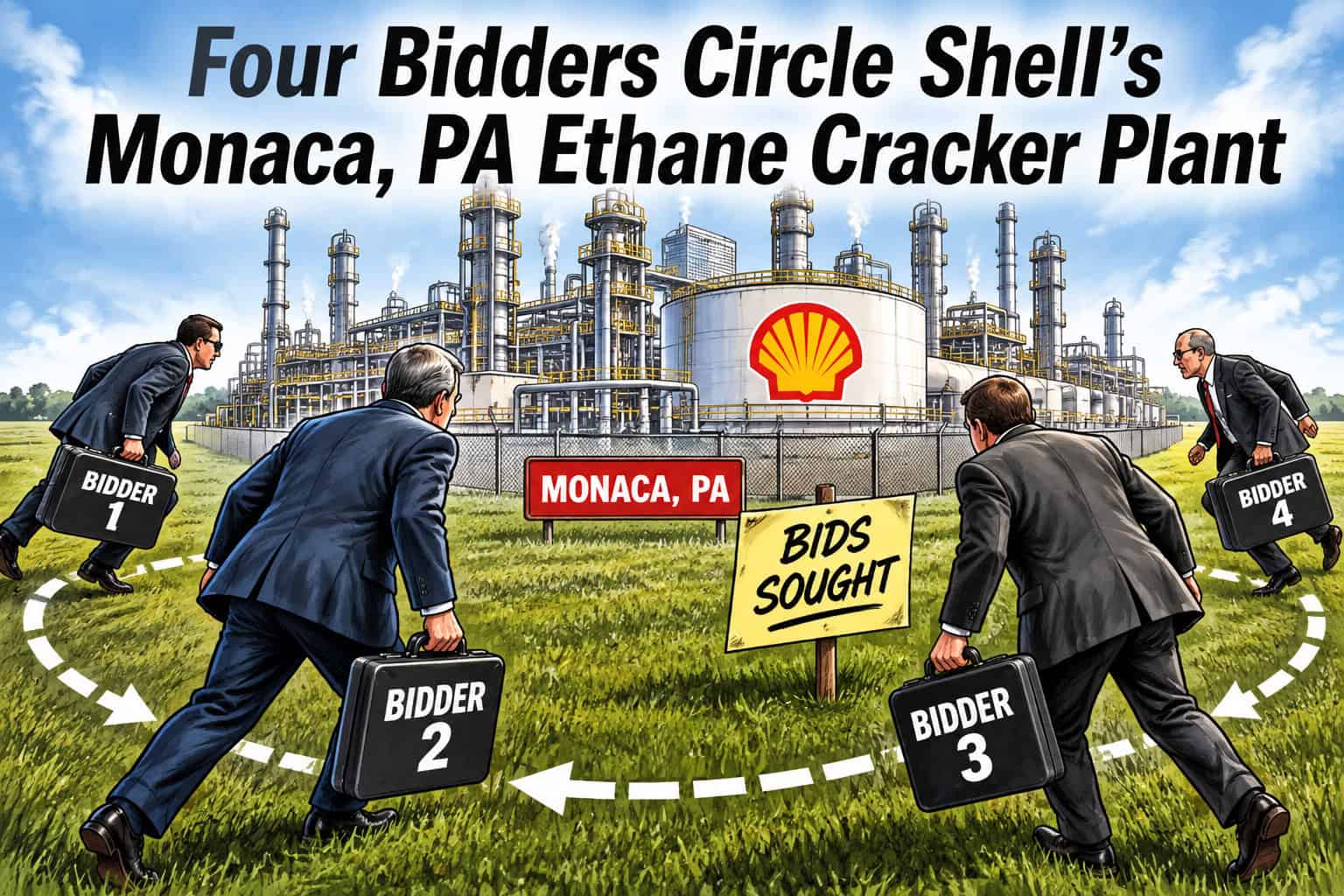
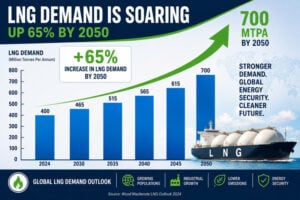 Shell, which dropped “Royal Dutch” from its name after leaving the Netherlands in 2022 due to high taxes and overregulation, is one of the world’s supermajors (oil and gas driller). Shell is also one of (perhaps THE) largest producers and vendors of LNG, or liquefied natural gas, worldwide. The company has just released its tenth annual LNG Outlook 2026 (full copy below), which highlights key trends in 2025 and hauls out the crystal ball to predict where things are heading over the next 25 years. Shell’s annual LNG outlook says shipping disruptions in the Strait of Hormuz from the Iran war—which shut in roughly one-fifth of global monthly LNG supply—could keep 2026 global LNG trade flat if flows normalize within three months, with growth resuming in 2027.
  In March 2025, the Wall Street Journal reported that Shell is “exploring a potential sale of its chemicals assets in Europe and the U.S.,” which includes the Monaca (Beaver County, PA) ethane cracker complex (see
  The Pennsylvania Department of Environmental Protection (DEP) has extended three temporary air permits for the Shell ethane cracker plant in Monaca, PA, which would have expired on April 28, 2026. The DEP did the same thing in May 2024 (see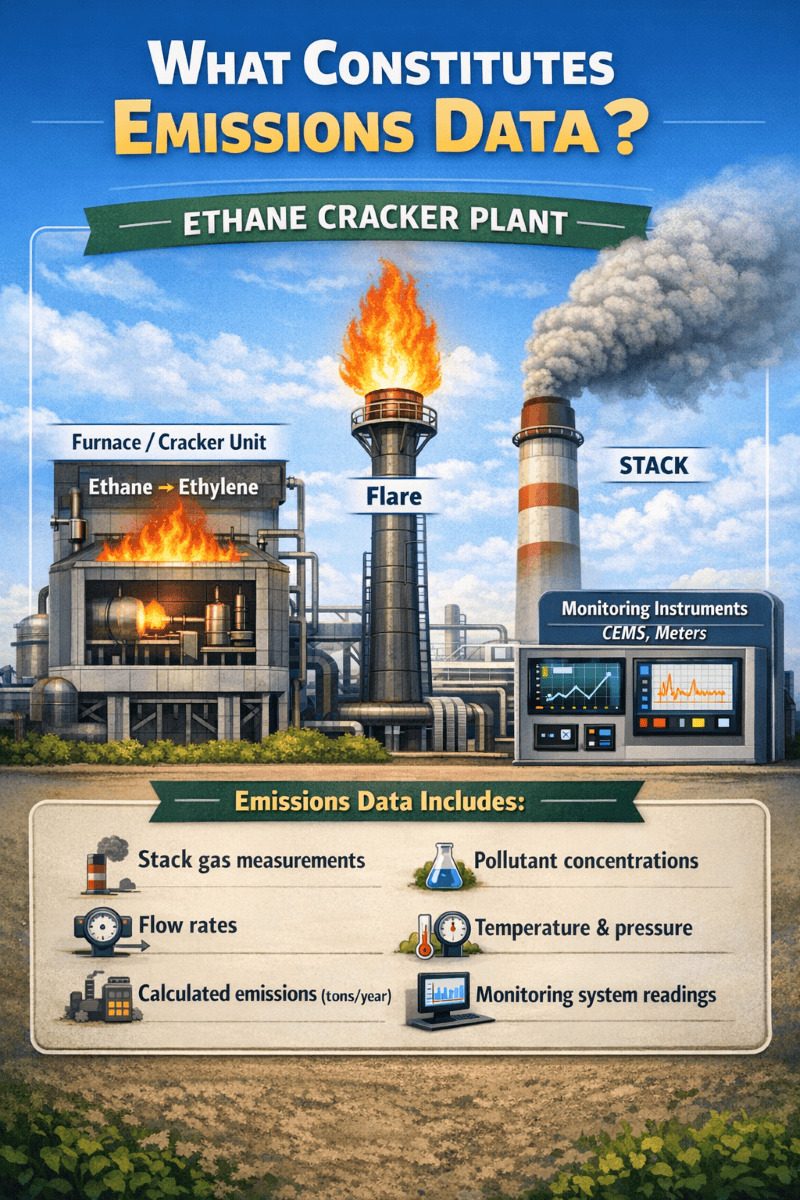
 Venture Global’s Calcasieu Pass (CP) LNG export facility in Louisiana began operations in March 2022 (see
  METLEN (Greek energy company) and Shell have signed a memorandum of understanding to cooperate on liquefied natural gas (LNG) supply and trading between 2027 and 2031. This partnership allows the Greek company to secure up to one billion cubic meters of LNG annually, leveraging domestic terminals and the Vertical Gas Corridor to supply Central Europe and Ukraine. The agreement highlights Greece’s growing importance as a strategic energy hub designed to replace Russian gas with U.S.-produced alternatives. This shift is further reinforced by increased Mediterranean exploration by major U.S. firms such as Chevron and ExxonMobil, solidifying the region’s role in European energy security. Believe it or not, there are implications for the Marcellus/Utica region.
  Yesterday, Shell’s chemical division reported a $66 million fourth-quarter loss, driven by weak margins and operational hurdles at its $14 billion Beaver County ethane cracker plant complex. Shell CEO Wael Sawan acknowledged the chemicals business is underperforming, making a turnaround a “top priority” for 2026. Although Shell is exploring a sale or joint venture for the Monaca facility due to its geographic isolation and high costs, no specific updates were shared during the latest earnings call.
  This is really rich. Venture Global (VG), now the second-largest LNG (liquefied natural gas) exporter in the U.S., is accusing Shell of waging a “three-year campaign” to damage VG’s LNG business. VG’s Calcasieu Pass (CP) LNG export facility in Louisiana began operations in March 2022. Typically, a new LNG facility will load and ship several (maybe two or three) cargoes to “work out the kinks” and ensure everything is working as advertised. VG, using loopholes in its signed contracts, maintained that it was working out the kinks long after it began shipping. After *hundreds of cargoes* were shipped, CP’s customers were still not receiving their contracted (at lower prices) shipments. Shell, along with several other customers, sued (see
  Venture Global’s Calcasieu Pass (CP) LNG export facility in Louisiana began operations in March 2022 (see
  In February 2016, Shell completed a $69.7 billion buyout and merger with BG, the largest such oil and gas deal since Exxon bought Mobil in 1999, driven by the company’s love of LNG (see