
Butler Co. Data Center Plans 300 MW Power Plant Tied to Gas Well Pad
 Another big data center is heading to western Pennsylvania, and this one includes its own power plant, plus access to a shale gas well pad. A Florida LLC and a Coraopolis microgrid company have filed preliminary plans for the Misty Hollow Energy & Data Campus: a 1-million-square-foot data center and a 300-megawatt power generation facility on a former dairy farm along Prospect Road (PA Route 528) in Forward Township, Butler County. A letter in the project file says PennEnergy Resources will give the project access to its natural gas well pad. The developers haven’t said what fuel the power plant will burn. But when your neighbor is a Marcellus well pad, we’d guess it isn’t solar panels. Read More “Butler Co. Data Center Plans 300 MW Power Plant Tied to Gas Well Pad”
 Expand Energy — America’s #1 gas producer, which drills in Pennsylvania under the name Expand Oper LLC — just picked up a fresh batch of Notices of Violation from DEP. Pressure tests witnessed by DEP inspectors on Aug. 6 and Aug. 13 confirmed new casing/cementing defects in four wells across three pads in Susquehanna and Wyoming counties, while two more pads remain under watch for older, unresolved issues.
  Alpha Compute Corp. (Nasdaq: ALP), the tiny AI outfit that wants to build a 200 MW gas-fired data center in Tioga County (see
  The U.S. Chemical Safety and Hazard Investigation Board (CSB) last Wednesday, Sept. 16, released its final report on the June 4, 2025, explosion and fire at Shell Polymers Monaca, the ethane cracker plant in Beaver County, PA (see
  The Pittsburgh Tribune-Review (via the TribLive website) ran a big Saturday feature arguing that Western Pennsylvania’s drilling rebound is being driven by the data center boom. The legwork is real — five township officials, two activist groups, a CNX executive, a Pitt professor. The framing isn’t. The story gives readers three different answers to “how many wells does Pennsylvania have,” gets the cause of last year’s drilling backward, and then, twelve hundred words in, quietly disproves its own headline.
  Three weeks. Same number. The Marcellus/Utica sat at 33 rigs again for the week ended September 18, while the national count added four to reach 595—a fresh 52-week high, topping the 593 we charted on August 14. Oil rigs up. Gas rigs up. Frac spreads up. And WTI closed at $100.74 a barrel with Henry Hub at $2.91. Everything in this report moved except the Marcellus/Utica.
 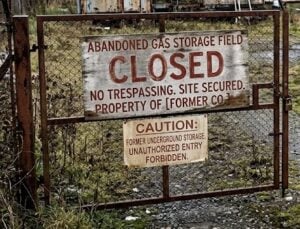 Columbia Gas Transmission (a TC Energy company) has asked federal regulators for permission to permanently walk away from three underground natural gas storage fields straddling the Pennsylvania/West Virginia line near Majorsville — plugging 71 wells, tearing out a compressor station, and abandoning nearly 20 miles of pipe. On September 9, FERC set the clock on its environmental review. If you’re a landowner in Greene or Washington County, PA, or Marshall County, WV, this one lands in your backyard. Here’s the plain-English version of a very technical filing.
 The Marcellus/Utica region received 16 new drilling permits last week, September 7 – 13, down from the 28 permits issued two weeks ago. Pennsylvania issued 13 of the new permits. Ohio issued 3 new permits. And West Virginia issued no new permits. The drillers who received new permits last week were: CNX Resources, EOG Resources, EQT, Infinity Natural Resources, and Range Resources.
  Shale Insight 2026
 Yesterday it was a Reuters rumor. This morning it’s official. National Fuel Gas Company (NFG) says its board will decide by October 15 whether to split the 124-year-old company in two. One half would be a brand-new, publicly traded Marcellus/Utica driller made up of Seneca Resources and the NFG Midstream gathering business. The other half, which keeps the National Fuel name, would be a 100% regulated utility and pipeline company. If the board says yes, NFG shareholders would get shares in the new driller, tax-free.
  It finally happened. Chord Energy, the Bakken-focused driller that inherited a big non-operated slice of the northeast Pennsylvania (NEPA) Marcellus when it bought Enerplus in 2024, has found a buyer. That buyer is POSCO International, the trading and energy arm of South Korean steel giant POSCO. The price is $550 million. MDN first told you in February 2025 that Chord was thinking about selling this asset, and in July 2025 that it was actively shopping it (see links below). The deal covers approximately 32,000 net acres and trailing 12-month (TTM) production of approximately 121 MMcf/d (MMcf/d means million cubic feet per day). The gas is all “residue” gas, meaning dry gas with no NGLs (natural gas liquids like ethane and propane).
  NextEra Energy took its $13 billion, 3,750-megawatt (MW) East Riverside Energy Center to the people on Tuesday night, and the people showed up. Hundreds of Fayette County residents filled Brownsville Area High School for their first look at what would be one of the largest gas-fired power plants in the country. They got poster boards, experts to chat with, and a five-minute slideshow every hour. What they didn’t get was a microphone for questions. We picked up a few new details, including one that producers and pipeline companies should read twice.
  The Upper Burrell Township (Westmoreland County, PA) Planning Commission hit the pause button Tuesday on recommending the township’s latest draft data center ordinance. The delay gives residents time to email their wish lists to supervisors before an Oct. 7 meeting. Supervisors hope to pass the ordinance at a special meeting in October, ahead of the Nov. 2 end of their data center moratorium, and Westmoreland County gets a say, too. The rules won’t touch TECfusions’ existing operations at the former Alcoa/Arconic campus, but they would govern new development there. Buried in the 26-page draft is a line that should make every Marcellus/Utica (M-U) driller and landowner sit up: every new data center must supply its own baseload power. And the township says its next project is writing rules for power plants.
  It took three years, two conditional use applications, one appellate court loss, a subdivision, a three-hour hearing, and a deadline extension — but EQT finally got its vote. On Monday night (Sept. 14), Elizabeth Township’s (Allegheny County, PA) Board of Commissioners voted unanimously to approve two conditional use permits for EQT’s six-well Heracles project: one for the well pad, and one for the interconnect pad (the spot where gas from the wells hands off to a pipeline). The pad sits less than a half-mile from Elizabeth Forward High School, so the approvals come with a long list of strings attached, including a 10-year “emergency preparedness fund” EQT must pay into. Big Green group Protect Elizabeth Township (PET) says it will keep fighting in court. In a surprise twist, the commission president revealed that someone has approached the township about building a data center.