
ORVI Says Ohio Shale Is Shrinking. The Data Says Otherwise.
 The Ohio River Valley Institute (ORVI), the radical anti-fossil fuel outfit that wants to shut down Appalachian shale, is at it again. Today ORVI senior researcher Sean O’Leary published an op-ed in the Ohio Capital Journal claiming that shale’s importance to Ohio’s economy is “small and shrinking.” He lists seven “facts.” We checked every one of them against the same government data he cites. Some are technically true but badly misleading. At least one is flat wrong — by a factor of a million. Here’s what the data actually says. Read More “ORVI Says Ohio Shale Is Shrinking. The Data Says Otherwise.”

 The Ohio Department of Natural Resources (ODNR) will ask the state Controlling Board on Monday, August 17, for authority to spend $105 million of oil and gas lease money on Ohio’s wildlife areas — construction, renovation and grants, on a budget line that currently has zero dollars appropriated for the year. It’s the biggest single deployment of shale money since Ohio started leasing public land, and it’s a good moment to revisit what the opposition told Ohioans would happen instead.
  Ascent Resources — one of the largest privately held oil and gas producers in the U.S. and the biggest gas driller in Ohio’s Utica Shale — issued its second quarter 2026 results on Wednesday. Ascent flowed 2,194 MMcfe/d (2.19 Bcfe/d) and booked a $303 million profit. But the real story for MDN readers isn’t the profit line. It’s what Ascent did with its checkbook: a leasing spree that nearly quadrupled land spending year over year, and a July deal that hands back a quarter-Bcf/d of long-haul pipeline space.
  Houston-based EOG Resources posted record second-quarter 2026 results on August 4th, and buried inside the good news for shareholders is an even better story for Ohio landowners and the Utica supply chain: the former Encino Energy assets EOG bought a year ago are now outperforming the company’s own pre-acquisition playbook. EOG’s CEO called the deal a “home run” on the August 5th earnings call, and the numbers back him up — well costs down 20% from where Encino left them, drilling and completion speeds up double digits, and activity levels more than tripled versus pre-acquisition rates. Company-wide, EOG posted $2.7 billion in adjusted net income ($5.07/share), $2.8 billion of free cash flow, and record oil volumes of 548.8 MBod. Full detail below, with the Utica numbers front and center.
  In June, Ohio Governor Mike DeWine signed Senate Bill (SB) 219 into law. The new law, the first significant update to Ohio’s oil and gas laws since the Kasich administration more than a decade ago, reforms Ohio’s orphaned oil and gas well program and other elements of Ohio’s O&G laws. One aspect of the new law establishes an expedited drilling and plugging permit process. The law prevents the state from rejecting expedited permit requests (capped at 10 per owner annually), shortens timelines for leasing and drilling on public lands—including 30-day permit approvals—and limits landowners’ ability to challenge expired lease renewals. Anti-fossil fuelers are fuming. What’s new?
  Ohio’s program to lease state-owned land for fracking beneath it (never on top) has been an astonishing success. Ohio has earned $314 million from leasing roughly 22,000 acres of state parks and wildlife areas for fracking. Most came from signing bonuses: $62 million for 6,200 acres under Salt Fork State Park and $238 million for Jockey Hollow and Egypt Valley wildlife areas. Royalties have also begun flowing—Infinity Natural Resources has paid $11.3 million from Salt Fork production since October 2025.
  In October 2025, we reported that Ohio Republican Senators had introduced Senate Bill (SB) 219, the first significant update to Ohio’s oil and gas laws since the Kasich administration more than a decade ago (see
  JobsOhio, a private, nonprofit corporation that works on behalf of the state to drive job creation and new capital investment in Ohio by attracting business, contracts its economic research to Cleveland State University (CSU) to monitor the Utica Shale industry. JobsOhio released the latest CSU twice-a-year report yesterday (full copy below). It shows that Ohio’s shale energy sector drew another $2.9 billion in direct investment between January and June 2025, pushing cumulative investment in the Utica since 2011 to nearly $117.5 billion. All private money! It’s massive.
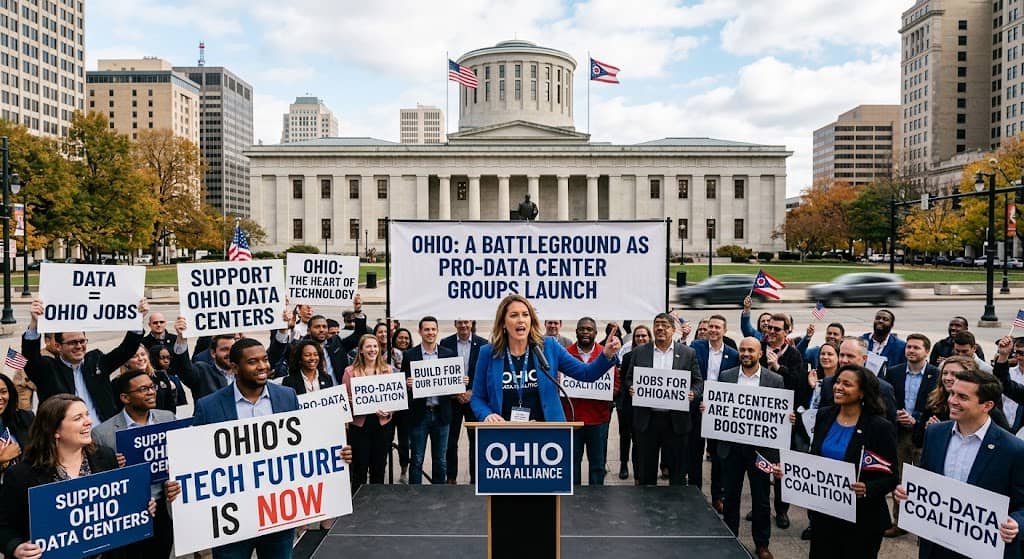
 Ohio Governor Mike DeWine announced on May 27, 2026, that he has directed the chair of the Ohio Tax Credit Authority to pause consideration of any new data center tax exemption requests. The pause comes while the Ohio General Assembly’s Joint Data Center Committee “studies” the growth of data centers in the state. DeWine noted that data centers previously granted sales and use tax benefits reported a total capital investment of $27.2 billion in 2025. The Tax Credit Authority will stop accepting new exemption proposals after a meeting next Monday, where it will consider one final proposal. DeWine said the move is a suspension of new exemptions, NOT a data center ban.
  Natural gas flows along the Rover Pipeline have been cut by 387 MMcf/d (out of 3.25 – 3.4 Bcf/d) due to maintenance at the Bulger Compressor Station, which is expected to last through the end of the month, curbing Appalachian takeaway capacity to the Midwest and Canada. Additionally, the MarkWest Harmon Creek gas processing plant in Washington County, PA, is reported to be offline due to this work.
  The Ohio Supreme Court issued a decision in a case we previously did not know about, one with the potential to affect landowners and drillers. In the case Faith Ranch & Farms Fund, Inc. v. PNC Bank, the Supremes ruled that a former Harrison County landowner did NOT reserve underground oil and gas rights in a 1953 deed that mentioned coal and “other minerals.” Using the phrase “other minerals” may refer to oil and gas, but that isn’t necessarily the case, the justices said in a 6-1 ruling. The phrase was considered in relation to how it’s contextualized in a deed, one of the justices wrote.
  The Abu Dhabi (United Arab Emirates) investment group 2PointZero, via its subsidiary ePointZero, has agreed to acquire U.S. natural gas infrastructure firm Traverse Midstream Partners for $2.25 billion. This acquisition includes stakes in the Rover Pipeline and Ohio River System, which connect the productive Utica/Marcellus shale region to major demand centers and export hubs. Despite escalating Middle East geopolitical tensions and global energy disruptions, the deal underscores the UAE’s commitment to commercial partnerships with the United States.
  Last week, we told you that a supposed “group of rural Ohioans” in Adams and Brown counties was seeking a constitutional amendment to ban data centers exceeding 25 megawatts, citing concerns over resource consumption and a lack of local control (see