
Both Sides of PA’s New Title Washing Law, Act 27 — Who’s Right?

In July, we wrote about the Pennsylvania Supreme Court’s decision in the Proctor “title washing” case and got an earful from landowners who told us the story was more complicated than it looked (see Revisiting the 2025 PA Supreme Court Decision on “Title Washing”). They were right. Since then, the General Assembly has passed Act 27 of 2026, which effectively reverses that decision, and the fight has moved from the courtroom to the Capitol and back to the courtroom again. There is real money on the table — an estimated $1 billion in natural gas — and, more to the point for our readers, there are Pennsylvania landowners on both sides of this. Below we lay out how title washing works, what the Court actually decided, what Act 27 actually says, and the strongest arguments each side is making. We’re not picking a winner in this one. We’re going to explain it. Read More “Both Sides of PA’s New Title Washing Law, Act 27 — Who’s Right?”
 EQT is planning another pipeline — and this one is big. Through a brand-new subsidiary called Appalachian Transmission Gateway LLC (ATG), the Marcellus/Utica’s largest driller has opened bidding on the “POWER Pipeline,” a 42-inch, 50-mile line that would carry a full 1 billion cubic feet per day (Bcf/d) of gas from Greene County, Pennsylvania, west to the Clarington hub in Monroe County, Ohio. The open season quietly began Aug. 26 and runs through Oct. 26. We found no press release announcing it — the notice simply went up, and the trade press caught it a week later.
  Range Resources had a genuinely rotten 16 hours at its Laurel Hill B well pad in Cogan House Township, Lycoming County, last week. First, a gasket blew on a water filter pod and sent recycled frack water down the pad’s fill slope. Then, while the state inspector was standing there writing that one up, a water truck hauling more of the same stuff drove off the access road and rolled over. MDN obtained both DEP inspection reports, and they tell a more complete story than the headlines indicate.
  Yesterday, the Pennsylvania Independent Fiscal Office (IFO) released its quarterly Natural Gas Production Report covering April through June 2026 (full copy below). Three numbers, all pointing in the same direction: PA drillers spudded (started drilling) 89 new horizontal wells in 2Q26, down 16 wells (-15.2%) from the 105 spudded in 2Q25. Production volume was 1,925 billion cubic feet (Bcf), down 32 Bcf (-1.6%) from 1,957 Bcf in 2Q25 — the lowest quarterly volume since 4Q24. And the average Pennsylvania spot hub price was $2.11 per MMBtu, down 27 cents (-11.3%) from last year’s $2.38.
 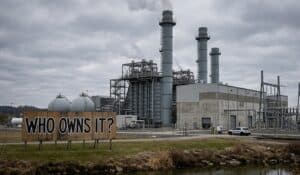 Fayette County, Pennsylvania, spent six months quietly chasing NextEra Energy’s giant gas plant, and now that it’s landed, county officials are publicly sharing their support. Two follow-up stories — one from the Pittsburgh Business Times, one from Salena Zito at the Washington Examiner — fill in a lot of what we didn’t have yesterday about the East Riverside Energy Center. Including who is actually going to own the thing. Hint: it isn’t NextEra.
  Anti-drilling group Protect PT has opened a new front against the biggest gas-fired AI project in Westmoreland County, Pennsylvania. On Aug. 25, Protect PT and two Upper Burrell residents — Allen Uhler and Guy Fuller — filed a land use appeal in Westmoreland County Court challenging the township supervisors’ approval of TECfusions’ work at the former Alcoa/Arconic research campus. Notably, the appeal doesn’t attack the gas turbines or the Marcellus wells feeding them. It attacks a piece of paper. Or rather, the absence of one.
  Eight anti-fossil fuel groups gathered on the banks of the Delaware River on September 2 to hold a press conference defending the Delaware River Basin Commission’s ban on fracking. Here’s the part that made us laugh: they already won in July. Republican leadership never even offered the amendment that would have stripped the DRBC of its power to ban drilling. So why hold a rally to defend something that isn’t under attack? Because they’re nervous — and when you read what they’re claiming, you can see why.
  We finally have a number. Two weeks after a casing failure sent frack water gushing across the Infinity Natural Resources (NYSE: INR) Cooper well pad in Young Township, Indiana County, PA, the Department of Environmental Protection (DEP) has put an estimate on it: 336,000 gallons of frack flowback water released during the incident. An “undetermined amount” of that reached Whiskey Run, the small stream below the pad. Here’s what that number actually means — and what it still doesn’t tell us.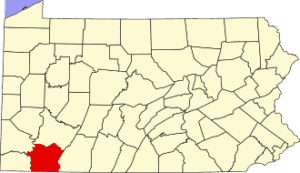
 A Dallas-based hyperscaler wants to build a 1.7-million-square-foot computing campus — plus its very own 450-megawatt natural gas power plant — on a reclaimed strip mine in Washington County, PA. The gas would come off a lateral tied to Energy Transfer’s Rover Pipeline, which runs right past the property line. Prime Data Centers made its first real presentation to the Hanover Township Board of Supervisors Monday night, in front of a fire hall packed past capacity with residents who are, to put it mildly, not sold. Three hours of testimony later, the supervisors scheduled four more hearings.
  In April, we told you the Federal Energy Regulatory Commission (FERC) was taking a fresh look at the revived Constitution Pipeline and the associated Wright Interconnect project, and that the agency had to decide whether a relatively quick Environmental Assessment (EA) would do the job — or whether it would drag the projects through a full-blown, years-long Environmental Impact Statement (EIS). We got our answer on August 21. FERC staff issued the EA for both projects — 79 pages plus appendices — and the bottom line is the one supporters have been waiting on: building Constitution “would not constitute a major federal action significantly affecting the quality of the human environment.” In plain English — no significant impact. No years-long supplemental EIS is needed.
  A group of North Fayette Township (Allegheny County, PA) residents who tried to block a Range Resources well pad has lost its appeal — not because a court weighed their evidence, but because they live too far away to sue. The Pennsylvania Commonwealth Court ruled August 25 that Stephen Bates and Heather Forster, who share an address more than two miles from the proposed pad, lack “standing” — the legal right to bring a case — to challenge the township’s approval in court.
  The Marcellus/Utica region received 19 new drilling permits last week, August 17 – 23, down from the 27 permits issued two weeks ago. For the second week in a row, Pennsylvania issued the fewest new permits, with 2 (after issuing just 4 two weeks ago). What’s up with PA? Ohio issued 4 permits. And West Virginia took the prize last week, issuing 13 new permits. The drillers who received new permits were: Expand Energy (6), Infinity Natural Resources (1), Northeast Natural Energy (1), Pennsylvania General Energy (2), Tiburon Oil & Gas (3), and Vickery Energy (6).
  Nineteen months after TECfusions bought the old Alcoa research campus in Upper Burrell (Westmoreland County), PA, and promised to build 3 gigawatts of gas-fired AI computing capacity, the company announced yesterday that the site is live and delivering GPU capacity to a paying customer. It’s a small first bite of a very large apple—but it’s real, it’s running on gas turbines today, and it sits on top of Marcellus wells the company already owns.
  Back in June, we praised South Strabane Township in Washington County, PA, for doing the hard, unglamorous work of writing data center rules instead of slamming the door shut (see