
Accidents | Energy Companies | Expand Energy | Industrywide Issues | Pennsylvania | Pipelines | Susquehanna County
Expand’s Susquehanna Week: Minor Pad Fire, New 4-Mile Water Line
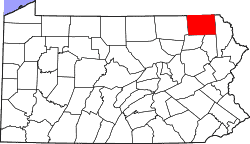
Expand Energy’s operating arm made the Pennsylvania Department of Environmental Protection (DEP) news twice last week, both times in Susquehanna County. One item sounds scary but isn’t: A small “flash fire” inside a compressor building on a well pad, and the equipment put it out before firefighters arrived. The other is a new permit for a 4-mile temporary waterline that will carry fresh water to Expand’s Marcellus wells in Auburn Township. It’s the second such line DEP has OK’d in that township in a month. David Hess at PA Environment Digest Blog flagged both items. Here’s the scoop. Read More “Expand’s Susquehanna Week: Minor Pad Fire, New 4-Mile Water Line”
 The Marcellus/Utica region received 29 new drilling permits last week, September 28 – October 4, nearly double the 16 permits issued two weeks earlier. Pennsylvania issued 20 of the new permits. Ohio issued 9 new permits. And West Virginia got skunked, issuing no new permits. The drillers who received new permits last week were: Blackhill Energy, Coterra Energy (now Devon Energy), EOG Resources, Expand Energy, Gulfport Energy, Infinity Natural Resources (INR), and Snyder Brothers.
  Expand Energy, the largest natural gas producer in the country (born from the 2024 merger of Chesapeake Energy and Southwestern Energy), is going all-in on artificial intelligence (AI). Recently, tech consulting firm Thoughtworks announced that Expand has hired it to build AI capability across the entire company. Not just out in the field, but in the office and on the gas marketing desk, too. Expand wants a working AI tool in “production” (i.e., actually being used, not just tested) by the end of this year. That’s about 12 weeks from now! This is not Expand’s first AI rodeo. Back in January, Expand signed a deal with Baker Hughes to put AI-powered software on thousands of its Marcellus, Utica, and Haynesville wells.
  The highly functional and responsible Susquehanna River Basin Commission (SRBC), unlike its dysfunctional and irresponsible counterpart, the Delaware River Basin Commission (DRBC), continues to support the shale energy industry by approving water withdrawals and consumptive use requests for responsible, safe shale drilling. The SRBC published a notice in the September 26th Pennsylvania Bulletin that the SRBC approved and/or renewed 35 general water use permits in August for individual shale gas well drilling pads in Bradford, Clinton, Elk, Lycoming, Sullivan, Susquehanna, Tioga, and Wyoming counties.
  Expand Energy, the country’s largest natural gas producer, opened
  Expand Energy — America’s #1 gas producer, which drills in Pennsylvania under the name Expand Oper LLC — just picked up a fresh batch of Notices of Violation from DEP. Pressure tests witnessed by DEP inspectors on Aug. 6 and Aug. 13 confirmed new casing/cementing defects in four wells across three pads in Susquehanna and Wyoming counties, while two more pads remain under watch for older, unresolved issues.
  Accounting giant Ernst & Young dropped its annual reserves benchmarking study yesterday, and while the press release leads with oil, the real story for our part of the country is buried in the tables: EQT is now the largest holder of proved natural gas reserves in the United States, and Appalachian-focused producers control roughly a third of all the gas reserves booked by America’s 30 biggest publicly traded drillers.
  Appalachian drillers just got a hard lesson in how fast the money can vanish. New analysis from RBN Energy shows pre-tax profits at gas-weighted producers cratered 75% in the second quarter — and nine of the ten companies in RBN’s gas-weighted peer group are Marcellus/Utica operators. This is an M-U report card, whether RBN calls it one or not. The piece, written by Nicholas Cacchione and published August 26, covers second quarter results for 37 publicly traded exploration and production companies (E&Ps). RBN sorts them into three buckets: Oil-Weighted, Diversified, and Gas-Weighted. Every company in that last bucket except Comstock Resources — a Haynesville player — has major operations in the Marcellus or Utica.
  Epsilon Energy (NASDAQ: EPSN) keeps calling its Susquehanna County, PA, acreage a “legacy” asset — and then keeps telling investors it’s sitting on up to 200 billion cubic feet of gas it hasn’t produced yet. At the EnerCom Denver energy investment conference on Tuesday, Epsilon’s VP of Finance put hard numbers on the northeast Pennsylvania position for the first time, disclosed pad-level economics that are rare to see in public, and dropped the news item that matters most to anyone with a lease inside the Auburn dedication: the company is reviewing an expansion of the Auburn Gas Gathering System to handle drilling coming in 2028 and beyond.