
Antero Resources | Ascent Resources | Devon Energy | Energy Companies | EOG Resources | EQT Corp | Expand Energy | Industrywide Issues | Research
Utica Rig Count Fell 42%. Utica Drilling Didn’t. Here’s Why.
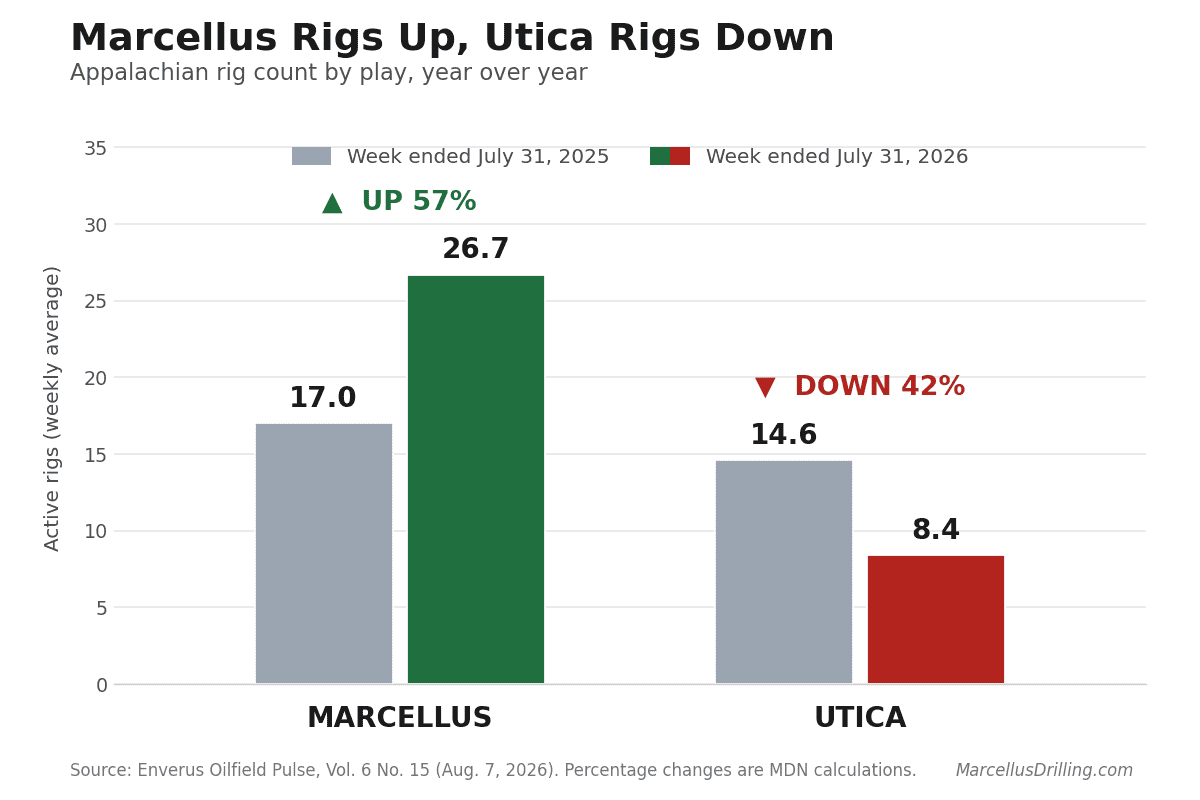
Enverus, the Austin-based energy data outfit, rolled out its Top U.S. Drillers of 2026 rankings yesterday (Aug. 18). Here’s the headline nobody else will write: two of the three biggest land drilling customers in America now own Appalachian acreage. EOG Resources ranks No. 2 and Devon Energy ranks No. 3, and between them they hold the largest Utica position and the best Marcellus rock in the basin. Dig deeper, and you’ll find something that ought to calm a few nerves — the Enverus data shows Utica rigs down 42% in a year, and that number does not mean what it looks like it means. Read More “Utica Rig Count Fell 42%. Utica Drilling Didn’t. Here’s Why.”
 The Marcellus/Utica region received 8 new drilling permits last week, August 3 – 9, down 7 from two weeks ago. Pitiful. (Cue Linda Ronstadt’s “
 Expand Energy, the largest natural gas producer in the country, reported its second-quarter 2026 numbers on Tuesday and held its analyst call Wednesday morning. Headline items: net production of 7.48 Bcfe/d (billion cubic feet equivalent per day), net income of $522 million, and a reaffirmed full-year guide of 7.4–7.6 Bcfe/d on $2.75–$2.95 billion of capital spending. But the news that matters most to MDN readers isn’t in the headline — it’s buried in the slide deck. Expand quietly paid roughly $5,000 an acre for 3,000 acres in core Bradford County, Pennsylvania, and turned in the best drilling quarter in the history of its Southwest Appalachia business. Meanwhile, interim CEO Mike Wichterich says the search for a permanent boss is in “the back third” and will land inside the promised nine months. Let’s break it down.
  Expand Energy, the largest natural gas producer in North America and a giant in the Marcellus/Utica, announced yesterday that it has signed a definitive agreement to buy Twin Eagle Holdings for $1.25 billion in cash from private equity owner Five Point Infrastructure. Twin Eagle is not a driller. It doesn’t own a single well. It’s a physical gas marketer — a middleman that buys gas from producers, moves it through pipelines and storage, and sells it to utilities, power plants, and factories. Twin Eagle markets more than 5 Bcf/d (billion cubic feet per day), controls 44 Bcf (billion cubic feet) of storage and roughly 2 Bcf/d of firm pipeline capacity, and serves over 1,000 customers across the U.S. and Canada. The deal is expected to close in the third quarter. When it does, Expand becomes the country’s biggest gas seller as well as its biggest gas producer.
  The highly functional and responsible Susquehanna River Basin Commission (SRBC), unlike its dysfunctional and irresponsible counterpart, the Delaware River Basin Commission (DRBC), continues to support the shale energy industry by approving water withdrawals and consumptive use requests for responsible, safe shale drilling. The SRBC published a notice in the July 25th Pennsylvania Bulletin that the SRBC approved and/or renewed 21 general water use permits in June for individual shale gas well drilling pads in Clearfield, Lycoming, Sullivan, Susquehanna, Tioga, and Wyoming counties.
  We stumbled across an article by East Daley Analytics that is a real eye-opener for us. East Daley analyzed 13 major public G&P (gathering and processing) operators (i.e., pipeline companies). They found that Expand Energy (created by the merger of Chesapeake Energy with Southwestern Energy), with major assets in the Marcellus/Utica and the Louisiana Haynesville, accounts for 52% of DT Midstream’s gathering volumes, 32% of Williams’, and 21% of Energy Transfer’s throughput. Yikes! Just one company.
  Despite rising Northeast gas demand from retiring coal plants and new data centers, plus added Appalachian pipeline capacity, production growth isn’t guaranteed—operators prioritize capital discipline, debt reduction, and shareholder returns over volume. Appalachia has held flat at roughly 33-36 Bcf/d since 2020. Can anything tempt Marcellus/Utica drillers to drill and produce more than they are now? According to RBN Energy, sustained Henry Hub prices above $4/MMBtu (versus the current $3.50-$3.60 long-dated curve) and better takeaway infrastructure could be enough of a temptation.
  Thanks to the work of David Hess at the PA Environment Digest Blog, which tracks Department of Environmental Protection (DEP) notices published in the Pennsylvania Bulletin, we know of two water pipeline projects (for EQT and Expand Energy) approved by the DEP related to drilling new shale wells in two different northeastern PA counties: Lycoming and Bradford. Water is used for fracking. New water pipelines mean new fracking is on the way in those locations.
  In February, Expand Energy fired its CEO, Nick Dell’Osso, the guy who grew the company into the largest natural gas producer in the U.S. (see