PA-OH-WV Shale Permits Oct 12-18: 12 New Wells, 19 Older-Well Moves
 The Marcellus/Utica region received 12 new shale well permits last week, October 12-18, up 3 from 9 the week before. Pennsylvania issued 9 of the new permits. Ohio issued 2. And West Virginia issued a single new permit. The drillers who received new-well permits last week were: Antero Resources, Ascent Resources, Expand Energy, Range Resources, and Seneca Resources. Before we go further, a quick housekeeping note: Starting this week, MDN counts only permits for brand-new wells in the headline number. State agencies also issue renewals (more time to drill a well that was already permitted), modifications (changes to a well that was already permitted, like a new wellbore path), and in Ohio, “deepen” permits. Those wells were already counted the first time around, so counting them again would double-count. We now list them separately, in their own section below. Read More “PA-OH-WV Shale Permits Oct 12-18: 12 New Wells, 19 Older-Well Moves”
 Yesterday, the Pennsylvania Department of Environmental Protection (DEP) threw another party, this time to celebrate the 500th orphan and abandoned well plugged since Josh Shapiro became governor in January 2023. Good for them. Seriously. But we can’t help noticing that Ohio plugged 480 orphan wells in 2025 alone, nearly as many as PA has plugged in almost four years. From 2023 through 2025, Ohio plugged 1,215 old wells. That’s 2.4 times PA’s entire Shapiro-era total, and it doesn’t count a single well Ohio has plugged so far in 2026.
 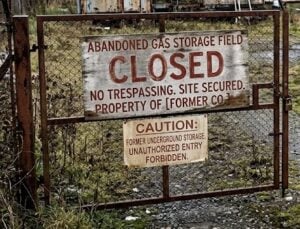 Columbia Gas Transmission (a TC Energy company) has asked federal regulators for permission to permanently walk away from three underground natural gas storage fields straddling the Pennsylvania/West Virginia line near Majorsville — plugging 71 wells, tearing out a compressor station, and abandoning nearly 20 miles of pipe. On September 9, FERC set the clock on its environmental review. If you’re a landowner in Greene or Washington County, PA, or Marshall County, WV, this one lands in your backyard. Here’s the plain-English version of a very technical filing.
  In a companion post today, we told you that of 22 proposed data center campuses in Northeastern Pennsylvania, exactly one plans to build its own gas-fired power (see Only 1 of 22 NEPA Data Centers Plans Its Own Gas Plant). The Pittsburgh Post-Gazette hands us the mirror image. Reporter Anya Litvak counted 10 new natural gas power plants proposed within an hour’s drive of Pittsburgh — more than 20 gigawatts (GW) of new capacity, most of it chasing data center demand, all of it aimed at the next five years. Pennsylvania’s entire existing generating fleet, every power plant and wind turbine and solar panel in the state, adds up to about 45 GW. Southwestern PA alone is proposing to add 22 GW. That is not an expansion. That is a second Pennsylvania grid.
  Back in June, we praised South Strabane Township in Washington County, PA, for doing the hard, unglamorous work of writing data center rules instead of slamming the door shut (see
 A new Penn State study went looking for radium from fracking in southwestern Pennsylvania drinking water. It tested 91 private wells and springs in Washington and Greene counties and found exactly zero samples above the EPA limit — and the radium it did find carries the chemical fingerprint of the rock the water sits in, not Marcellus brine. You wouldn’t know that from Penn State’s press release headline, which falsely blares, “