
Energy Companies | Energy Services | EQT Corp | Equitrans/EQT Midstream | Harrison County | Industrywide Issues | Pipelines | Regulation | West Virginia
Equitrans Dusts Off 2018 Pipeline Plan to Fuel WV Wolf Summit Plant
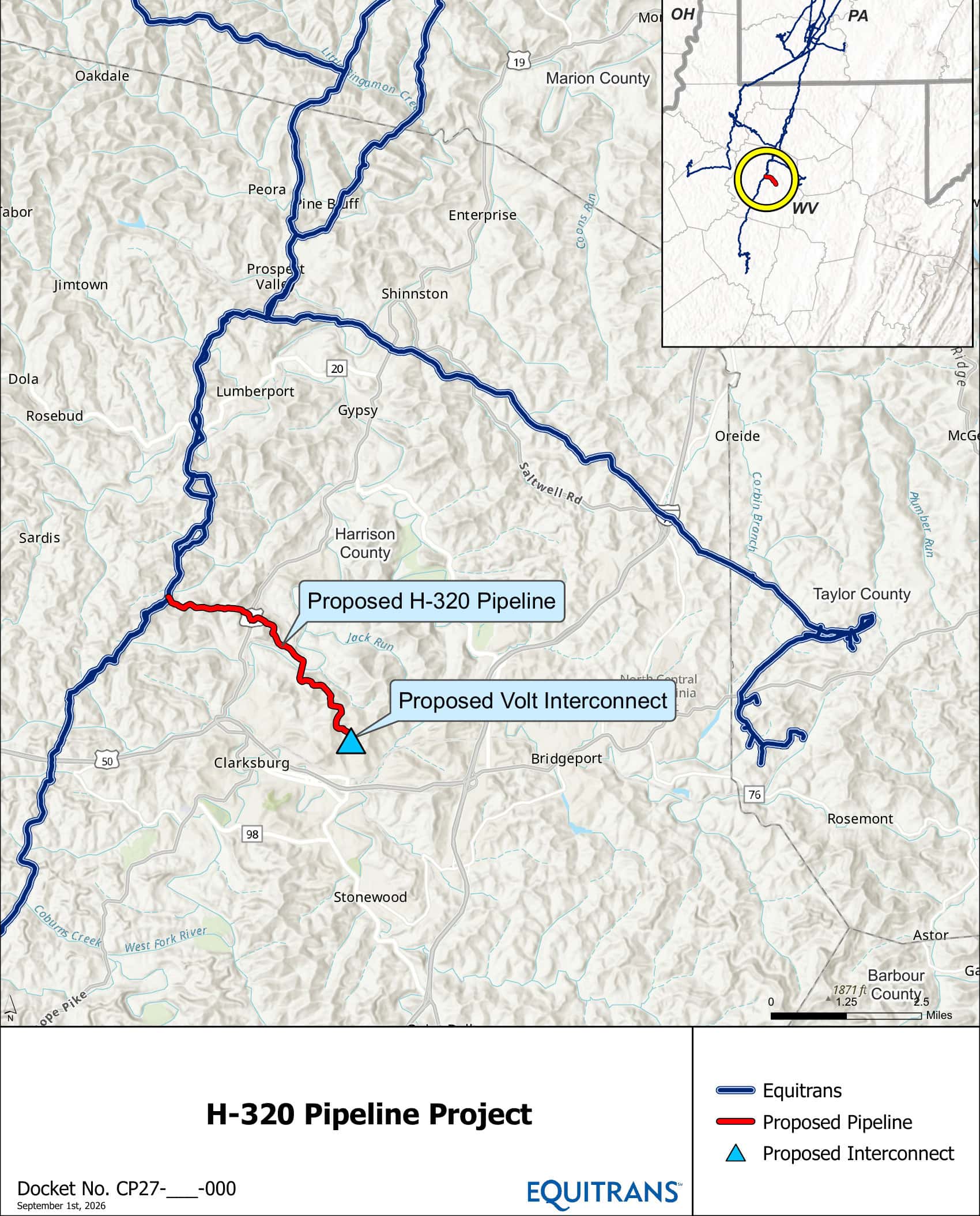
Some pipeline projects take the scenic route. Equitrans’ H-320 Pipeline, a 4.9-mile, 12-inch line in Harrison County, WV, first won FERC approval back in 2018. Its job was to feed a gas-fired power plant that never got built. Now that plant is finally rising out of the ground as Wolf Summit Energy, so EQT-owned Equitrans has gone back to FERC to build what it calls “essentially the same” project. The new version is a bit bigger and more than twice as expensive. Read More “Equitrans Dusts Off 2018 Pipeline Plan to Fuel WV Wolf Summit Plant”
 The Marcellus/Utica region received 9 new shale well permits last week, Oct. 19 – 25, down 3 from 12 the week before. Pennsylvania issued 4 new permits, Ohio issued 4, and West Virginia issued 1. The drillers who received new-well permits last week were: Antero Resources, Gulfport, INR, JKLM Energy, and Snyder Brothers. It was a quieter week on the new-permit front. The busiest driller of all, EOG Resources, didn’t get a single permit for a brand-new well — but it did get seven permits to tweak wells it was already approved to drill in Ohio (more on that below).
 How many times over the years have we reported on (and cheerleaded for) gas-fired power plants to get built in West Virginia? MANY times. Dozens, maybe hundreds of posts about this topic. Yet, in all the time we’ve been writing MDN (since January 2009), not a single, solitary *new* gas-fired power plant has been built in the Mountain State (although there are four existing, older gas-fired plants). Not one new plant! Until now. Kindle Energy yesterday announced it has broken ground at Wolf Summit Energy, a previously announced fully contracted, 600-megawatt greenfield combined-cycle gas turbine (CCGT) power generation facility in Harrison County, WV.
 The Intermediate Court of Appeals of West Virginia vacated an order combining 58 oil and gas tracts into a Harrison County drilling unit, ruling that the state’s Oil and Gas Conservation Commission failed to provide sufficient findings of fact. The case involves the “JOsborn 213 Unit” operated by Arsenal Resources, which mineral rights owners claim failed to negotiate in good faith as required by law. The court found the Commission ignored conflicting testimony and provided only summary conclusions rather than a detailed analysis. Consequently, the case was remanded for further proceedings, requiring the Commission to properly evaluate all evidence and issue a new order.