
Allegheny County | Earthquakes | Energy Companies | EQT Corp | Hydraulic Fracturing | Industrywide Issues | Pennsylvania | Regulation | Westmoreland County
Westmoreland Seismic Event: DEP Checks EQT Pad, No Red Flags Found
 Did the ground rumble in Westmoreland County on Sunday, October 4, because of fracking? The Pennsylvania Department of Environmental Protection (DEP) asked that question, checked EQT’s nearby Porter well pad, and found nothing abnormal. EQT’s pressure logs for that day were clean, no violations were cited, and DEP asked for more paperwork. That’s good news for EQT, even if the headline you may have seen elsewhere makes it sound much more ominous. Read More “Westmoreland Seismic Event: DEP Checks EQT Pad, No Red Flags Found”
 Allegheny County, home to Pittsburgh, just became the first county in the nation to force private employers to pay for 12 weeks of parental leave — at up to 100% of wages, with the employer footing the entire bill. County Executive Sara Innamorato signed the regulation yesterday, two days after County Council approved it 11-4. Here’s what caught our eye (thanks to a heads-up from PIOGA): the mandate doesn’t care where your headquarters is. If you’re a driller or service company with 15 or more employees anywhere, and one of your employees works 80 hours in Allegheny County in a year, that worker is covered.
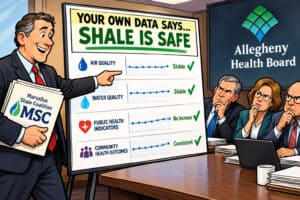 Last Wednesday, MDN told you about the Allegheny County Board of Health’s latest move against shale drilling (see
 A developer from Bucks County wants to build a 1-gigawatt (GW) natural gas-fired power plant and up to 28 data center buildings on a former U.S. Steel landfill in Elizabeth Township, Allegheny County. If built, the plant would burn somewhere around 150 million cubic feet of Marcellus/Utica gas every day. That’s the good news. The not-so-good news? It’s the same spot where Invenergy tried, and failed, to build a gas plant a decade ago. And the anti group that fought Invenergy spent this summer fighting EQT’s Heracles well pad down the road.
 The Allegheny County Board of Health has fired the first shot in what looks like a slow-motion campaign to squeeze shale drilling out of the county. At its September meeting, the board voted unanimously to have the county health department look into whether Article 21, the county’s air pollution rulebook, should be rewritten to remove permitting exemptions that oil and gas operations now enjoy. Nothing changes yet. But the idea came straight out of the board’s own “Fracking Committee,” chaired by a writer for an anti-fracking group, and the folks at Food & Water Watch are already celebrating. Here’s what happened, what it could mean for drillers and landowners in Allegheny County, and why MDN isn’t buying the “it’s just a review” line.
 The Marcellus/Utica region received 17 new drilling permits last week, September 14 – 20, up 1 from the 16 permits issued two weeks ago. Pennsylvania issued 6 of the new permits. Ohio also issued 6 new permits. And West Virginia issued 5 new permits. The drillers who received new permits last week were: Ascent Resources, EOG Resources, EQT, Expand Energy, and Seneca Resources.
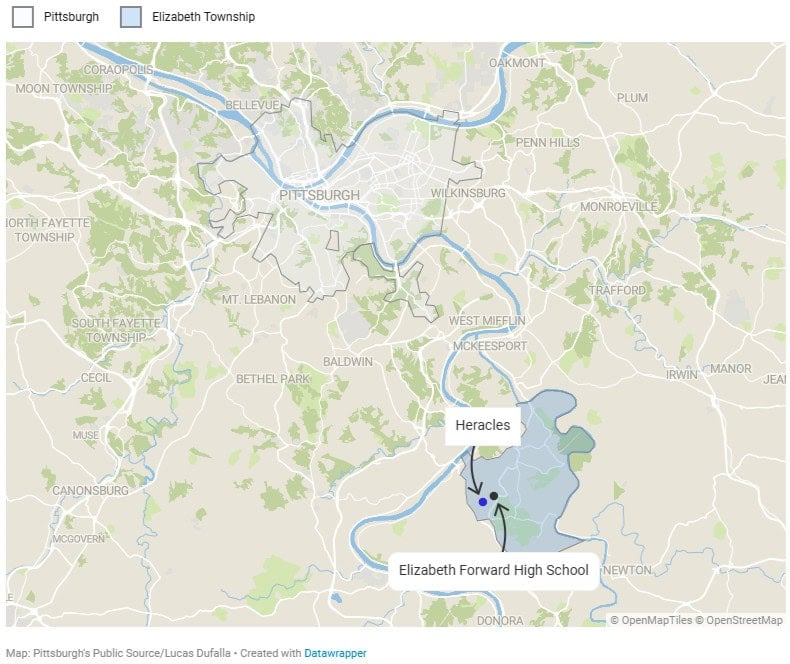
 It took three years, two conditional use applications, one appellate court loss, a subdivision, a three-hour hearing, and a deadline extension — but EQT finally got its vote. On Monday night (Sept. 14), Elizabeth Township’s (Allegheny County, PA) Board of Commissioners voted unanimously to approve two conditional use permits for EQT’s six-well Heracles project: one for the well pad, and one for the interconnect pad (the spot where gas from the wells hands off to a pipeline). The pad sits less than a half-mile from Elizabeth Forward High School, so the approvals come with a long list of strings attached, including a 10-year “emergency preparedness fund” EQT must pay into. Big Green group Protect Elizabeth Township (PET) says it will keep fighting in court. In a surprise twist, the commission president revealed that someone has approached the township about building a data center.
 A group of North Fayette Township (Allegheny County, PA) residents who tried to block a Range Resources well pad has lost its appeal — not because a court weighed their evidence, but because they live too far away to sue. The Pennsylvania Commonwealth Court ruled August 25 that Stephen Bates and Heather Forster, who share an address more than two miles from the proposed pad, lack “standing” — the legal right to bring a case — to challenge the township’s approval in court.
 Yesterday, Pennsylvania Department of Environmental Protection (DEP) Secretary Jessica Shirley visited the site of an orphaned well being plugged in Allegheny County, PA, to celebrate the plugging of the 400th orphaned well since Josh Shapiro assumed the governorship in January 2023. There’s nothing wrong with Shapiro’s bragging and chest-puffing, except that Ohio plugged 480 orphaned wells last year. Since January 2023, Ohio has plugged 1,214 orphaned wells, compared to PA’s 400 wells (3X more). Which makes us ask: Why does it take so much longer and cost so much more to plug wells in PA than in OH?
 Olympus Energy (now owned by EQT) drills in the Greater Pittsburgh region, in Allegheny and Westmoreland counties. In 2021, Olympus applied to build a new well pad in a rural part of Allegheny County, in West Deer Township. So-called Concerned Residents of West Deer (CROWD) got amped up to oppose the project. They succeeded when town supervisors rejected the Dionysus well pad (see
 The Trump administration’s proposed Fiscal Year 2027 budget would establish four Centers of Excellence at the National Energy Technology Laboratory (NETL), focusing on oil and natural gas, coal, critical minerals, and geothermal energy. Pittsburgh’s South Park facility will house the oil and gas center, while Morgantown, West Virginia, will host the coal center. NETL’s infrastructure funding will rise 2% to $58 million, but research operations will face an 8% cut to $80 million. Programs supporting coal-impacted communities and clean hydrogen hubs would be eliminated. Industry groups, including the Marcellus Shale Coalition and Pennsylvania Coal Alliance, praised the administration’s energy-focused direction.
 Southwestern Pennsylvania voters chose poorly when they elected a Communist radical as their representative to the U.S. Congress: Democrat Summer Lee. She and two other far far far far far left radicals, Congresswoman Rashida Tlaib (Democrat from Michigan), and Congresswoman Adelita Grijalva (Democrat from Arizona), together just launched what they euphemistically call the People’s Environmental Justice Caucus in Congress. A better name is the “oil and gas is racist” caucus, an attempt to smear the oil and gas industry with the label of racism, claiming that O&G projects only get built in communities of color or where the residents are poor—people who (says Lee & co.) can’t fight back against the industry.
 Just coming to light now, more than a month after it happened, the Pennsylvania Department of Environmental Protection (DEP) is investigating whether there is any connection between a low-level earthquake (“seismic event”) near Murrysville in Westmoreland County, PA, and the Penneco Environmental Solutions LLC Sedat 3A injection well in Plum Borough in Allegheny County. Operators of injection wells in PA are (usually) required to maintain on-site seismometers. On Feb. 7, the seismometer at the Penneco Sedat 3A site registered a “seismic event” about six miles away near Murrysville.