
Energy Transfer Bolts NYSE for New Texas Stock Exchange
 Energy Transfer, one of the biggest midstream players in the country and a familiar name to Marcellus/Utica landowners thanks to the Revolution and Mariner East systems, announced last week that it is pulling its primary stock listing off the New York Stock Exchange and moving it to the brand-new Texas Stock Exchange (TXSE) in Dallas. Three affiliated companies are going with it. Together the four represent close to $100 billion in market value — the largest chunk of listing business the NYSE has ever lost to a startup rival. Before you declare the end of Wall Street, though, there’s an asterisk the size of Texas attached to this one. Read More “Energy Transfer Bolts NYSE for New Texas Stock Exchange”
 A Dallas-based hyperscaler wants to build a 1.7-million-square-foot computing campus — plus its very own 450-megawatt natural gas power plant — on a reclaimed strip mine in Washington County, PA. The gas would come off a lateral tied to Energy Transfer’s Rover Pipeline, which runs right past the property line. Prime Data Centers made its first real presentation to the Hanover Township Board of Supervisors Monday night, in front of a fire hall packed past capacity with residents who are, to put it mildly, not sold. Three hours of testimony later, the supervisors scheduled four more hearings.
  Last week, we covered Enterprise Products Partners signaling a “rate reset” on ATEX, the ethane pipeline that carries Marcellus/Utica ethane to Mont Belvieu (see
  Energy Transfer (ET), the Dallas-based pipeline behemoth that owns the Mariner East pipeline system, the Marcus Hook NGL terminal near Philadelphia, and a 32.6% stake in the Rover Pipeline, issued its second quarter 2026 update on Tuesday — and it was a monster. Adjusted EBITDA hit $5.07 billion, up 31% from 2Q25’s $3.87 billion. Distributable cash flow attributable to partners came in at $2.59 billion, up 32%. Net income attributable to partners more than doubled, hitting $2.09 billion versus $1.16 billion a year ago. ET raised its full-year 2026 EBITDA guidance to $18.8–$19.1 billion, up half a billion dollars at the midpoint from what the company told investors just three months ago. ET is a sprawling company with assets in 44 states, so let’s do what we always do — strip out the Permian noise and get to what matters for the Marcellus/Utica.
  We stumbled across an article by East Daley Analytics that is a real eye-opener for us. East Daley analyzed 13 major public G&P (gathering and processing) operators (i.e., pipeline companies). They found that Expand Energy (created by the merger of Chesapeake Energy with Southwestern Energy), with major assets in the Marcellus/Utica and the Louisiana Haynesville, accounts for 52% of DT Midstream’s gathering volumes, 32% of Williams’, and 21% of Energy Transfer’s throughput. Yikes! Just one company.
  The Abu Dhabi (United Arab Emirates) investment group 2PointZero, via its subsidiary ePointZero, closed on its deal to acquire U.S. natural gas infrastructure firm Traverse Midstream Partners for $2.25 billion. This acquisition includes stakes in the Rover Pipeline and Ohio River System, which connect the productive Utica/Marcellus shale region to major demand centers and export hubs. The all-cash transaction gives the Abu Dhabi-based energy infrastructure platform a 35% non-operated stake in the Rover Pipeline and a 25% interest in the Ohio River System (ORS), both of which are operated by Energy Transfer.
  Energy Transfer has asked the Pennsylvania Public Utility Commission (PUC) to restructure and dissolve the Sunoco Pipeline Company, separating its pipeline assets between two new entities. Energy Transfer NE NGL Pipelines LLC would own and operate the Mariner East system and other natural gas liquids pipelines, while Energy Transfer RP Pipelines LLC would control refined petroleum product pipelines. The proposal also would transfer Sunoco’s public utility operating certificates. Formal protests and intervention petitions are due July 27, 2026.
  Energy Transfer (ET) disclosed last week that co-CEO Marshall “Mackie” McCrea III will retire on or before December 31, 2026, with co-CEO Thomas Long set to become sole CEO upon McCrea’s departure. The company said McCrea cited a desire to pursue personal objectives and spend more time with his family, while also expressing confidence that the partnership is well-positioned for the future. ET owns important assets in the Marcellus/Utica region, including the Mariner East and Rover pipeline systems. Does McCrea’s retirement signal anything about the company’s future with the M-U?
 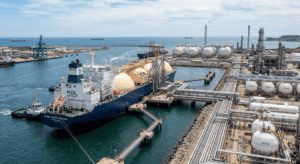 Energy Transfer LP (ET) owns and operates one of the largest and most diversified portfolios of energy assets in the U.S., with approximately 140,000 miles of pipeline and associated energy infrastructure. ET’s strategic network spans 44 states and includes assets in all major U.S. production basins, including the Marcellus/Utica. The company issued its first quarter 2026 update last week. ET sees the Marcellus/Utica region as a key source of NGL supplies for its export operations, particularly exports from the Marcus Hook terminal near Philadelphia.
 This is sad and unexpected. Five weeks ago, MDN reported that Energy Transfer was holding off on a final investment decision (FID) for its Lake Charles LNG export project until 80% of the project had been sold to equity partners (see
  A month ago, MDN reported that Energy Transfer was holding off on a final investment decision (FID) for its Lake Charles LNG export project until 80% of the project had been sold to equity partners (see
  It’s time to revisit a topic we’ve covered many times before — philanthropy in the Marcellus/Utica region. Drillers and pipeline companies in the M-U region already contribute to the region through the generous lease bonuses and royalties paid to landowners. In addition to the billions that flow to landowners, M-U companies cumulatively donate millions of dollars to local communities and nonprofit organizations. Here’s the latest example of that in action: The Marcellus Shale Coalition (MSC) says its members (and their employees) have embraced this Thanksgiving season by giving back through food drives, volunteering at local charities, and supporting community initiatives.
  In April, we told you that Energy Transfer’s (ET) Lake Charles LNG project had landed a new partner to help pay for the project, MidOcean Energy, which will cover 30% of the cost of building the plant (see