
Appalachian Spot Prices Jump While NYMEX Futures Slide Below
 Here’s a head-scratcher for you. On Tuesday, the price of natural gas futures on the New York Mercantile Exchange (NYMEX) took a tumble, slipping below $3 for the first time in more than two weeks. Yet on that very same day, the “spot” (cash) price for gas right here in Appalachia went UP—and one trading point jumped more than 20% in a single day. How does that happen? And should drillers and royalty owners break out the champagne? Let’s unpack it. Read More “Appalachian Spot Prices Jump While NYMEX Futures Slide Below”
 On Friday, we told you a leak on Columbia Gas Transmission’s Mountaineer XPress (MXP) pipeline had pushed Appalachian gas down to $1.06 (see
  The feds have spoken: this winter in the Northeast will most likely be warmer than normal, and maybe a little soggier, too. NOAA’s Climate Prediction Center released its official winter outlook last Thursday (Oct. 15), and a “super” El Niño is calling the shots. For those who make a living from Marcellus/Utica gas, a warm winter means less gas burned to heat homes, and that means softer prices. The market noticed. November futures slid 12 cents on Friday. But here’s the twist. In pipeline-starved New England, traders are still betting on $20-plus gas in January. A mild winter can’t fix what bad policy broke.
  On Thursday, physical (spot) natural gas sold at Louisiana’s Henry Hub (the national benchmark) went for $3.30 per MMBtu. On the same day, gas sold at Texas Eastern M-2, which is the main price point for gas produced in southwestern Pennsylvania, West Virginia, and Ohio, went for $1.055. That’s the same molecule of methane, and our version fetched about 32 cents on the dollar. Why? Because a pipeline carrying Appalachian gas out of the region sprang a leak again. Here’s what happened, why it matters to your royalty check, and why there’s some good news on the horizon.
  The rest of the country is heading into winter swimming in natural gas. Production is at record highs, storage is above average, and Henry Hub January futures are trading below $4. Yet traders are paying more than $20 per MMBtu for gas delivered into parts of New England in January. That’s more than five times the national benchmark. The problem isn’t a shortage of gas. It’s a shortage of pipe. New England sits just a few hundred miles from the Marcellus Shale, one of the most prolific gas fields on the planet, but more than a decade of blocked pipeline projects means it can’t get enough of our gas when the weather turns cold.
  Here’s a head-scratcher for you. The Henry Hub spot (physical, not futures) price, the national benchmark for natural gas down in Louisiana, closed yesterday at $3.155 per MMBtu (million British thermal units, roughly the same as 1 Mcf, or a thousand cubic feet). Up here in the Marcellus/Utica, the very same molecule of gas sold for 88.5 cents. That’s not a typo. Our gas traded at a $2.27 discount to Henry Hub, fetching just 28 cents on the dollar. Why? The short answer is the same one we’ve given for 15 years: not enough pipelines.
  Where do the people who actually drill for, and service, oil and gas wells think the price of natural gas is going? Every three months the Federal Reserve Bank of Dallas asks them, and the answer from the latest survey is: not much higher in the short run, but steadily higher over the next five years. The third-quarter 2026 Dallas Fed Energy Survey, released September 30, found executives expect the Henry Hub price to finish 2026 at $3.29 per MMBtu, rise to $3.82 in two years, and reach $4.28 in five years. Meanwhile, the price in the real world right now is hovering around $3.00. Here’s what the crystal ball says, and what it means for the Marcellus/Utica.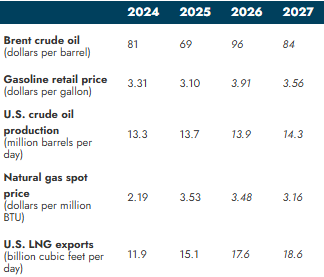
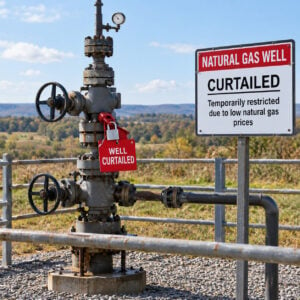 The pipeline got fixed. The price didn’t. In midday trading on Monday, Eastern Gas South (the M-U pricing point formerly known as Dominion South) sold for $1.005 per MMBtu, while Henry Hub in Louisiana sat at $2.960. That’s a $1.955 haircut. Gas sold in our backyard fetched about one-third of the national benchmark price. And M-U drillers are doing what smart business people do: leaving gas in the ground until someone offers a fair price for it.
 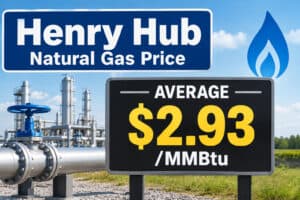 This July was the hottest July on record for the Lower 48 states, averaging 77°F. You’d think a heat wave like that, with everybody cranking up the A/C, would send natural gas prices soaring. Nope. The U.S. Energy Information Administration (EIA) reports the Henry Hub spot price averaged $2.93 per MMBtu (million British thermal units, roughly 1,000 cubic feet of gas) from June through August, 6% less than the same period last summer. EIA credits (or blames, depending on your point of view) record gas production, full storage caverns, LNG export plant maintenance, and more solar and wind generation. That’s the national story. Here in Marcellus/Utica country, the story is the same, only more so. Our local prices ran far below Henry Hub all summer.
  Expand Energy, the country’s largest natural gas producer, opened
  When Appalachian gas prices fall into the basement, EQT turns down the valves, and CEO Toby Rice says the strategy is paying off. In an interview with Reuters on Tuesday, Rice put a dollar figure on it for the first time: a little over $200 million a year in benefit from selling less gas when prices are low and more when they’re high. He also said EQT, the country’s No. 2 gas producer, will pump more gas in 2026 than last year while spending less to do it. Rice talked up the company’s proposed POWER Pipeline to Ohio, its Mountain Valley Pipeline expansions, and a new 10-year LNG supply deal with Lithuania. His outlook for global gas demand is, let’s say, very bullish.