
Tetco M-2 Sinks to $1.435, Below EQT’s $1.50 Shut-In Trigger
 The fall “turn down the valves” season for Marcellus/Utica gas has arrived, and it showed up about a week early. Last Friday (Sept. 11), the spot price at Texas Eastern M-2 (aka Tetco M-2), the key pricing point for gas produced in southwestern Pennsylvania, West Virginia, and Ohio, averaged $1.435 per MMBtu (million British thermal units, roughly 1,000 cubic feet of gas). That’s 6.5 cents below the $1.50 mark that EQT, the region’s biggest driller, has flagged as its trigger for curtailing (temporarily cutting back) production. So, are shut-ins coming? History says probably, at least for a while. Read More “Tetco M-2 Sinks to $1.435, Below EQT’s $1.50 Shut-In Trigger”
 The U.S. Energy Information Administration (EIA) dropped its September Short-Term Energy Outlook (STEO) yesterday, and for once the natural gas headline numbers barely budged. Henry Hub is forecast at $3.43/MMBtu for 2026 and $3.28/MMBtu for 2027 — a penny and three cents below last month. After August’s 23-cent haircut, that’s practically a rounding error. The interesting stuff this month isn’t in the price line. It’s in the regional production tables, where EIA lays out exactly who is growing and who isn’t. Spoiler: it’s the same story as last month, only now EIA has put hard numbers on it.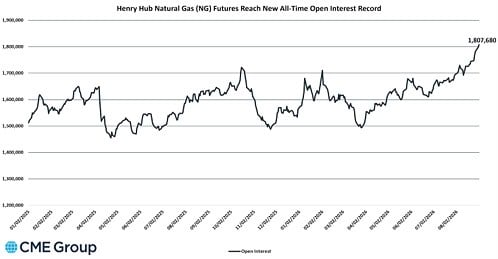
 Yesterday, the Pennsylvania Independent Fiscal Office (IFO) released its quarterly Natural Gas Production Report covering April through June 2026 (full copy below). Three numbers, all pointing in the same direction: PA drillers spudded (started drilling) 89 new horizontal wells in 2Q26, down 16 wells (-15.2%) from the 105 spudded in 2Q25. Production volume was 1,925 billion cubic feet (Bcf), down 32 Bcf (-1.6%) from 1,957 Bcf in 2Q25 — the lowest quarterly volume since 4Q24. And the average Pennsylvania spot hub price was $2.11 per MMBtu, down 27 cents (-11.3%) from last year’s $2.38.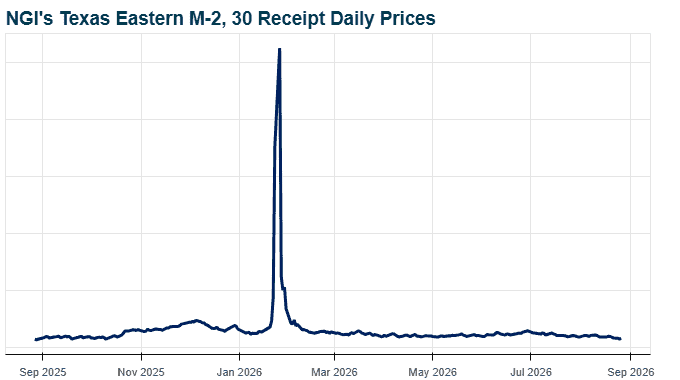
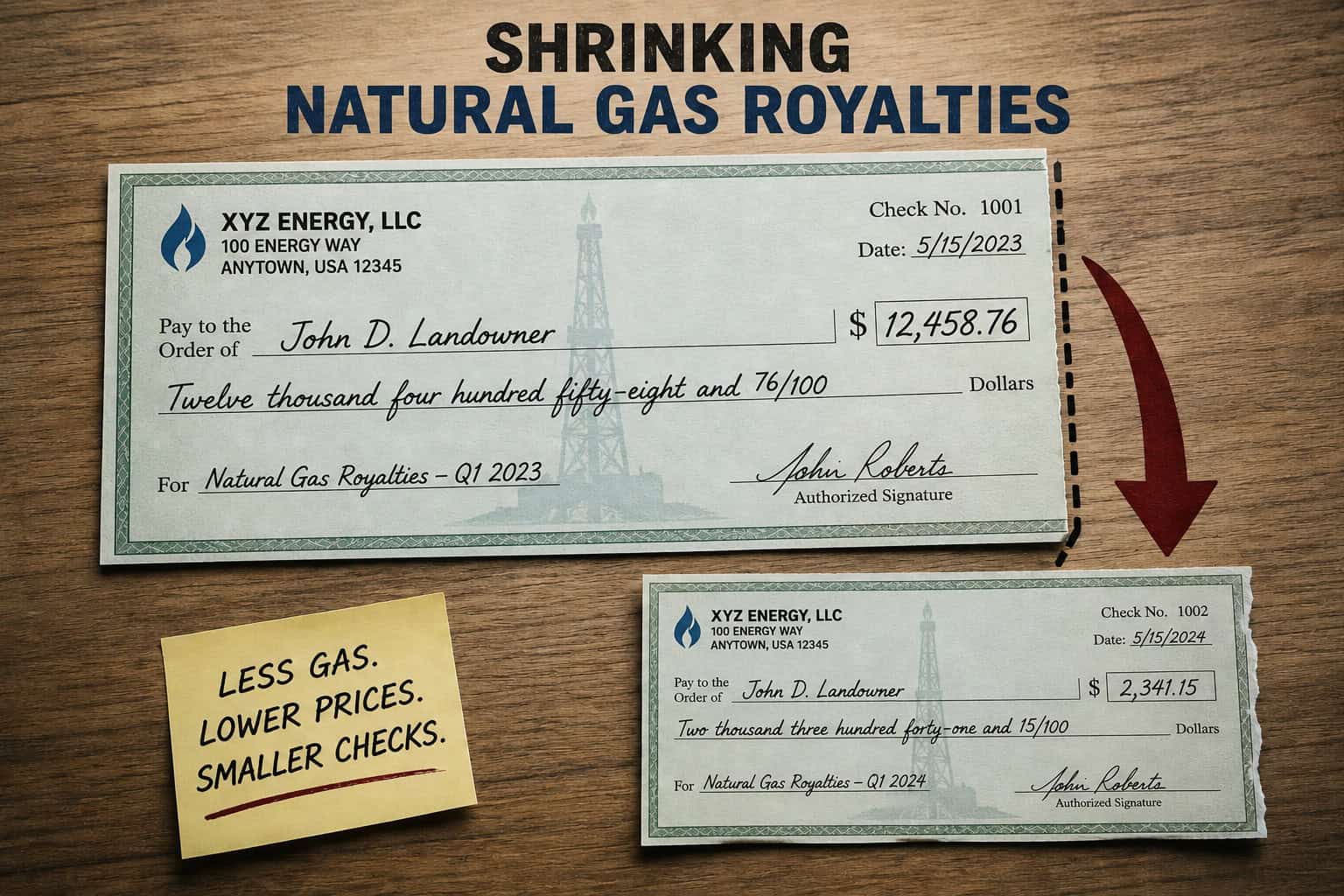
 Six days after WhiteHawk Minerals (NYSE: WHK) filed its first quarterly report as a public company, CEO Daniel Herz took the stage at EnerCom Denver and did something CEOs usually avoid: he put a dated natural gas price forecast on the record. He thinks $4 gas is the number that unlocks the next wave of supply, he doesn’t think the Haynesville gets where people expect, and he thinks the back half of this decade is going to be a roller coaster.
 The U.S. Energy Information Administration (EIA) released its August Short-Term Energy Outlook (STEO) on Tuesday — the agency’s monthly toss at the energy dartboard. Last month EIA nudged its Henry Hub natural gas price forecast up a few pennies. This month it took a real bite out of it. EIA now expects Henry Hub to average $3.44/MMBtu in 2026 (down from $3.67 last month) and $3.31/MMBtu in 2027 (down from $3.49). For the current quarter, the number is $2.87/MMBtu — a full 50 cents below what the agency predicted a month ago. The short version for landowners and royalty owners: gas is going to be cheap this fall. The longer version is more interesting, and it’s a story about where the gas is coming from.
  Want to know what the smartest money in the natural gas business expects to happen in the Northeast this winter? Don’t ask a politician. Look at the forward curve. As of the first of August, traders were pricing December-through-February gas at Algonquin Citygate (the Boston benchmark), Iroquois Zone 2 in New York, and three Tennessee Gas Zone 6 points in New England above $18 per MMBtu. At the other 77 pricing hubs Natural Gas Intelligence tracks across the U.S. and Canada, that same three-month strip averages under $5. Read that again. Same country. Same historically abundant supply. Roughly four times the price.
  The Intercontinental Exchange (ICE) — the outfit that owns the New York Stock Exchange and runs the world’s largest energy derivatives markets — put out a press release in mid-July containing a number that ought to catch the eye of every Marcellus/Utica producer and royalty owner. On July 1, open interest in ICE’s North American financial natural gas futures and options markets hit an all-time record of 13.4 million contracts, up 9% from a year ago. “Open interest” is just a fancy way of counting the bets still sitting on the table — contracts that have been opened and not yet closed out or settled. A record means more people than ever are using these markets to lock in a price ahead of time. Which raises the obvious question: lock in a price against what?
  Despite rising Northeast gas demand from retiring coal plants and new data centers, plus added Appalachian pipeline capacity, production growth isn’t guaranteed—operators prioritize capital discipline, debt reduction, and shareholder returns over volume. Appalachia has held flat at roughly 33-36 Bcf/d since 2020. Can anything tempt Marcellus/Utica drillers to drill and produce more than they are now? According to RBN Energy, sustained Henry Hub prices above $4/MMBtu (versus the current $3.50-$3.60 long-dated curve) and better takeaway infrastructure could be enough of a temptation.
  Global research firm Wood Mackenzie warns that a decade of cheap U.S. natural gas is ending, with Henry Hub prices—historically stuck between $2 and $4 per MMBtu—expected to approach $5 by 2035. The shift is driven by surging demand from LNG exports and AI data centers. U.S. LNG exports jumped from 0.5 Bcf/d in 2016 to 15.0 Bcf/d in 2025, with capacity expected to nearly double by 2031. Meanwhile, power-sector demand could require an additional 17 Bcf/d by the mid-2030s. Supply-side tailwinds—prime drilling acreage, cheap associated gas, and annual productivity gains—have largely run their course. WoodMac says $5 gas remains globally competitive.
  The U.S. Energy Information Administration (EIA) issued its latest monthly Short-Term Energy Outlook (STEO) on Tuesday. Using the official EIA dartboard, the STEO is the agency’s monthly best estimate of where energy prices and production will go over the next 12 months. There was a revision to the agency’s prediction about the spot price (at the Henry Hub) for natural gas in 2026 and 2027. Last month, the EIA predicted 2026 would end up with an average HH price of $3.50/MMBtu and 2027 would see an average of $3.18/MMBtu. On Tuesday, the EIA revised both numbers up. The agency sees an average price of $3.60 this year, up a dime from last month, and $3.46 in 2027, up a robust 28 cents.
  Here’s a story that may, at first glance, seem to have nothing to do with the Marcellus/Utica. Au contraire! The story of what’s happening with Permian drillers has a great deal to do with the M-U region. Although MDN frequently refers to the Haynesville Shale as the #1 competitor to the M-U because both plays target natural gas as the primary hydrocarbon, would it surprise you to learn that the Permian basin is the #2 producer of natural gas behind the M-U? And it’s catching up. Permian Basin drillers are experiencing starkly contrasting fortunes, reaping historic profits from war-driven oil price rallies while facing negative regional natural gas prices due to severe pipeline bottlenecks. To curb financial losses from associated gas, major producers like Permian Resources and Devon Energy are shutting in wells, while others resort to flaring to maintain more profitable crude production.