Through the Roof: Winter Storm, Bitter Cold Drive NYMEX to $6.80
 Yesterday, the natural gas price rocketship continued its flight into the stratosphere. U.S. natural gas futures soared Monday, with the front-month contract surging to a three-year high, closing at $6.80/MMBtu, as winter storm Fern swept across the country, driving up heating demand and threatening supply. Spot prices are literally through the roof, spiking to levels we’ve not seen in years. The deep freeze continues through the eastern half of the country at least until Feb. 9, according to NOAA’s temperature outlook. However, there are signs that a “sharp collapse” may soon unfold. Read More “Through the Roof: Winter Storm, Bitter Cold Drive NYMEX to $6.80”
 An Arctic blast in the U.S. has sent natural gas prices soaring to their highest levels since 2022, fueled by surging heating demand and production “freeze-offs” in major shale basins. As the world’s leading LNG exporter, supply disruptions in the U.S. now trigger global price hikes, particularly in Europe, which relies heavily on American gas following the loss of Russian pipeline flows. While increased global liquefaction capacity and floating inventories help manage volatility in LNG prices, the market has become structurally more interconnected. Consequently, when the U.S. freezes, the global LNG market catches a cold.
  As we predicted may happen in a post yesterday, the NYMEX “front month” natural gas futures price closed above $5 yesterday (see
  Old Man Winter has proven once again that he is the one in charge of natural gas prices. A cold blast now entering the Midwest and Northeast, which is moving in until early February (at least), is the reason for a dramatic jump in the NYMEX front-month futures contract price, rising 80.4 cents per MMBtu (26%) in one day, yesterday, to a closing price of $3.9070 MMBtu. It is the largest one-day percentage gain in four years, since January 2022. The price continued climbing this morning (Wednesday) and looks like it might flirt with $5.00!
  The U.S. Energy Information Administration (EIA) issued its latest monthly Short-Term Energy Outlook (STEO) on Tuesday. The STEO is the agency’s monthly best estimate of where energy prices and production will head over the next 12 months. The EIA published its first energy-sector forecasts through 2027. For natural gas, the EIA predicts the U.S. benchmark Henry Hub spot price to decrease about 2% to just under $3.50 per million British thermal units (MMBtu) in 2026, then rise sharply in 2027 to just under $4.60/MMBtu. The reason for the sharp increase next year? Growth in demand—led by expanding LNG exports and more natural gas consumption in the electric power sector—will outpace production growth.
 Henry Hub spot gas prices “collapsed to $2.86 per MMBtu” on Monday. Less than a month ago, on Dec. 8, the HH spot price was $5.01. Yeah, that constitutes a collapse! What about across the Marcellus/Utica region? The Appalachian Regional Average yesterday (as near as we can tell) was $2.28/MMBtu, down from $4.80 on Dec. 8. Also a collapse. Why the drop in the M-U? We’ll tackle some reasons below. What about the NYMEX futures price for natgas? That price was $3.35 yesterday, down for the fifth consecutive trading session and the lowest since Oct. 28.
 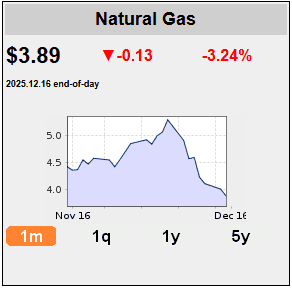 You knew it had to happen. After the meteoric rise of the NYMEX “front month” futures contract from bumping along under $3 just a couple of months ago to hitting a 52-week high of $5.289 on Friday, Dec. 5, 2025, the drop has been almost as rapid. We first crashed back into the $4 range, and as of yesterday, the price sank below $4, closing at $3.8860. The stated reason is a warm weather forecast for the rest of this month. The NOAA Climate Prediction Center (what an oxymoron that is!) shows that the vast majority of the country will experience much warmer-than-average temperatures through Dec. 30.
  We are checking in as we regularly do on the price of natural gas—both the futures price and the spot price in the Marcellus/Utica. Yesterday, the NYMEX futures price for natural gas got clobbered, falling 37.7 cents (-7.13%) to $4.9120 per million British thermal units (MMBtus). We’re still delighted that the price is so high! Don’t be bummed. But why did it fall? In a word, a new weather forecast showed U.S. temperatures warming mid-month, potentially curbing natgas heating demand. It can’t stay cold forever. (We woke up to 0 on the thermometer here in the Southern Tier of New York. We’re ready for warmer weather!) What about the spot (physical) price at various trading hubs in the M-U region? They’ve gone down a bit since last week, but we’re still thrilled where they are, too.
 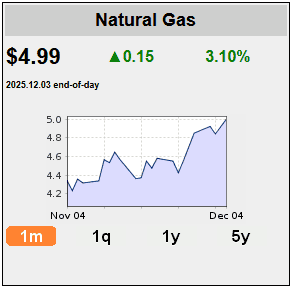 Yesterday, the NYMEX “front-month” futures price for natural gas closed up 15 cents at $4.995 (call it $5), which is the highest closing price for NYMEX in nearly three years (since Dec. 27, 2022). Intraday trading of the front-month contract floated above $5 at points. Weather forecasts of impending frigid weather were the main reason for the increase. Futures prices are now up more than 60% compared with a year ago. “Forecasts for the coldest December since 2010 may tip storage into a deficit by Christmas,” trading firm EBW Analytics wrote in a note to clients. Fewer molecules with more demand equals higher prices. As for the spot price at trading hubs in the Marcellus/Utica region, averaging all of them together, the price closed yesterday at $4.74, nearly at parity with the Henry Hub spot price of $4.87. That’s unheard of!
  In the space of two months, the NYMEX “front month” natural gas futures contract went from bumping around under $3/MMBtu (million British thermal units) to the mid-$4 range. It’s been an amazing ride. And it would be easy to think “we’ve arrived” and can kiss $3 territory goodbye. That would be a mistake. While we earnestly hope the price will remain where it is, in the $4 range, analysts, including EBW Analytics Group, caution that for U.S. natural gas prices, “immediate-term volatility risks remain high into December expiration.” Volatility means the price can swing wildly at a moment’s notice. Where is the NYMEX and spot/physical price now? And where might prices go over the next couple of weeks?