
Record “Open Interest” Trading Across North American NatGas Markets
 We spotted a press release by the Intercontinental Exchange (ICE) announcing record “open interest” across its global energy markets in May 2026, reaching 130.5 million contracts. It’s all highly technical financial jargon. We decided to research it to figure out (a) what it is saying, and (b) how/why it’s important for the Marcellus/Utica. We’re glad we did. The press release from ICE—one of the largest financial exchanges in the world—announces that the global energy market is currently seeing a historic amount of financial activity. In short, more energy companies, investors, and utilities than ever before are using financial contracts to lock in future natural gas and electricity prices. Read More “Record “Open Interest” Trading Across North American NatGas Markets”
 The U.S. Energy Information Administration (EIA) issued its latest monthly Short-Term Energy Outlook (STEO) yesterday. Using the official EIA dartboard, the STEO is the agency’s monthly best estimate of where energy prices and production will go over the next 12 months. There was a revision to the agency’s prediction about the spot price (at the Henry Hub) for natural gas in 2026 and 2027. For the second month in a row, the EIA has significantly lowered its predictions for the HH spot price. Last month, EIA predicted the spot price would average $3.67 per million British thermal units (MMBtus) this year, and $3.59 next year (see
 Following the February 28 closure of the Strait of Hormuz, global and U.S. natural gas prices have sharply diverged. The shutdown halted roughly 20% of global LNG supplies, primarily from Qatar, forcing Asian and European buyers to scramble for replacement cargoes. Consequently, European TTF and Asian JKM benchmark prices surged 35% ($14.80/MMBtu) and 51% ($16.02/MMBtu), respectively. In stark contrast, U.S. Henry Hub prices fell 9%. Because U.S. LNG export terminals are already operating at near-maximum capacity, producers cannot significantly increase exports to capture these high global prices. This leaves ample gas domestically, insulating the U.S. market from international price volatility.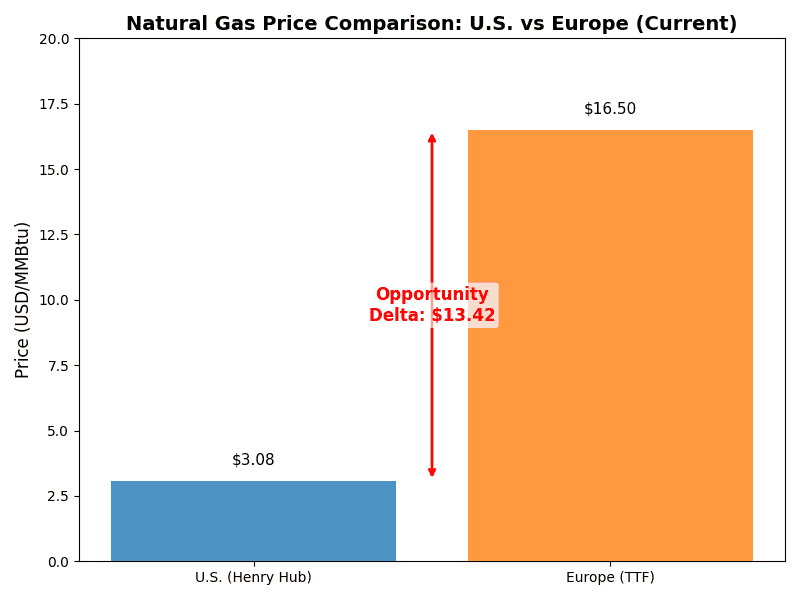

 In January 2026, New England experienced record-high natural gas prices triggered by an intense cold snap. On January 27, wholesale electricity costs reached $441.8/MWh, a significant jump from the previous January’s average of $135.08/MWh. The problem is not enough natural gas pipelines. But that’s not what the dunderheads who run the blue states of New England believe. They think natgas is the problem and that more unreliable renewables are the solution. You can’t fix stupid, but you can vote it out of office.
  Hedging is the practice of locking in a price now to sell gas you will produce in the future. We’ve written a fair bit about hedging (
 Natural gas markets are currently facing significant storage deficits for the first time in a year, following the severe disruptions caused by Winter Storm Fern. Record-breaking withdrawals, including a weekly high of 360 Bcf, have pushed inventories 130 Bcf *below* the five-year average due to spiked heating demand and production freeze-offs. This supply-demand imbalance triggered a 300% surge in Henry Hub prices, which peaked at nearly $14.00. However, as production recovers and forecasts predict warmer late-February temperatures, analysts expect market volatility to stabilize and cash prices to gradually converge with front-month contracts as supply concerns ease.
  Natural gas futures suffered a historic 26% collapse—the steepest one-day percentage drop since 1995 (over 30 years!)—as the most-active “front month” contract plunged over a dollar to close at $3.237/MMBtu. This dramatic retreat was fueled by forecasts of “well above normal” temperatures across the Eastern U.S. and a recovery in production following recent freeze-offs, both of which point toward a looming inventory buildup. Although analysts at NatGasWeather.com suggest the market may have overshot the actual data, the combination of a thawing climate and stabilizing supply clearly spooked investors enough to trigger this record-breaking slide.
  Yesterday, the NYMEX natural gas March futures contract became the “front month” contract after the previous February contract expired. As we reported, the February contract went into the stratosphere, closing at $7.46/MMBtu based on something called a short squeeze (see
  A pretty unique situation is happening with the price of natural gas, both the NYMEX futures price and the spot (cash) price. Yesterday was the last day for the NYMEX February contract as the “front month.” The price, already high, rose further, adding 50.6 cents from the previous day to close at $7.46 per million British thermal units (MMBtu). It is the highest settlement value since Wednesday, Sept. 21, 2022. However, yesterday the physical spot (cash) price for natural gas crashed back down to earth. The benchmark Henry Hub lost about 75% of its value yesterday. Today, the March NYMEX contract becomes the “front month.” As of this morning, the March contract is trading around $3.80/MMBtu. The reason the NYMEX soared again yesterday was a short squeeze.