
Butler County | Energy Companies | Industrywide Issues | Lease & Royalty Payments | Litigation | Pennsylvania | XTO
XTO Wins PA Royalty Case, Then Asks Judge to Undo the Judgment
 In March, MDN told you that Butler County landowners were appealing after a federal judge tossed their royalty class action against XTO Energy (see Landowners Appeal Dismissal of XTO Lawsuit re Royalties in W. Pa.). That appeal is now on hold — because on Aug. 6, the same judge wiped out his own judgment and declared it void. And the party that asked him to do it was XTO, which won the case. Read More “XTO Wins PA Royalty Case, Then Asks Judge to Undo the Judgment”
 A free-market think tank in New Jersey has published a report that says out loud what MDN readers figured out years ago: the Garden State keeps its lights on with natural gas — a lot of it, Marcellus gas — while chasing a 2035 clean-electricity mandate propped up by offshore wind that does not exist and batteries that have barely been built. The report, Reliability Before Retirement: Reassessing New Jersey’s 2024 Energy Master Plan, comes from the Garden State Initiative (GSI), a Morristown-based nonprofit that pushes free-market policy in one of the least free-market states in America. Author Anurag Bhat is no fracking cheerleader — he’s a sustainability-credentialed analyst who co-wrote GSI’s 2025 critique of the same Energy Master Plan (EMP). Which makes the findings that much more useful to us.
  Epsilon Energy (NASDAQ: EPSN), the non-op partner that bankrolls a chunk of Expand Energy’s Marcellus drilling in Susquehanna County, PA, reported Q2 2026 results last week showing Pennsylvania gas production down sharply — but for a reason that’s actually good news for the wells coming next. Epsilon also sold off a package of small Marcellus overriding royalty interests for $3.9 million and confirmed five new wells are headed for completion by December, which should boost both production and Auburn Gas Gathering System throughput.
  The Marcellus/Utica region received 8 new drilling permits last week, August 3 – 9, down 7 from two weeks ago. Pitiful. (Cue Linda Ronstadt’s “
 Back in March, we brought you news that the Trump administration had announced “South Mon,” a $17 billion, 4.3-gigawatt (GW) natural gas-fired power hub headed for southwestern Pennsylvania, funded as part of Japan’s $550 billion U.S. investment commitment (see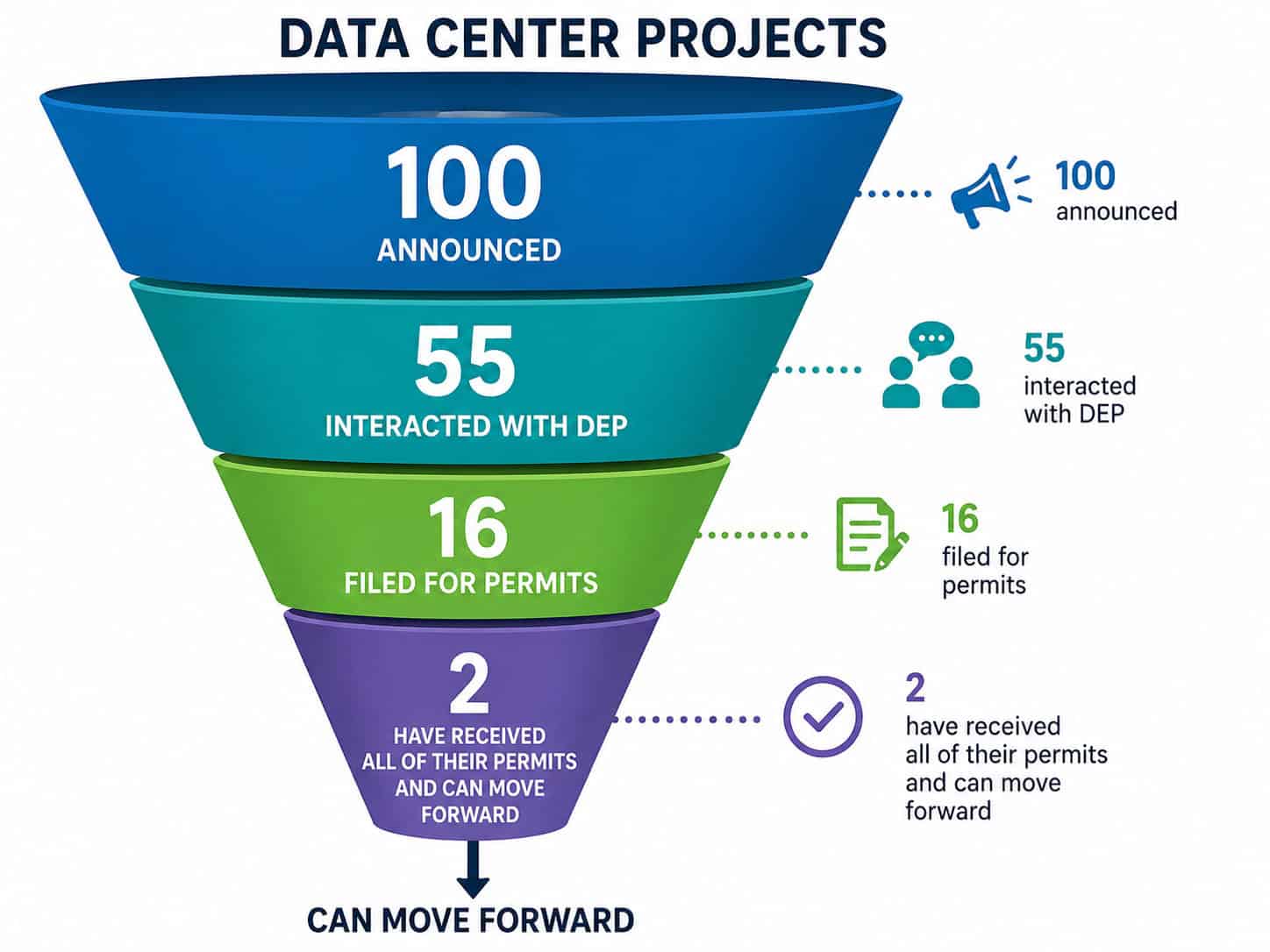
 Two panels at
  Pennsylvania got off easy in the 2026-27 budget. Only one data center bill made it into law, and it was a toothless one. But the Pittsburgh Business Times reports Harrisburg is loading up for another round this fall — and this time the antis have a working blueprint to copy. It’s called New York, where Gov. Kathy Hochul banned new hyperscale data centers last month, and where the anti-fracking crowd has already spent a decade proving what happens when a state tells industry to go away.
  A Nasdaq-listed company you’ve almost certainly never heard of says it has signed a binding term sheet to buy roughly 1,800 acres of unleased Marcellus mineral rights in “northern Pennsylvania,” drill a dozen wells on it, burn the gas in on-site turbines, and run a 200-megawatt AI data center behind the meter — with a stretch goal of 1 gigawatt. The company, Alpha Compute Corp. (Nasdaq: ALP), never says which county. We think we’ve figured it out: Tioga County. Here’s what’s actually known, what we deduced, and what nobody should be printing as fact yet.
  Devon Energy and Williams spent the last week of July doing something that doesn’t show up on a reserve report: teaching northeastern Pennsylvania teenagers how the gas business actually works. Then, on July 30, the Pennsylvania Chamber Foundation named both companies “Greatest Places to Intern in PA.” Six days later, Devon CEO Clay Gaspar told analysts he’s fielding “no shortage of incoming phone calls” about which assets he might sell — with the Marcellus at the top of everybody’s list. Which raises a question nobody on Wall Street is asking: who inherits the workforce machine?
  A federal magistrate judge has excluded six people (well, five leases covering six people and one municipal authority) from the 2,300-plus-member class suing XTO Energy over royalty underpayments in Butler County — not because XTO won a big legal fight, but because both sides agreed these particular leases require arbitration, not a courtroom. This is the latest chapter in Kriley v. XTO Energy Inc., the six-year-old Butler County royalty case MDN has followed since February (see
  Last week, the Pennsylvania Marcellus lost one rig, now down to 16 active rigs after running 17 rigs for 12 weeks in a row. Bummer. Ohio lost a rig two weeks ago and didn’t pick it back up last week, remaining at 10 active rigs for the second week. And West Virginia picked up Ohio’s lost rig two weeks ago, boosting its number to 9 active rigs, maintaining that number last week. All told, the M-U operated 35 rigs last week, which is 21 fewer than our biggest rival (for money and attention), the Haynesville, which operated 56 rigs last week.
  With Devon Energy’s first full quarter as a combined Devon-Coterra company now in the books, the numbers on the former Coterra Marcellus assets tell an interesting story — one that lines up with what MDN has been reporting for months about activist pressure to sell the Appalachian position. Devon reported second-quarter 2026 earnings on August 4, followed by an analyst call on August 5. Buried in the supplemental tables and sprinkled through management’s answers to Wall Street analysts is a clear picture of how the Marcellus fits (or doesn’t) into the new, Permian-obsessed Devon. Below we break down what the company said — and didn’t say — about its Northeast Pennsylvania gas position, plus the latest on the broader portfolio review that has investors like Kimmeridge Energy pushing for a Marcellus sale.
  Two months ago, we told you PA Attorney General Dave Sunday had charged Eureka Resources with seven crimes over years of leaking tanks at its Standing Stone plant in Bradford County (see
  Amazon Web Services (AWS) is now in talks to build a data center campus next to the Homer City Energy Campus in Indiana County, PA — meaning the company that already pledged $20 billion for data centers in eastern PA (see our prior coverage