
Charm Offensive Flops: Va. Leaders Pile on Dominion/NextEra Merger
 So much for the charm offensive. Five weeks after NextEra Energy and Dominion Energy sweetened their $67 billion merger with bigger bill credits, 1,000 new jobs and a shiny new Richmond office tower (see Sweeter Deal: NextEra/Dominion Add Credits, Jobs to Woo Virginia), Virginia’s top leaders and the state’s own utility regulators are lined up against the deal as it stands. On Monday, staff at Virginia’s State Corporation Commission (SCC) recommended rejecting the deal unless the companies accept a long list of new conditions. That same day, Gov. Abigail Spanberger filed expert testimony calling for a six-year freeze on residential base-rate increases and nearly triple the bill credits. On Tuesday, Attorney General Jay Jones and Lt. Gov. Ghazala Hashmi piled on. Is the deal dead? No. Is it in trouble? Yes. And that raises a question MDN readers should think about: what happens if it falls apart? Read More “Charm Offensive Flops: Va. Leaders Pile on Dominion/NextEra Merger”
 Back on Sept. 1, we told you Dominion Energy’s monster 3,000-megawatt (3 gigawatt) gas-fired power plant in Cumberland County, Virginia, had cleared its first hurdle when the county planning commission voted 5-1 to recommend approval (see
 NextEra Energy and Dominion Energy, which want to combine into the country’s biggest electric utility in a $67 billion deal, launched a full-blown charm offensive (i.e., piles of money) aimed at Virginia yesterday. The two companies unveiled what they call a “transformational” benefits package that doubles bill credits for homeowners (from two years to four), promises 1,000 new direct jobs, and throws in a brand-new office tower in downtown Richmond, paid for by NextEra shareholders. Why all the sweeteners? Because Virginia Gov. Abigail Spanberger says she is “deeply skeptical” the deal is good for her state, and she has formally inserted herself into the regulatory review. Here’s what’s in the new package, how it’s being received, and why it matters to Marcellus/Utica drillers.
 We told you back in July that the two landowners fighting the 2,180-megawatt (MW) Canadys Station gas-fired power plant in South Carolina’s Lowcountry were teeing up an appeal straight to the state Supreme Court (see
 Last week we told you Dominion Energy cleared its first hurdle for the monster 3,000-megawatt (3 gigawatt) Cumberland Energy Center in Cumberland County, Virginia (see
 Virginia Democrats have spent the summer hammering the proposed $67 billion NextEra-Dominion merger — letters to regulators, a 64-question interrogation, a statewide listening tour, a demand for a special session. Last week the pile-on reached the very top when House Speaker Don Scott (D-Portsmouth) filed his own letter with the State Corporation Commission (SCC). Here’s the twist: the same Democrat leaders doing the loudest complaining just refused to do the one thing that would actually slow this deal down.
 Dominion Energy reported second-quarter 2026 results on July 31, and while Wall Street focused on the penny-counting, there were three items in the release and on the analyst call that matter to Marcellus/Utica producers, midstreamers, and landowners: two new gas-fired power plants moving into permitting, a merger timeline that’s now locked in at the state level, and a nine-figure write-off on renewable assets that tells you which way the wind is actually blowing.
 Two days ago, we brought you word of a big new gas-fired power plant headed for Dominion Energy’s Mt. Storm complex in Grant County, WV (see
 Back in May we brought you the news that NextEra Energy is buying and merging with Dominion Energy in a deal valued around $66.8 billion (see
 There’s terrific news brewing in Grant County, West Virginia — with an asterisk roughly the size of a cooling tower. Word circulated over the weekend that Dominion Energy plans to build a brand-new natural gas-fired power plant at its Mt. Storm complex, the same site where three coal-fired units have been cranking out electrons since 1965. The key detail: the gas plant would run alongside the coal units, not replace them. That’s more power, not swapped power. We like that math.
 In June, members of the South Carolina Public Service Commission (PSC) approved a revised project proposal to build a 1,020-megawatt (MW) gas-fired power plant in the state’s Lowcountry, in Colleton County (see
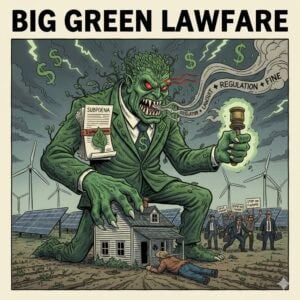 Over the years, we have chronicled the far-left Chesapeake Bay Foundation’s (CBF) lawfare against fracking, gas-fired power plants, and pipelines (
 In February 2024, members of the South Carolina Public Service Commission (PSC) approved a proposed project to build a 1,020-megawatt (MW) gas-fired power plant in the state’s Lowcountry, in Colleton County (see