
Anti-Drilling/Fossil Fuel | Enbridge | Energy Services | Industrywide Issues | North Carolina | Pipelines | Regulation
Chatham County, NC Commissioners Vote to Fight Enbridge Pipe
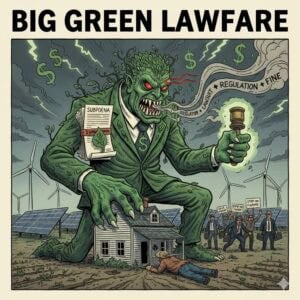 Chatham County, North Carolina’s Board of Commissioners last week unanimously passed a resolution opposing Enbridge Gas North Carolina’s proposed 28-mile natural gas pipeline from Siler City to Moncure. This isn’t a garden-variety “we don’t like it” resolution. It authorizes the county to actively fight the project by challenging environmental permits, teaming up with like-minded groups, working the media, organizing residents, and coaching landowners on how to resist condemnation. In other words, a county government just signed itself up as a Big Green activist group, with taxpayers picking up the tab. Read More “Chatham County, NC Commissioners Vote to Fight Enbridge Pipe”
 Here’s one you don’t see every day. The North Carolina Utilities Commission (NCUC) has said “no” to a Duke Energy gas-fired power plant. On Sept. 18, the commission voted 3-1 to deny Duke Energy Progress a certificate of public convenience and necessity (CPCN, the state’s permission slip to build) for a 255-megawatt (MW) gas-fired “peaker” turbine at the Smith Energy Complex in Richmond County. Price tag: $584 million. The twist? The three commissioners who voted no are all Republican appointees, and the lone vote in favor came from a Democrat. Nobody on the commission said gas is the problem. The problem, they said, is data centers: how much of this plant’s power data centers will use, and who would pay for it.
  Duke Energy just handed Marcellus/Utica producers something more useful than another press release. It handed us a calendar. Back in July we told you Duke had picked its sites: two 1,360-megawatt (MW) combined-cycle gas plants on its Davie County, North Carolina parcel, and the largest liquefied natural gas (LNG) storage facility in company history directly across the Yadkin River in Davidson County (see
  Back in May, we told you about a new 28-mile intrastate natural gas pipeline Enbridge Gas North Carolina (EGNC) wants to build in Chatham and Lee counties, running from Siler City southeast to Moncure (see
  Back in May we brought you the news that NextEra Energy is buying and merging with Dominion Energy in a deal valued around $66.8 billion (see
 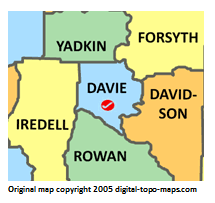 In January, MDN broke the news that Duke Energy was eyeing a 1,360-megawatt (MW) gas-fired power plant on 1,600 acres in Davidson County, North Carolina (see
 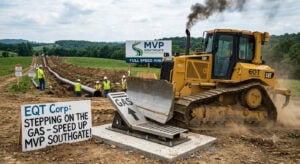 Yesterday, EQT Corporation, the largest Marcellus/Utica-only producer by far, issued its second-quarter 2026 update. We’re pulling out what we consider to be the biggest news from that update for this separate post. During an earnings call with analysts, EQT CEO Toby Rice said that since the Federal Energy Regulatory Commission (FERC) approved the company’s 31-mile Mountain Valley Pipeline (MVP) Southgate project from southern Virginia into northern North Carolina in June (see
  Williams’ Transco Southeast Supply Enhancement Project (SESE) is a 55-mile, 42-inch-wide pipeline that will run through Pittsylvania County, Virginia, and Rockingham, Guilford, Forsyth, and Davidson counties in North Carolina. Construction for SESE started March 2, 2026, according to FERC filings. Transco (Williams) received its final federal authorization and a Notice to Proceed, and crews mobilized in early spring. Initial activities have included tree felling, installation of acoustic barriers, and test drilling in preparation for blasting. Antis finally gave up trying to block construction of SESE in June (see
  This is a momentous occasion. Yesterday, the Federal Energy Regulatory Commission (FERC) issued a “Notice to Proceed with Construction” order authorizing Mountain Valley Pipeline (owned by EQT Corporation) to proceed with construction of MVP Southgate pipeline in North Carolina. This follows FERC granting permission to begin building Southgate in Virginia in April (see
  Williams’ Transco Southeast Supply Enhancement Project (SESE) is a 55-mile, 42-inch-wide pipeline that will run through Pittsylvania County, Virginia, and Rockingham, Guilford, Forsyth, and Davidson counties in North Carolina. It will provide natural gas to Duke Energy customers. Big Green sued to overturn a federal water quality permit issued by the U.S. Army Corps of Engineers. Big Green wanted the court to block construction until the full case could be heard. In May, a three-judge panel from the U.S. Court of Appeals for the Fourth Circuit (4th Circuit) rejected arguments Big Green put forward that claimed the Army Corps’ decision was “arbitrary and capricious” and refused to block construction (see
  The same three judges from the U.S. Court of Appeals for the Fourth Circuit who blocked the 303-mile Mountain Valley Pipeline (MVP) for *years* suddenly changed course in late April, ruling on an extension of MVP into North Carolina called Southgate. Big Green, represented by the Sierra Club and Appalachian Voices, sued to block a permit issued by North Carolina regulators for the Southgate project. While the three judges grumbled and complained about Southgate during oral arguments (see
 It seems that not all of the judges who sit on the U.S. Court of Appeals for the Fourth Circuit (4th Circuit) are clowns, the way the three judges who oversee cases dealing with the Mountain Valley Pipeline (MVP) Southgate project are (see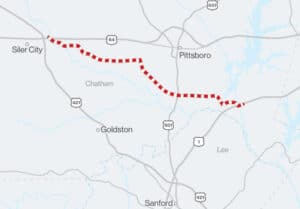
 Just yesterday, MDN told you that three left-wing judges from the 4th Circuit (“Circus”) who hate the Mountain Valley Pipeline (MVP) were back at it, badmouthing an extension of MVP into North Carolina, called Southgate (see