
Energy Companies | Energy Services | EQT Corp | Equitrans/EQT Midstream | Industrywide Issues | Montgomery County | Pipelines | Virginia
MVP Boost Update: FERC Decision Near, State Permit Frozen
Mountain Valley Pipeline’s (MVP) plan to push more natural gas through its existing pipe, a project called MVP Boost, is closing in on a federal decision. FERC staff have already given the project a clean bill of environmental health. But back in Virginia, Boost is stuck in neutral, all because one county can’t seem to make up its mind. The centerpiece of Boost is a brand-new compressor station in Elliston (Montgomery County), Virginia. It’s called the Swann Compressor Station, named after Pittsburgh Steelers Hall of Famer Lynn Swann (MVP’s operator is based in Pittsburgh). Right now, Swann is having trouble getting off the line of scrimmage. Read More “MVP Boost Update: FERC Decision Near, State Permit Frozen”
 When Appalachian gas prices fall into the basement, EQT turns down the valves, and CEO Toby Rice says the strategy is paying off. In an interview with Reuters on Tuesday, Rice put a dollar figure on it for the first time: a little over $200 million a year in benefit from selling less gas when prices are low and more when they’re high. He also said EQT, the country’s No. 2 gas producer, will pump more gas in 2026 than last year while spending less to do it. Rice talked up the company’s proposed POWER Pipeline to Ohio, its Mountain Valley Pipeline expansions, and a new 10-year LNG supply deal with Lithuania. His outlook for global gas demand is, let’s say, very bullish.
  EQT is planning another pipeline — and this one is big. Through a brand-new subsidiary called Appalachian Transmission Gateway LLC (ATG), the Marcellus/Utica’s largest driller has opened bidding on the “POWER Pipeline,” a 42-inch, 50-mile line that would carry a full 1 billion cubic feet per day (Bcf/d) of gas from Greene County, Pennsylvania, west to the Clarington hub in Monroe County, Ohio. The open season quietly began Aug. 26 and runs through Oct. 26. We found no press release announcing it — the notice simply went up, and the trade press caught it a week later.
  Sixty-two days after a wastewater pipeline let go at Equitrans’ Richter impoundment in Aleppo Township, Greene County, the Pennsylvania Dept. of Environmental Protection (DEP) went back out to look at the site on August 18 — and didn’t like what it found. Contaminated water is still moving, soil is still dirty, and DEP says the cleanup has largely stalled. Quick refresher for those just tuning in. On June 17, 2026, Equitrans Water SVC (PA) LLC — the water-handling arm of EQT — reported a wastewater release from a pipeline tied to its Richter Shale Gas Water Impoundment while the site was being reclaimed. DEP issued a cleanup order on June 30 requiring the company to stop contaminated water from migrating off site and from reaching ground or surface water.
 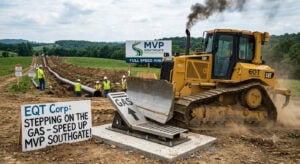 Yesterday, EQT Corporation, the largest Marcellus/Utica-only producer by far, issued its second-quarter 2026 update. We’re pulling out what we consider to be the biggest news from that update for this separate post. During an earnings call with analysts, EQT CEO Toby Rice said that since the Federal Energy Regulatory Commission (FERC) approved the company’s 31-mile Mountain Valley Pipeline (MVP) Southgate project from southern Virginia into northern North Carolina in June (see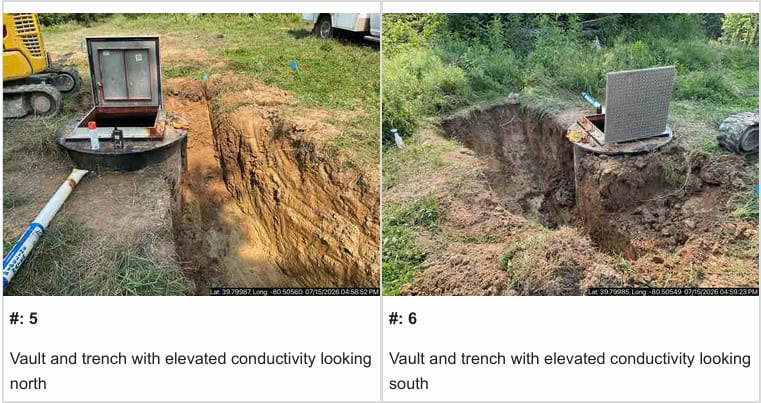
 This is a momentous occasion. Yesterday, the Federal Energy Regulatory Commission (FERC) issued a “Notice to Proceed with Construction” order authorizing Mountain Valley Pipeline (owned by EQT Corporation) to proceed with construction of MVP Southgate pipeline in North Carolina. This follows FERC granting permission to begin building Southgate in Virginia in April (see
  The same three judges from the U.S. Court of Appeals for the Fourth Circuit who blocked the 303-mile Mountain Valley Pipeline (MVP) for *years* suddenly changed course in late April, ruling on an extension of MVP into North Carolina called Southgate. Big Green, represented by the Sierra Club and Appalachian Voices, sued to block a permit issued by North Carolina regulators for the Southgate project. While the three judges grumbled and complained about Southgate during oral arguments (see
  Just yesterday, MDN told you that three left-wing judges from the 4th Circuit (“Circus”) who hate the Mountain Valley Pipeline (MVP) were back at it, badmouthing an extension of MVP into North Carolina, called Southgate (see
  In July 2024, EQT Corporation closed on a $5.4 billion deal to buy back the midstream division it had spun off in 2018 (see
  On Tuesday, seven radicalized Big Green groups filed a court challenge to the Federal Energy Regulatory Commission’s (FERC) authorization for Mountain Valley Pipeline, LLC, to construct the MVP Southgate gas pipeline. The petition for review, filed by the Southern Environmental Law Center (SELC), Appalachian Mountain Advocates, and Sierra Club in the United States Court of Appeals for the District of Columbia Circuit (DC Circuit), asks the court to vacate the amended certificate of convenience and public necessity issued by FERC in December 2025.
 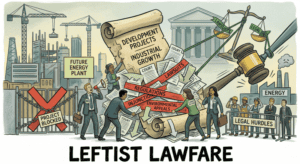 Several Big Green groups, including the Sierra Club, Wild Virginia, Appalachian Voices, and the Center for Biological Diversity, have filed a legal challenge against a permit issued by Virginia for the Mountain Valley Pipeline (MVP) Southgate extension. The Virginia Department of Environmental Quality (DEQ) approved a water permit for the project in January 2026. Big Green radicals argue that the pipeline “threatens” 138 streams, wetlands, and regional drinking water supplies. It’s the typical lawfare tactic used by the left to stall work on projects, hoping to delay them long enough that the builder (EQT in this case) gives up. Or if the builder won’t give up, they have to pay double or triple the price to construct it. That’s the game the radicals are playing.
  In August, the parents of four children under the age of 18 (from three families) filed a lawsuit on their kids’ behalf against EQT subsidiaries EQT Production Company and EQT XL Midstream Operating, claiming that emissions from a nearby compressor station and nearby shale wells operated by EQT have led to severe health-related problems for the kids (see