
Sweeter Deal: NextEra/Dominion Add Credits, Jobs to Woo Virginia
 NextEra Energy and Dominion Energy, which want to combine into the country’s biggest electric utility in a $67 billion deal, launched a full-blown charm offensive (i.e., piles of money) aimed at Virginia yesterday. The two companies unveiled what they call a “transformational” benefits package that doubles bill credits for homeowners (from two years to four), promises 1,000 new direct jobs, and throws in a brand-new office tower in downtown Richmond, paid for by NextEra shareholders. Why all the sweeteners? Because Virginia Gov. Abigail Spanberger says she is “deeply skeptical” the deal is good for her state, and she has formally inserted herself into the regulatory review. Here’s what’s in the new package, how it’s being received, and why it matters to Marcellus/Utica drillers. Read More “Sweeter Deal: NextEra/Dominion Add Credits, Jobs to Woo Virginia”
 Virginia is officially rejoining the Regional Greenhouse Gas Initiative (RGGI) carbon tax scheme this July after a liberal court deemed its previous withdrawal under former Governor Glenn Youngkin unlawful. This reentry forces utilities like Dominion Energy to resume purchasing carbon credits—modern-day indulgences for the “sin” of emitting carbon dioxide. The cost will be passed on to ratepayers through monthly bill increases (see
  Last year, MDN warned readers that the newly elected, incoming governor of Virginia, Abigail Spanberger, is a radical left Democrat (see
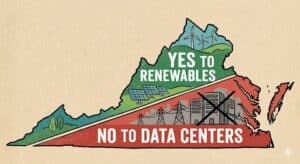
  Virginia Senate Bill 253, introduced by State Senator Louise Lucas (D-Portsmouth), aims to shift energy infrastructure costs from residents to data centers, potentially saving households a whopping $65 annually. The legislation requires data centers—which account for 20% of Dominion Energy’s sales—to fund their own electrical substations and cover specific “capacity costs.” If the bill becomes law and the proposals in it receive approval from the State Corporation Commission (SCC), the typical monthly energy bill for data centers would rise by about 16%, while the typical bill for residential and other customers would decrease by 3% to 3.5%. Looks like Virginia, with more data centers than any other state in the union, is now closed for data center business. Too bad.
 Democrats in Virginia are experiencing political ecstasy at the prospect of reversing four years of common-sense energy policies under outgoing Governor Glenn Youngkin. Gov. Youngkin removed the state from the odious Regional Greenhouse Gas Initiative (RGGI) carbon tax scheme. Incoming Gov. Abigail Spanberger has pledged to re-enroll the state in the program. Youngkin vetoed bills that would have favored unreliable renewable energy. Now, the Dems will not only have Spanberger as Governor, but hardened leftist Ghazala Hashmi as Lt. Governor, and a strong majority in both chambers of the legislature. They are already planning to reintroduce bills favoring renewables and blocking new data centers. It’s a crying shame what Virginia has done in electing these radicals to lead it.
 Those who support natural gas and who live (and work) in Virginia apparently labor under a serious delusion: That far-left Democrat Governor-elect Abigail Spanberger will support expanding (or even the continued use of) natural gas in the state. On the campaign trail in August, Spanberger said that natural gas is going to “be part of the energy mix into the future.” And people actually believed her. Suckers. Those who support natgas are reminding Spanberger of her promise regarding natgas. And now that she’s been elected? “Spanberger’s campaign did not return a request for comment on the future of natural gas in Virginia.” She’s ghosting natgas supporters. Suprised? We aren’t.
  A new group, the
  We spotted an interesting court ruling in Virginia with the potential to impact midstream (pipeline) companies in the state. The case is Zinner v. Washington Gas Light Co. On July 1, the Court of Appeals of Virginia ruled that a proposed Washington Gas Light (WGL) natural gas pipeline project is a “distribution” and not a “transmission” pipeline project. In Virginia, distribution pipelines are exempt from needing to conform to local municipal ordinances, while transmission lines are subject to such ordinances.
  The Federal Energy Regulatory Commission (FERC), the North American Electric Reliability Corporation (NERC), and its Regional Entities recently issued a report reviewing how the country’s Bulk-Power System performed well during successive cold weather events in January 2025. The report found that the system was a stellar performer, with no significant issues in either the natural gas or electric systems. The 303-mile Mountain Valley Pipeline (MVP) was called out for its “crucial role” in helping to keep the lights on throughout the Atlantic Coast region during the coldest parts of winter.
  During last week’s first quarter update from Williams, management announced a new project called the Transco Power Express expansion. The project will expand Transco capacity by a whopping 950 MMcf/d (nearly a full Bcf) to flow more Marcellus/Utica molecules to the power-hungry Virginia market. The Virginia market is power hungry because of the data centers already built there, and the many more planned for the state. The Power Express project, if built, is expected to go online in the third quarter of 2030 (five years from now).
  Oh, the many different “colors” of hydrogen (and natural gas). The wacko left dreams up all sorts of labels for the things they do and don’t like, hoping to influence the weak of mind to buy into their psychoses. The Appalachian Regional Commission (ARC), a U.S. federal–state partnership that works with the people of Appalachia to create opportunities for self-sustaining economic development and improved quality of life, has just awarded a $1.3 million grant to Virginia Tech to figure out how to produce “turquoise” hydrogen from Virginia natural gas. What the heck is turquoise hydrogen?
  On Monday, the U.S. District Court for the Western District of Virginia (Roanoke Division) ruled in two of five cases before it in which Mountain Valley Pipeline (MVP), which is now majority-owned by EQT Corporation, sued radical protesters who blocked the construction of the pipeline in Roanoke County, Virginia. The court dismissed one count in the two cases (count #4) against the protesters, which the media focused on. The media doesn’t want to talk about the fact that there are five other counts, far more serious than the dismissed count, that the court is allowing to advance. These protesters are in a world of legal hurt over their illegal blocking of MVP construction.
 In November 2023, the Federal Energy Regulatory Commission (FERC) agreed with a petition from Dominion Energy subsidiary Virginia Electric and Power Company that requested a planned LNG production, storage, and regasification facility in Greensville County, VA, should be exempt from FERC jurisdiction under section 7 of the Natural Gas Act (see