
Columbia Pipeline Group | Commodity Price | Energy Services | Industrywide Issues | Pipelines | TC Energy/TransCanada | West Virginia
Update: MXP Pipeline Fixed Early, Appalachian Gas Prices Bounce
 On Friday, we told you a leak on Columbia Gas Transmission’s Mountaineer XPress (MXP) pipeline had pushed Appalachian gas down to $1.06 (see Mountaineer XPress Leak Sinks Appalachian Gas Price to $1.06). There’s an update, and most of it is good news. TCO fixed the leak and lifted its force majeure Friday afternoon, a day earlier than it had predicted. Local prices had already started to recover in Friday morning trading. But the second outage we flagged, on Texas Eastern in Kentucky, won’t be fixed until early November. Read More “Update: MXP Pipeline Fixed Early, Appalachian Gas Prices Bounce”
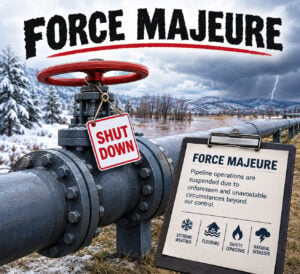 On Thursday, physical (spot) natural gas sold at Louisiana’s Henry Hub (the national benchmark) went for $3.30 per MMBtu. On the same day, gas sold at Texas Eastern M-2, which is the main price point for gas produced in southwestern Pennsylvania, West Virginia, and Ohio, went for $1.055. That’s the same molecule of methane, and our version fetched about 32 cents on the dollar. Why? Because a pipeline carrying Appalachian gas out of the region sprang a leak again. Here’s what happened, why it matters to your royalty check, and why there’s some good news on the horizon.
  The front-month October NYMEX natural gas futures contract settled Friday (Sept. 25) at $3.196 per MMBtu, up 28.4 cents, or 9.75%, for the week. That’s a nice week to be long gas. Most of the fireworks came on Thursday, when a leak on TC Energy’s Mountaineer XPress (MXP) pipeline in West Virginia knocked roughly 1.8 Bcf/d of Appalachian takeaway offline and sent futures up 9.06% in a single day, the biggest one-day gain since January (see
 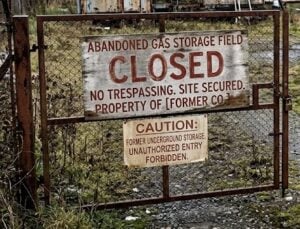 Columbia Gas Transmission (a TC Energy company) has asked federal regulators for permission to permanently walk away from three underground natural gas storage fields straddling the Pennsylvania/West Virginia line near Majorsville — plugging 71 wells, tearing out a compressor station, and abandoning nearly 20 miles of pipe. On September 9, FERC set the clock on its environmental review. If you’re a landowner in Greene or Washington County, PA, or Marshall County, WV, this one lands in your backyard. Here’s the plain-English version of a very technical filing.
  TC Energy issued its second quarter 2026 update on July 30, and the headline numbers were strong: comparable EBITDA of C$2.9 billion, up 12% over 2Q25, and full-year guidance now tracking the upper end of the C$11.6–$11.8 billion range. Nice, but that’s investor stuff. The news that matters for Marcellus/Utica landowners, drillers, and midstreamers is sitting in the project tables — and in a demand forecast TC has now raised two years running.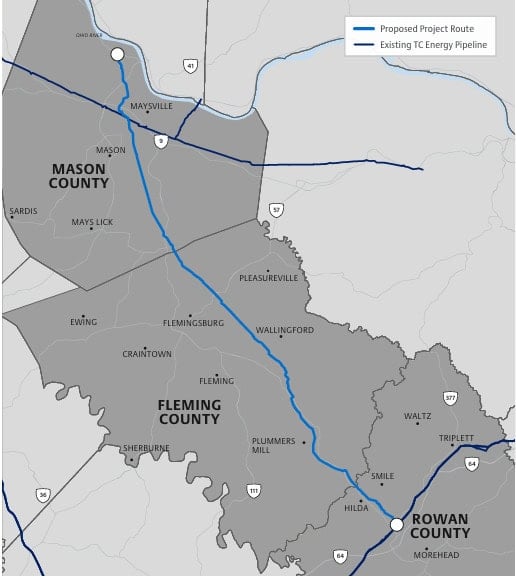
 Existing pipelines in the Marcellus/Utica region are testing the market for expansion. Two weeks ago, we told you that DT Midstream (50% owner of NEXUS Pipeline) is eyeing the growing AI data center market in northwestern Ohio as a customer for M-U molecules that flow through NEXUS (see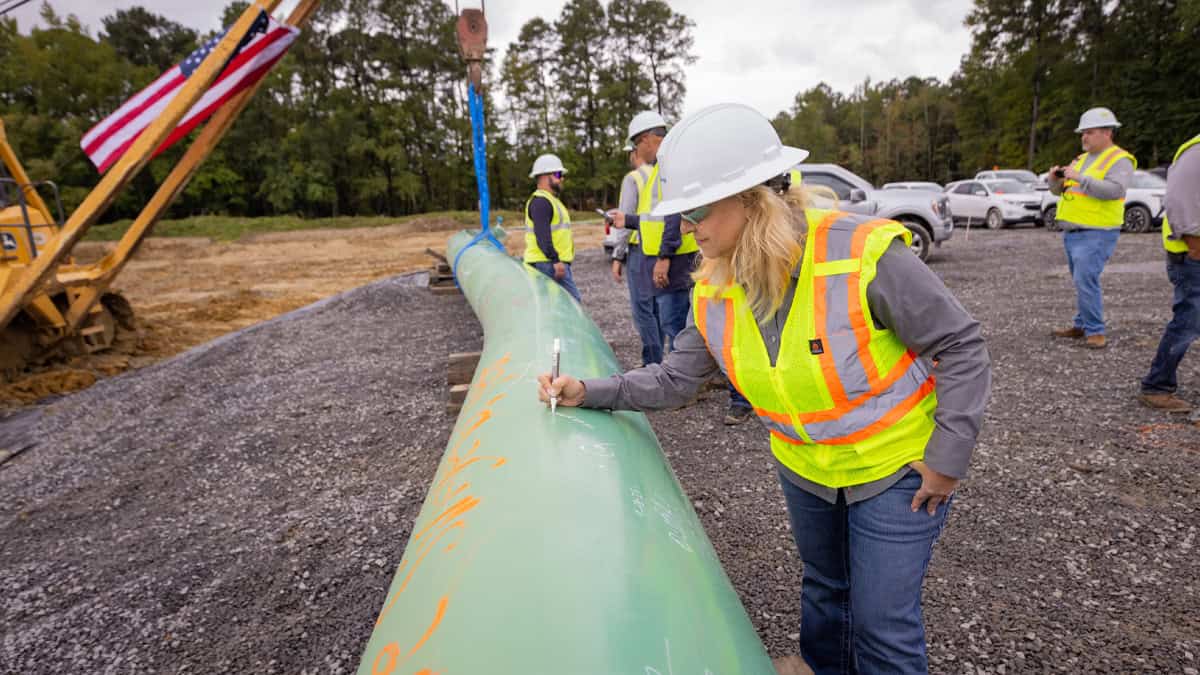
 It took eight years and untold legal fees (on both sides) before a tiny 3.4-mile, 8-inch natural gas pipeline under the Potomac River was finally built and went online in July (see
  TransCanada Corporation, which renamed itself TC Energy in 2019, made a play for and bought out/merged with U.S.-based Columbia Pipeline Group in 2016 (see
  TC Energy, formerly TransCanada, is a huge pipeline company headquartered in Canada. TC owns and operates the Columbia Gas Transmission and Columbia Gulf Transmission pipeline systems in the Marcellus/Utica region. Yesterday, TC announced that it plans to move its regional headquarters from Kanawha City (a neighborhood in Charleston, WV) to downtown Charleston and build a new $60 million building in the process. TC said the existing 110,000-square-foot former CASCI building will be demolished and replaced with a new building, with construction expected to be complete in 2025 and employees moving in by 2026.
 Two related pipeline projects in southeast Virginia now have all regulatory approvals in hand, and the projects will soon begin construction. Columbia Gas Transmission (a subsidiary of TC Energy) applied with the Federal Energy Regulatory Commission (FERC) to build the Virginia Reliability Project (VRP), which includes two new compressor units and the replacement of existing pipeline. VRP will dig up, replace, and double the size of two sections, or about 48 miles, of the Columbia Gas pipeline between Chesapeake and Petersburg. Williams’ Commonwealth Energy Connector Project will feed VRP by building six miles of new pipeline within Transco’s existing right-of-way in Virginia, expanding a meter station, and building a 30,500-hp electric motor-drive compressor. Both projects received final approval by FERC in November (see
  In August 2022, Columbia Gas Transmission (a subsidiary of TC Energy) filed an application with the Federal Energy Regulatory Commission (FERC) to build the Virginia Reliability Project (VRP), which includes two new compressor units and the replacement of existing pipeline (see
  We finally have some good news to share concerning Columbia Gas’ project to build a tiny 3.37-mile, 8-inch pipeline under the Potomac River from Maryland to West Virginia. The project, called the Eastern Panhandle Expansion, has been blocked repeatedly by leftwing wackos in Maryland (see