
Energy Services | Industrywide Issues | New York | Pennsylvania | Pipelines | Schoharie County | Susquehanna County | Williams
Uncle Sam Writes $42M Check to Jump-Start Constitution Pipeline
 The Trump administration just put real money where its mouth is on the Constitution Pipeline. Yesterday the U.S. Department of Energy (DOE) announced it will spend up to $42 million in Defense Production Act (DPA) money to nudge Williams’ long-dead, now-revived 125-mile pipeline from Susquehanna County, PA to Schoharie County, NY closer to reality. The money won’t buy a single length of pipe—it pays for permitting and pre-construction work. And it doesn’t change the fact that New York and its Big Green allies are still fighting the project tooth and nail. But it sends a loud message: Washington now officially considers Constitution a national security asset. Read More “Uncle Sam Writes $42M Check to Jump-Start Constitution Pipeline”
 The 108-mile “Women’s Water Walk” along the route of the proposed Constitution Pipeline wrapped up last Sunday in Schoharie. On Tuesday, the walkers carried jars of creek water to Gov. Kathy Hochul’s office in Albany. The walk is over, but it didn’t end quietly. It gave birth to a new, permanent anti-pipeline coalition run by Frack Action. The Governor’s office answered with a carefully worded statement that isn’t quite the “stand strong” pledge the walkers came for. And the walk’s fundraising came up about 80% short of its goal.
  Here’s one you don’t see every day. A Democratic polling firm, one that boasts of helping elect Democrats all the way up to the White House, says a majority of New York voters want the Constitution Pipeline built. And it isn’t close on natural gas itself: roughly three out of four New Yorkers support using natural gas in the Empire State. Somebody, please forward this to Food & Water Watch, which has been telling anyone who will listen that the “overwhelming majority” of New Yorkers oppose Constitution. Before we pop the champagne, though, there’s some fine print you need to see, including the question of who paid for this poll.
  Shovels, meet dirt. The Federal Energy Regulatory Commission (FERC) yesterday gave Iroquois Gas Transmission System the green light to begin construction on its Enhancement by Compression (ExC) project — well, most of it. FERC signed off on new compression and gas cooling equipment at Iroquois’ Athens and Dover compressor stations in New York and its Milford station in Connecticut. The fourth site, in Brookfield, Connecticut, is still stuck in state air permit purgatory. But three out of four ain’t bad. It means real work can finally start on pushing more Marcellus/Utica gas into New York City and New England, two of the most gas-starved (and highest-priced) energy markets in the country.
  A power company from Thailand just bought a big chunk of a natural gas-fired power plant sitting in Queens, New York — about two miles from LaGuardia Airport. Why should you care? Because the reason that plant is worth so much money is the very thing New York politicians keep telling us is a dead end. The Empire State has spent a decade banning fracking, killing pipelines, and lecturing the rest of us about the evils of methane. And yet: the single most valuable thing about Astoria Energy II is that nobody will ever be allowed to build another one like it. Scarcity, it turns out, pays very well. Somebody in Bangkok did the math.
 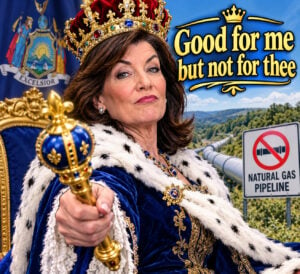 New York’s so-called leaders banned natural gas hookups in new homes (see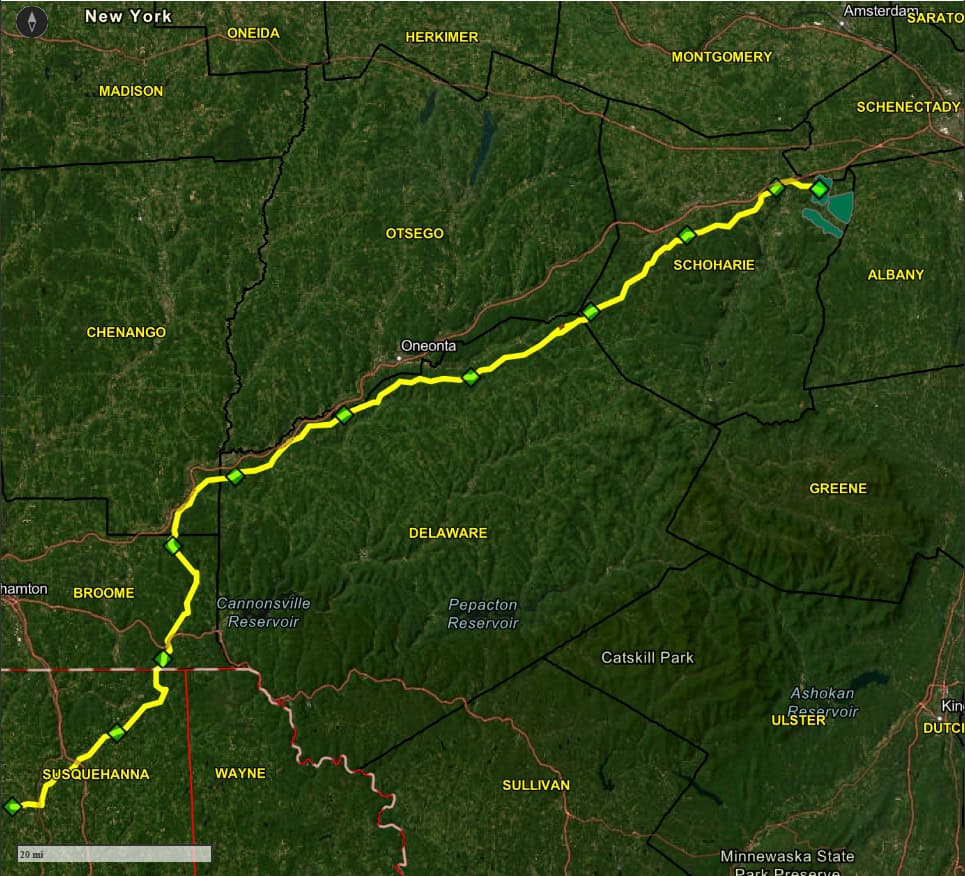
 Pittsburgh-based Alcoa says it’s “very close” to selling its shuttered Massena East aluminum smelter in New York’s North Country to a data center developer. Here’s the part that other reporting left out: the buyer has been sitting on that site since 2017, wants to build a 635-megawatt (MW) computing campus there — and Gov. Kathy Hochul froze the whole thing two months ago with her data center moratorium (see
  A federal judge in Syracuse dropped a legal anvil on New York’s $75 billion climate shakedown yesterday, ruling that the state’s Climate Change Superfund Act is preempted by federal law and cannot be enforced. It’s a complete win for West Virginia AG J.B. McCuskey, the 21 other state AGs who joined him, and the industry groups that piled on. We’ve been following this one since Gov. Kathy Hochul signed the bill in the waning days of 2024 (see
 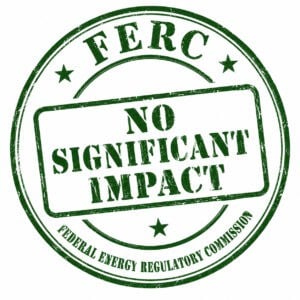 In April, we told you the Federal Energy Regulatory Commission (FERC) was taking a fresh look at the revived Constitution Pipeline and the associated Wright Interconnect project, and that the agency had to decide whether a relatively quick Environmental Assessment (EA) would do the job — or whether it would drag the projects through a full-blown, years-long Environmental Impact Statement (EIS). We got our answer on August 21. FERC staff issued the EA for both projects — 79 pages plus appendices — and the bottom line is the one supporters have been waiting on: building Constitution “would not constitute a major federal action significantly affecting the quality of the human environment.” In plain English — no significant impact. No years-long supplemental EIS is needed.
  The U.S. Court of Appeals for the Second Circuit last Friday slammed the door on Big Green’s attempt to yank the New York water permit for the Williams/Transco Northeast Supply Enhancement (NESE) pipeline. Six environmental groups asked the court to vacate the Clean Water Act Section 401 water quality certification (WQC) that the New York State Dept. of Environmental Conservation (DEC) issued in November 2025. In a summary order issued Aug. 21, a three-judge panel said no. The permit stands. NESE, already under construction, keeps building.
  Both federal and state regulators signed off last Thursday on PowerTransitions’ purchase of the 1,242-megawatt (MW) Roseton Generating Facility in Newburgh, New York — the sixth and by far the largest gas-fired plant the Houston-based company has grabbed in the Empire State this year. The Federal Energy Regulatory Commission (FERC) issued its order Aug. 13 (Docket EC26-95-000), and the New York Public Service Commission approved the transfer the same day. But the most interesting thing in the FERC order isn’t the approval. It’s the name of the company doing the buying.
  Pennsylvania got off easy in the 2026-27 budget. Only one data center bill made it into law, and it was a toothless one. But the Pittsburgh Business Times reports Harrisburg is loading up for another round this fall — and this time the antis have a working blueprint to copy. It’s called New York, where Gov. Kathy Hochul banned new hyperscale data centers last month, and where the anti-fracking crowd has already spent a decade proving what happens when a state tells industry to go away.
  New York’s Department of Environmental Conservation (DEC) and New York State Energy Research and Development Authority (NYSERDA) announced Wednesday they’ve formally adopted regulations tightening the Regional Greenhouse Gas Initiative (RGGI) — the multi-state carbon tax on coal- and gas-fired power plants — through 2037. The agencies used the words “affordable” or “affordability” six times in their joint announcement. Here’s what they didn’t mention: the price of an RGGI permit jumped 40% in one quarter this year, from $24.99 per ton in March to $35.00 in June. And New York households now pay the third-highest electricity prices in America, behind only Hawaii and California (according to federal data). Six mentions of affordability, zero mentions of the auction price. Funny how that works.
  I&S Inc. of New York, an Allegany-based well servicing company owned by Dan Sessler, is planning a $9 million expansion that will create at least 80 new jobs. The company, which has serviced oil, gas, and solution mining wells since 1988, is purchasing the old Allegany Drive-In property along Route 417 — just up the road from its current headquarters. Plans call for a new 5,000-square-foot office, a 14,400-square-foot commercial shop, and a 9,600-square-foot cold storage warehouse to store pipe for its oil, gas, and solution mining operations. The company secured a 10-year PILOT agreement from the Cattaraugus County IDA. Construction costs are estimated at $7.3 million.
  The Federal Energy Regulatory Commission (FERC) is close to issuing an environmental assessment for the Constitution Pipeline, a 125-mile greenfield pipeline from the Marcellus gas fields of Susquehanna County, PA, to Schoharie County, NY (see