
REX Waste Heat Now Powers Univ. of Dayton – Let’s Do More of This!
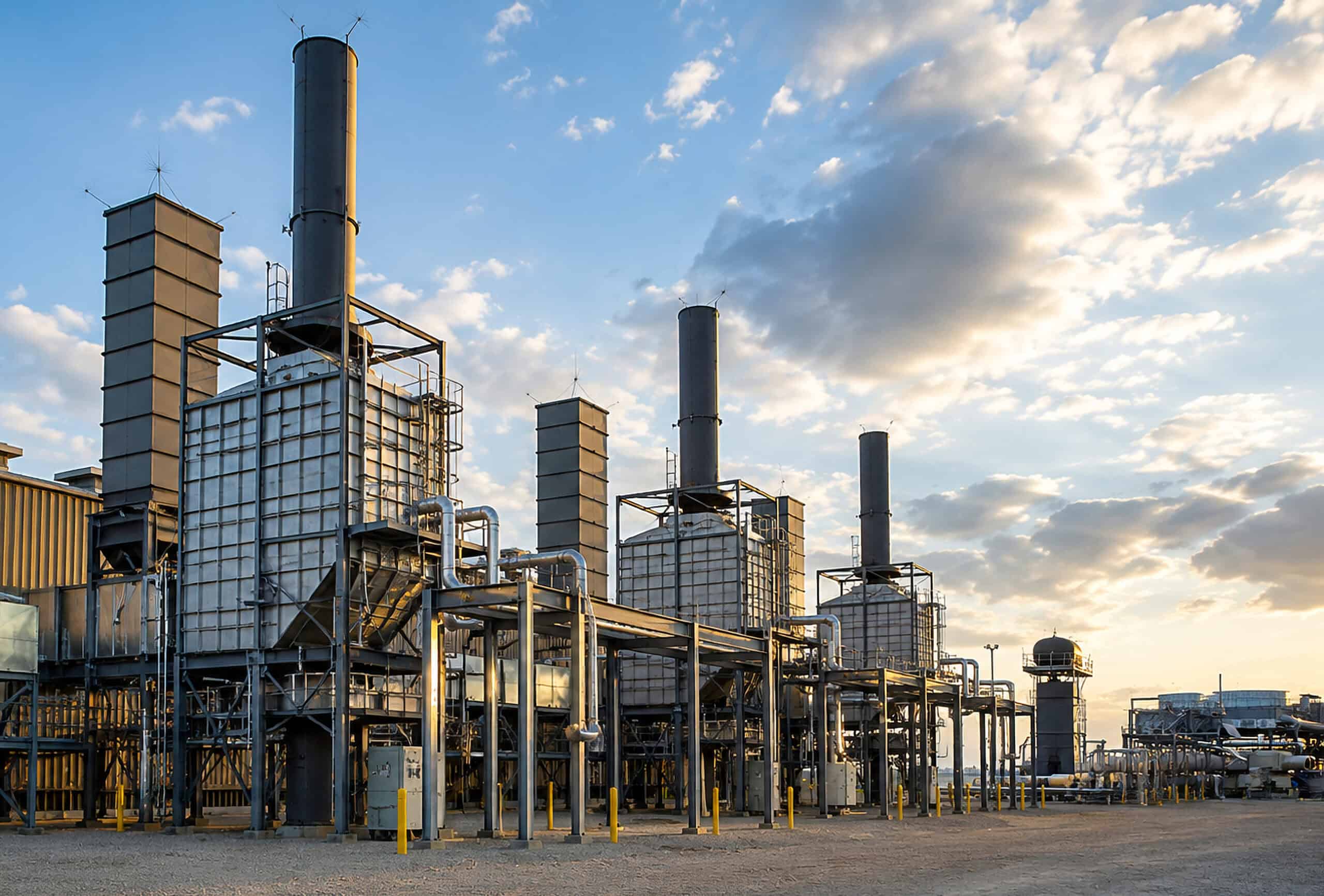
Back in March we told you Tallgrass was bolting waste-heat-to-power gear onto three Rockies Express (REX) compressor stations in Ohio and Indiana (see Rockies Express Compressor Stations Turn Waste Heat into Power). Those three were the sequel. Yesterday we got word the original is now up and running. Tallgrass, Kanin Energy, AES Ohio, and the University of Dayton announced that a waste-heat recovery system tied to the REX compressor station at Washington Court House (Fayette County), Ohio, is now generating electricity — enough to cover 100% of the university’s power needs under a 15-year power purchase agreement (PPA). The system is expected to crank out roughly 78,000 megawatt-hours (MWh) a year, trim about 55,000 metric tons of carbon dioxide annually, and cut UD’s carbon footprint by 71%. Construction started in October 2024 and wrapped up in early 2026. Read More “REX Waste Heat Now Powers Univ. of Dayton – Let’s Do More of This!”
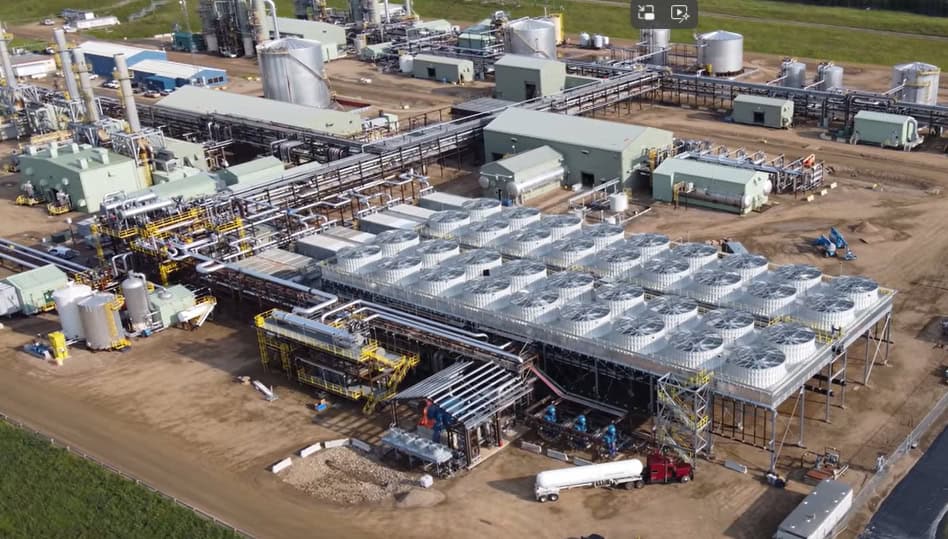
 Yesterday, Ameren Missouri, a subsidiary of Ameren Corporation, a regional electric utility, announced its updated 20-year plan to provide reliable, affordable, and resilient energy to its customers. The plan calls for investment in new on-demand energy sources (two new gas-fired power plants) to ensure the long-term stability of the energy grid and accelerated deployment of renewable energy generation. Even though the plan is loaded with all sorts of so-called new renewable electric generation, anti-fossil fuel zealots have latched onto the two new gas-fired power plants and are stroking out. By the way, those two gas-fired plants will get their molecules from the Marcellus/Utica.
 If an upstream (drilling) company with a long-term pipeline contract files for bankruptcy, does that give the company the right to break its pipeline contract? A major shipper on the Rockies Express (REX) pipeline, Ultra Resources, filed for bankruptcy with the express plan to skip out on its obligations to REX (see
  While Gulfport Energy (big Ohio Utica driller) hasn’t officially filed for bankruptcy, it’s certainly a possibility (see
  We still, to this day, marvel at how Tallgrass Energy Partners turned around what looked like a financial disaster, into a financial bonanza. Tallgrass built the Rockies Express (REX) pipeline that stretches from Colorado and Wyoming all the way to Ohio just in time for the shale revolution to hit. Whoops! Talk about bad timing! A significant portion of REX, it’s Zone 3 pipeline from Missouri to Ohio, was in danger of drying up in 2012 because of the increase in Marcellus/Utica gas being produced (see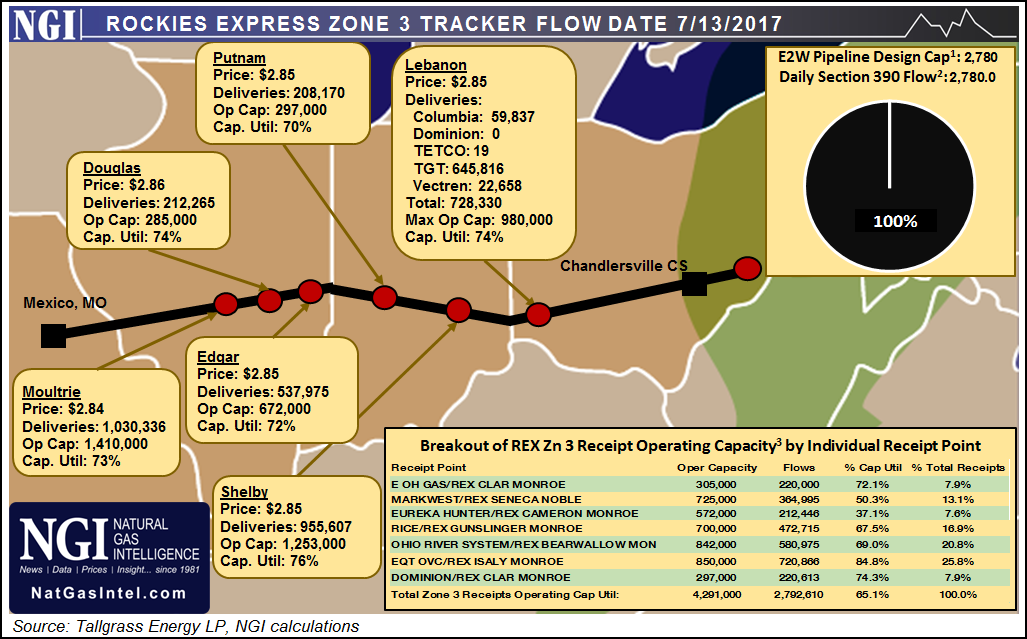
 The Rockies Express Pipeline (REX), originally built from Colorado and Wyoming to Monroe County, OH to bring natural gas from west to east, last year reversed the flow for a large and important section of the pipeline. On August 1, 2015 the section of REX from Monroe County, OH to Mexico, MO reversed the flow and began to carry 1.8 billion cubic feet per day (Bcf/d) of Utica and Marcellus Shale gas to the Midwest, including to the greater Chicago area. REX has been hard at work on plans to expand capacity even more by beefing up compressor stations along portions of the pipeline. REX filed a plan with FERC to add another 800 million cubic feet per day (MMcf/d) of capacity along the same portion of the reversed pipeline–for a grand total of 2.6 billion cubic feet per day (Bcf/d). In mid-December, the first 200 MMcf/d of capacity came online (see
 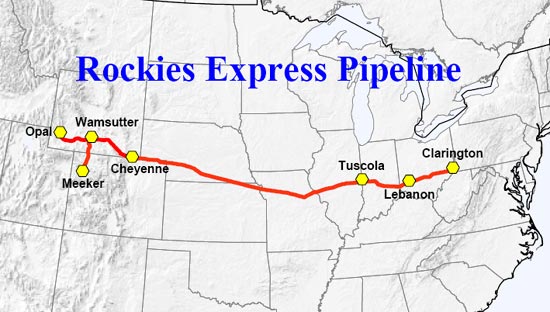 The Rockies Express Pipeline (REX), originally built from Colorado and Wyoming to Monroe County, OH to bring natural gas from west to east, last year reversed the flow for a large and important section of the pipeline. On August 1, 2015 the section of REX from Monroe County, OH to Mexico, MO reversed the flow and began to carry 1.8 billion cubic feet per day (Bcf/d) of Utica and Marcellus Shale gas to the Midwest, including to the greater Chicago area. REX has been hard at work on plans to expand capacity even more by beefing up compressor stations along portions of the pipeline. REX filed a plan with FERC to add another 800 million cubic feet per day (MMcf/d) of capacity along the same portion of the reversed pipeline–for a grand total of 2.6 billion cubic feet per day (Bcf/d). In mid-December, the first 200 MMcf/d of capacity came online (see
  Last Wednesday MDN (via a story from NGI) brought you the good news that the Rockies Express Pipeline (REX) had begun to flow an extra 200 million cubic feet per day (MMcf/d) of natural gas from East to West along the pipeline–moving more Utica and Marcellus gas from Ohio to places like the Chicago area (see