
REX Waste Heat Now Powers Univ. of Dayton – Let’s Do More of This!

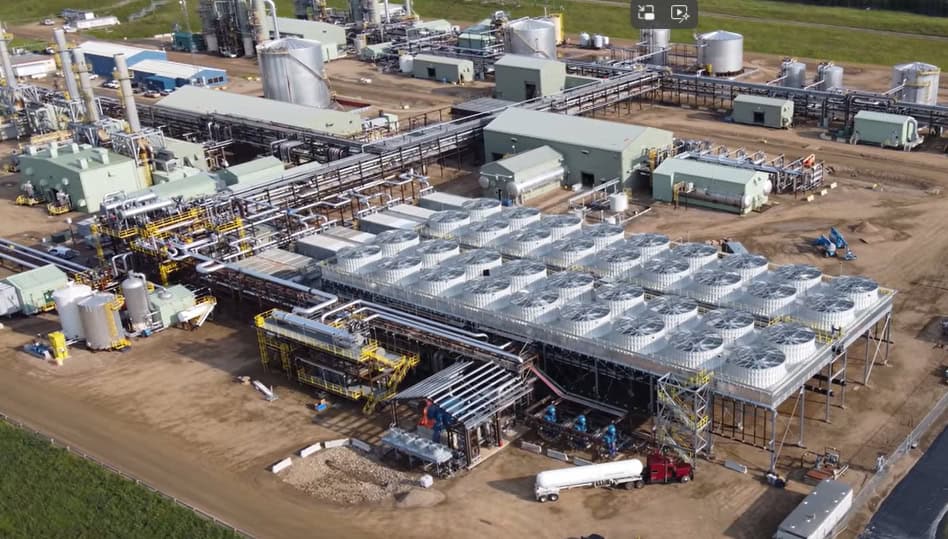
Back in March we told you Tallgrass was bolting waste-heat-to-power gear onto three Rockies Express (REX) compressor stations in Ohio and Indiana (see Rockies Express Compressor Stations Turn Waste Heat into Power). Those three were the sequel. Yesterday we got word the original is now up and running. Tallgrass, Kanin Energy, AES Ohio, and the University of Dayton announced that a waste-heat recovery system tied to the REX compressor station at Washington Court House (Fayette County), Ohio, is now generating electricity — enough to cover 100% of the university’s power needs under a 15-year power purchase agreement (PPA). The system is expected to crank out roughly 78,000 megawatt-hours (MWh) a year, trim about 55,000 metric tons of carbon dioxide annually, and cut UD’s carbon footprint by 71%. Construction started in October 2024 and wrapped up in early 2026. Read More “REX Waste Heat Now Powers Univ. of Dayton – Let’s Do More of This!”
 We still marvel, to this day, at how Tallgrass Energy Partners turned what looked like a financial disaster into an economic bonanza. Tallgrass built the Rockies Express (REX) pipeline, which stretches from Colorado and Wyoming to Ohio, just in time for the shale revolution to take hold. Whoops! Talk about bad timing! A significant portion of REX, its Zone 3 pipeline from Missouri to Ohio, was in danger of drying up in 2012 due to the increase in Marcellus/Utica gas production (see
  We spotted some news that, on the surface, may not appear to be connected to the Marcellus/Utica, but we think it is. The Canada Pension Plan Investment Board (CPP Investments) is investing approximately $843 million (CAD 1.2 billion) in Denver, Colorado-based Tallgrass Energy. CPP is a major investor in the Utica Shale (via Encino Energy), and Tallgrass is the owner and operator of the Rockies Express (REX) pipeline that flows Marcellus/Utica gas to the Midwest.
 In April, the Ohio Oil and Gas Commission upheld a regulatory order from the Ohio Dept. of Natural Resources (ODNR) suspending operations of three wastewater injection wells located in Torch (Athens County), OH, owned by K&H Partners, a subsidiary of Tallgrass Energy (see
  Tallgrass Energy, majority owner of the Rockies East Express (REX) pipeline — a 1,712-mile pipeline that runs from Colorado and Wyoming to Ohio — has owned 75% of REX since buying out a 25% share from Sempra Energy in 2016 for $440 million (see
  When a pipeline company considers whether or not to build a new pipeline, the company conducts an “open season”–a time when drillers (producers), traders, buyers, and others who want guaranteed capacity along that pipeline can sign long-term contracts. Such contracts guarantee pipeline companies will be able to make back the considerable amount of money they have to spend to build the pipeline. What happens when those 5-, 10-, and 20-year contracts expire?
 If an upstream (drilling) company with a long-term pipeline contract files for bankruptcy, does that give the company the right to break its pipeline contract? A major shipper on the Rockies Express (REX) pipeline, Ultra Resources, filed for bankruptcy with the express plan to skip out on its obligations to REX (see
  Last week MDN told you the news that EQT Corporation has sold part of its reserve capacity along the Mountain Valley Pipeline (MVP) to “an undisclosed investment-grade entity for six years” (see
  Everyone wants to be perceived as “responsible” these days, as in “responsibly sourced gas.” How to do it? Project Canary is a Denver-based firm that developed its own methane measurement technology and third-party verification called TrustWell™. A number of Marcellus/Utica drillers, including EQT, Chesapeake Energy, Southwestern Energy, Range Resources, and Seneca Resources have all joined the Project Canary program. Tallgrass Energy’s Rockies Express (REX) Pipeline aims to be the first interstate pipeline system that is Project Canary certified end-to-end, flowing Marcellus/Utica gas responsibly.
 If an upstream (drilling) company with a long-term pipeline contract files for bankruptcy, does that give the company the right to break their pipeline contract? A major shipper on the Rockies Express (REX) pipeline, Ultra Resources, is expected to file for bankruptcy very soon. REX is concerned Ultra may claim its bankruptcy is a “get-out-of-the-contract free” card. REX has asked FERC to preemptively “assert its jurisdiction” as the arbiter of whether or not companies like Ultra can skip out of contracts.
 Last December MDN told you that investment firm Blackstone Infrastructure Partners, a major investor in pipeline company Tallgrass Energy, pursued and caught the company, tentatively convincing Tallgrass to sell its public shares of stock to Blackstone, which will take the company “private” –meaning no publicly traded shares of stock (see
  The Ohio Supreme Court ruled yesterday that the Ohio tax commissioner correctly charged Tallgrass Energy’s Rockie Express (REX) pipeline $2 million in excise tax (based on $699 million of income), for gas transported from and to (within) Ohio. REX claimed it did not owe the tax because the same law that exempts gas transported out of state applies to gas sales in-state. But the tax commission, and now the Supremes, say that the portion of gas transported through REX that stays in Ohio is not exempt and can be taxed. So pay up.
 In December, Blackstone Infrastructure Partners, a major energy investment firm, announced it had cut a deal to buy the remaining shares of stock it doesn’t already own in Tallgrass Energy for $3 billion, with a plan to take the company private (see