Tallgrass Energy, founded in 2012, owns and operates more than 8,300 miles of natural gas pipelines, more than 800 miles of crude pipelines, and more than 300 miles of water pipelines across a broad portion of the U.S. Tallgrass is the owner/operator of the Rockies Express (REX) natgas pipeline that carries Marcellus/Utica gas to Midwest markets including the Chicago area. The founder of Tallgrass, David G. Dehaemers Jr. (still a relatively young man) is “retiring” and “stepping down as CEO” effective immediately. What happened? Read More “Tallgrass Energy Founder/CEO/Chairman David Dehaemers Retires”
Back in January Tallgrass Energy, builder and operator of the mighty Rockies Express (REX) pipeline which is a critical link that flows Marcellus/Utica gas to Midwestern markets, dropped the bombshell announcement that investment firm Blackstone was buying a “controlling” interest in the company (see Blackstone Buys Controlling Interest in Tallgrass Energy). Blackstone now wants to buy the rest of the shares they don’t already own–and take Tallgrass private. Read More “Blackstone Floats $3B Offer to Buy Rest of Tallgrass Energy”
We caught wind of something on the Tallgrass quarterly conference call yesterday that had previously eluded our otherwise reliable radar. Tallgrass, via its subsidiary BNN Water, bought out and merged in Central Environmental Services back in May. That’s important because Central is a “water services” provider in the Marcellus/Utica. Namely, Central (now BNN) operates three injection wells in Ohio. On yesterday’s Tallgrass conference call, company officials said they are working on a plan to build pipelines to those injection wells, saving a whole bunch of truck trips. Read More “Tallgrass Expanding Wastewater Disposal Biz in Marcellus/Utica”
Tallgrass Energy, builder and operator of the mighty Rockies Express (REX) pipeline which is a critical link that flows Marcellus/Utica gas to Midwestern markets, dropped a bombshell announcement yesterday. The company said that investment firm Blackstone is buying a “controlling” interest in the company. Which raises the question, will Blackstone indeed “control” the company? Read More “Blackstone Buys Controlling Interest in Tallgrass Energy”
In March, MDN brought you the news that the Federal Energy Regulatory Commission (FERC) had taken “significant action” to address the Trump tax cut legislation enacted last December (see FERC Takes Aim at Adjusting Pipe Rates in Light of Trump Tax Cut). FERC wants to be sure the tax cuts coming to electric companies and pipeline companies are passed on to consumers and pipeline shippers. The agency proposed new solutions to eliminate “tax loopholes” for natural gas pipelines. Closing these so-called loopholes will eliminate certain tax benefits for MLPs–master limited partnerships. Many pipeline companies (most) are organized as MLPs, which allows tax advantages to flow to investors. With certain tax benefits for MLP unitholders on the chopping block, all of a sudden some MLPs don’t look like such a hot investment anymore, at least on paper. Some analysts have speculated this may be the beginning of the end for MLPs. A few years ago Kinder Morgan got rid of all it’s MLP subsidiaries, combining them all into a single “C” corporation. In March, Tallgrass Energy, builder/operator of the mighty Rockies Express (REX) pipeline which flows Marcellus/Utica gas, announced it would do the same (see Tallgrass Energy Eliminating MLP – First “Casualty” of Tax Cut?). Yesterday Tallgrass MLP unitholders voted “overwhelmingly” to dissolve the MLP and merge it in with the corporation, which will happen later this week… Read More “First Pipeline “Casualty” of Trump Tax Cut Dissolves MLP Jun 29″
Every three months publicly traded companies, including those with major operations in the Marcellus/Utica, issue a required quarterly update for stockholders. It’s often referred to as “earnings season.” We like to cull through the updates to share items of interest with MDN readers. For drilling companies we dedicate an entire post to each company. We typically don’t cover midstream (i.e. pipeline) companies as much. However, there are a number of important projects cooking with companies like Williams, MarkWest Energy (MPLX), Summit Midstream and Tallgrass (REX Pipeline). We culled through the press releases and analyst phone call transcripts to pick out comments and portions that we think are helpful in understanding where some of these important projects are, and how they impact the bottom line of said companies. Below is our 1Q18 midstream potpourri… Read More “1Q18 Midstream Potpourri: Williams, MarkWest, Summit, Tallgrass”
Last week MDN brought you the news that the Federal Energy Regulatory Commission (FERC) had taken “significant action” to address the Trump tax cut legislation enacted last December (see FERC Takes Aim at Adjusting Pipe Rates in Light of Trump Tax Cut). FERC wants to be sure the tax cuts coming to electric companies and pipeline companies are passed on to consumers and pipeline shippers. The agency proposed new solutions to eliminate “tax loopholes” for natural gas pipelines. Closing these so-called loopholes will eliminate certain tax benefits for MLPs–master limited partnerships. Many pipeline companies (most) are organized as MLPs, which allows tax advantages to flow to investors. With certain tax benefits for MLP unitholders on the chopping block, all of a sudden some MLPs don’t look like such a hot investment anymore, at least on paper. Some analysts have speculated this may be the beginning of the end for MLPs. A few years ago Kinder Morgan got rid of all it’s MLP subsidiaries, combining them all into a single “C” corporation. Now, Tallgrass Energy, builder/operator of the mighty Rockies Express (REX) pipeline which flows Marcellus/Utica gas, is doing the same as Kinder did. Which causes us to ask the question, is Tallgrass’ MLP the first “casualty” of the Trump tax cut among pipeline companies?… Read More “Tallgrass Energy Eliminating MLP – First “Casualty” of Tax Cut?”
We still, to this day, marvel at how Tallgrass Energy Partners turned around what looked like a financial disaster, into a financial bonanza. Tallgrass built the Rockies Express (REX) pipeline that stretches from Colorado and Wyoming all the way to Ohio just in time for the shale revolution to hit. Whoops! Talk about bad timing! A significant portion of REX, it’s Zone 3 pipeline from Missouri to Ohio, was in danger of drying up in 2012 because of the increase in Marcellus/Utica gas being produced (see REX NatGas Pipeline Faces Stiff Competition from Marcellus). Tallgrass did an about face, reversing the flow of REX to run from Ohio to Missouri a year later, in 2013 (see REX Reverses Pipeline Flow from OH for Mystery Utica Customer). Since that time volumes along the Zone 3 portion of REX have done nothing but increase. A lot of Marcellus/Utica gas now flows from our region to the Midwest by hitching a ride on REX. The strategy of reversing the pipeline’s flow turned what was shaping up to be a disaster, into a bonanza. Yesterday Tallgrass issued its fourth quarter and full year 2017 update. While Tallgrass (as other pipeline companies) did well in 2017 in general, much of the company’s success came “as a result of incremental capacity sales in Zone 3” of the REX pipeline… Read More “Tallgrass has “Outstanding Quarter” Thx to REX Pipeline in the M-U”
On Wednesday around 2:30 am in the morning, a section of 24-inch pipeline that runs from the MarkWest Energy natural gas processing plant in Noble County, OH and the Rockies Express (REX) pipeline (also in Noble County) exploded and caught fire. The Noble County Emergency Management Office says it happened about three miles north of Summerfield, Ohio, near Ohio State Routes 513 and 379. Fortunately, no one was injured. Neighbors heard the explosion and saw a glowing night sky. The only damage was to some nearby trees. That short segment of pipeline is known as the Seneca Lateral, owned by Tallgrass (owner of REX Pipeline). Tallgrass is investigating the cause of the accident. Believe it or not, that one pipeline and the gas it flows from the MarkWest plant to REX, carrying it to the Midwest, has caused the entire national output of natural gas to decrease by an estimated 2%, according to Reuters. A single small pipeline can actually move the needle on output! Right away the Sierra Club jumped into the story with a wild claim that the pipeline was not properly reviewed before regulators signed off on it. Typical headline-grabbing propaganda from the Clubbers. Here are the details we could find about the explosion/fire… Read More “Utica Pipeline Explosion in Noble County, OH Affects Natl Output”
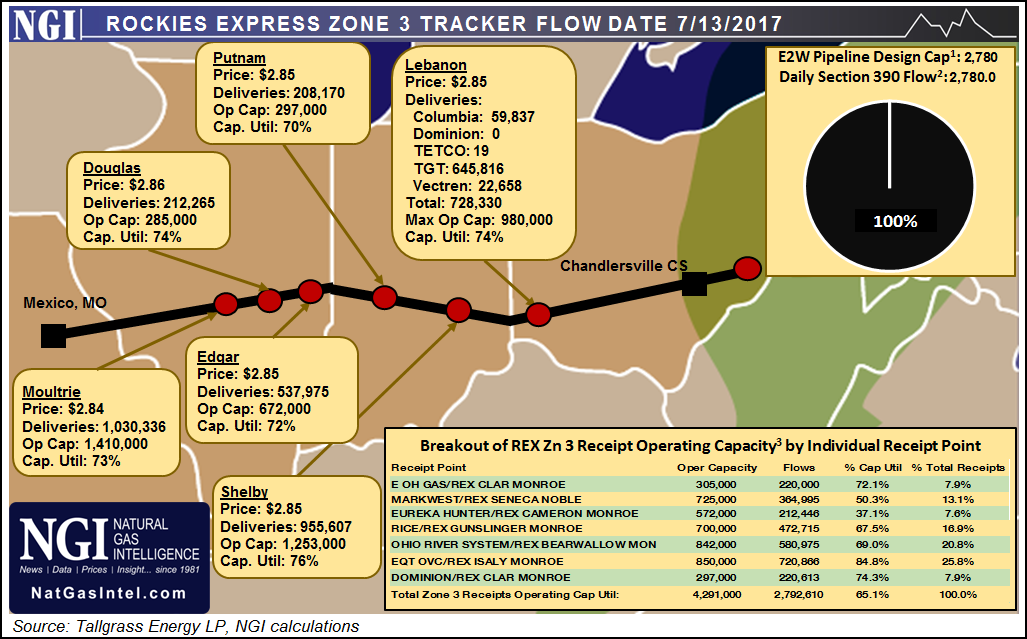
NGI’s Rockies Express Zone 3 Tracker – July 13, 2017 (click for larger version)
The Rockies Express Pipeline (REX) was originally built from Colorado and Wyoming to Monroe County, OH to bring natural gas from west to east. In 2015, REX began the process of reversing the flow for a large and important section of the pipeline–to send gas from the Utica/Marcellus to the Midwest. By January of this year, REX had reversed and was flowing 2.6 billion cubic feet per day (Bcf/d) of gas from Clarington, OH to Mexico, MO (see REX Pipe Completes Expansion Today, 2.6 Bcf/d Flowing East-to-West). Except REX wanted more! The demand is there, and REX announced in February they were working on a plan to flow another 150 million cubic feet per day (MMcf/d) of natgas from Ohio to the Midwest (see REX Pulls Rabbit Out of Pipeline – Adding Another 150 MMcf/d). REX ran a new open season and got commitments for 180 MMcf/d, and began flowing it in June, according to an announcement released yesterday. The announcement also shared that REX (independent subsidiary of Tallgrass Energy) has a new CEO: Crystal Heter. Crystal was once an engineering intern at REX and has steadily risen through the ranks to now sit in the big chair. We congratulate her! Here’s the info about REX’s latest coup in adding another 180 MMcf/d of capacity to its Zone 3, reversed pipeline… Read More “Rockies Express Pipeline Adds Another 180 MMcf/d from Ohio to Ill.”
What happens when you build a major interstate natural gas pipeline–and you’ve guessed wrong about the market. That happened to Tallgrass Energy and their Rockies Express Pipeline (REX), which runs from Colorado and Wyoming in the West to Ohio in the East. The REX Pipeline was completed in 2009, just in time for the shale revolution to begin in the Marcellus and now in the Utica. What to do when you’re pumping gas into a saturated market? You reverse the flow (see Reversing the Fortunes for “Wrong Way” REX Pipeline). On August 1, 2015 the section of REX from Monroe County, OH to Mexico, MO (called Zone 3) reversed the flow and began to carry 1.8 billion cubic feet per day (Bcf/d) of Utica and Marcellus Shale gas to the Midwest, including to the greater Chicago area. In January 2017, REX completed the reversal project and now flows 2.6 Bcf/d of Marcellus/Utica gas to the Midwest (see REX Pipe Completes Expansion Today, 2.6 Bcf/d Flowing East-to-West). The ace researchers at Natural Gas Intelligence have been looking at prices Utica drillers were able to get for their gas at key locations before and after REX reversed the pipeline and have found that single pipeline has “erased” the price differences between Utica and Marcellus gas. That is, Utica drillers now fetch much higher prices for their gas, everywhere they sell it (in Ohio and out), because of the REX pipeline and the new markets it has opened up… Read More “The Difference One Utica Pipeline Can Make on Gas Prices”
The Rockies Express Pipeline (REX), originally built from Colorado and Wyoming to Monroe County, OH to bring natural gas from west to east, last year reversed the flow for a large and important section of the pipeline. On August 1, 2015 the section of REX from Monroe County, OH to Mexico, MO reversed the flow and began to carry 1.8 billion cubic feet per day (Bcf/d) of Utica and Marcellus Shale gas to the Midwest, including to the greater Chicago area. REX has been hard at work on plans to expand capacity even more by beefing up compressor stations along portions of the pipeline. REX filed a plan with FERC to add another 800 million cubic feet per day (MMcf/d) of capacity along the same portion of the reversed pipeline–for a grand total of 2.6 billion cubic feet per day (Bcf/d). In mid-December, the first 200 MMcf/d of capacity came online (see Reversed REX Pipeline Goes from 1.8 Bcf to 2.0 Bcf). A week later another 250 MMcf/d was brought online (see REX Pipeline Adds Yet More Capacity, Now Flowing Extra 450 MMcf/d). In January, the final 350 MMcf/d went online, and REX is now flowing 2.6 Bcf/d of Utica/Marcellus gas to Chicagoland and beyond (see REX Pipe Completes Expansion Today, 2.6 Bcf/d Flowing East-to-West). Expansion complete. Except–Tallgrass says they can squeeze another 150 MMcf/d out of the reversed pipeline! Next month they’re going to run a new open season to sell yet more capacity, which would bump what had been 2.6 Bcf/d to 2.75 Bcf/d… Read More “REX Pulls Rabbit Out of Pipeline – Adding Another 150 MMcf/d”
The Rockies Express Pipeline (REX), originally built from Colorado and Wyoming to Monroe County, OH to bring natural gas from west to east, last year reversed the flow for a large and important section of the pipeline. On August 1, 2015 the section of REX from Monroe County, OH to Mexico, MO reversed the flow and began to carry 1.8 billion cubic feet per day (Bcf/d) of Utica and Marcellus Shale gas to the Midwest, including to the greater Chicago area. REX has been hard at work on plans to expand capacity even more by beefing up compressor stations along portions of the pipeline. REX filed a plan with FERC to add another 800 million cubic feet per day (MMcf/d) of capacity along the same portion of the reversed pipeline–for a grand total of 2.6 billion cubic feet per day (Bcf/d). In mid-December, the first 200 MMcf/d of capacity came online (see Reversed REX Pipeline Goes from 1.8 Bcf to 2.0 Bcf). A week later another 250 MMcf/d was brought online (see REX Pipeline Adds Yet More Capacity, Now Flowing Extra 450 MMcf/d). Beginning today, the final 350 MMcf/d is coming online. REX is now flowing 2.6 Bcf/d of Utica/Marcellus gas to Chicagoland and beyond… Read More “REX Pipe Completes Expansion Today, 2.6 Bcf/d Flowing East-to-West”
Last Wednesday MDN (via a story from NGI) brought you the good news that the Rockies Express Pipeline (REX) had begun to flow an extra 200 million cubic feet per day (MMcf/d) of natural gas from East to West along the pipeline–moving more Utica and Marcellus gas from Ohio to places like the Chicago area (see Reversed REX Pipeline Goes from 1.8 Bcf to 2.0 Bcf). REX previously filed a plan with the Federal Energy Regulatory Commission (FERC) to add another 800 million cubic feet per day (MMcf/d) of capacity along the reversed portion of the pipeline. In late November, FERC gave REX the go-ahead to start additional compressors added at three locations along the route. The plan is to have all of the extra 800 MMcf/d flowing by the end of this year. On Wednesday, as we noted, 200 MMcf/d of additional capacity kicked in. Then on Friday, NGI reported another 250 MMcf/d was added, meaning 450 MMcf/d was added to REX’s capacity in a single week. That’s another 450 MMcf/d of yummy, clean-burning fracked Utica/Marcellus shale gas flowing to the Midwest that wasn’t a week ago. We love it when a plan comes together… Read More “REX Pipeline Adds Yet More Capacity, Now Flowing Extra 450 MMcf/d”
The Rockies Express Pipeline (REX), originally built from Colorado and Wyoming to Monroe County, OH to bring natural gas from west to east, last year reversed the flow for a large and important section of the pipeline. On August 1, 2015 the section of REX from Monroe County, OH to Mexico, MO reversed the flow and began to carry 1.8 billion cubic feet per day (Bcf/d) of Utica and Marcellus Shale gas to the Midwest, including to the greater Chicago area. REX has been hard at work on plans to expand capacity even more by beefing up compressor stations along portions of the pipeline. REX filed a plan with FERC to add another 800 million cubic feet per day (MMcf/d) of capacity along the same portion of the reversed pipeline. In late November, the Federal Energy Regulatory Commission (FERC) gave REX the go-ahead to start additional compressors added at three locations along the route (see REX Pipe Begins Flowing Extra 800 MMcf/d Marcellus/Utica Gas West). NGI is reporting that the first 200 MMcf of the additional 800 MMcf is now flowing along the pipeline… Read More “Reversed REX Pipeline Goes from 1.8 Bcf to 2.0 Bcf”


 In February 2017, Spire, a natural gas utility company based in St. Louis, Missouri, filed an official application with the Federal Energy Regulatory Commission (FERC) to build the Spire STL Pipeline, a 65-mile, 24-inch diameter pipe that will flow 400 million cubic feet (MMcf) per day of yummy Marcellus/Utica gas from the Rockies Express (REX) pipeline to St. Louis (see
  Back in January Tallgrass Energy, builder and operator of the mighty Rockies Express (REX) pipeline which is a critical link that flows Marcellus/Utica gas to Midwestern markets, dropped the bombshell announcement that investment firm Blackstone was buying a “controlling” interest in the company (see
  We caught wind of something on the Tallgrass quarterly conference call yesterday that had previously eluded our otherwise reliable radar. Tallgrass, via its subsidiary BNN Water, bought out and merged in Central Environmental Services back in May. That’s important because Central is a “water services” provider in the Marcellus/Utica. Namely, Central (now BNN) operates three injection wells in Ohio. On yesterday’s Tallgrass conference call, company officials said they are working on a plan to build pipelines to those injection wells, saving a whole bunch of truck trips.
 Tallgrass Energy, builder and operator of the mighty Rockies Express (REX) pipeline which is a critical link that flows Marcellus/Utica gas to Midwestern markets, dropped a bombshell announcement yesterday. The company said that investment firm Blackstone is buying a “controlling” interest in the company. Which raises the question, will Blackstone indeed “control” the company?
 In March, MDN brought you the news that the Federal Energy Regulatory Commission (FERC) had taken “significant action” to address the Trump tax cut legislation enacted last December (see
  Every three months publicly traded companies, including those with major operations in the Marcellus/Utica, issue a required quarterly update for stockholders. It’s often referred to as “earnings season.” We like to cull through the updates to share items of interest with MDN readers. For drilling companies we dedicate an entire post to each company. We typically don’t cover midstream (i.e. pipeline) companies as much. However, there are a number of important projects cooking with companies like Williams, MarkWest Energy (MPLX), Summit Midstream and Tallgrass (REX Pipeline). We culled through the press releases and analyst phone call transcripts to pick out comments and portions that we think are helpful in understanding where some of these important projects are, and how they impact the bottom line of said companies. Below is our 1Q18 midstream potpourri…
 We still, to this day, marvel at how Tallgrass Energy Partners turned around what looked like a financial disaster, into a financial bonanza. Tallgrass built the Rockies Express (REX) pipeline that stretches from Colorado and Wyoming all the way to Ohio just in time for the shale revolution to hit. Whoops! Talk about bad timing! A significant portion of REX, it’s Zone 3 pipeline from Missouri to Ohio, was in danger of drying up in 2012 because of the increase in Marcellus/Utica gas being produced (see
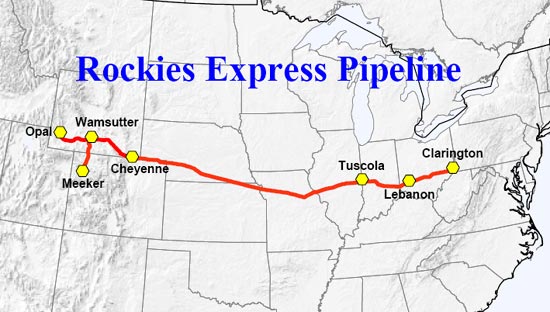
 The Rockies Express Pipeline (REX), originally built from Colorado and Wyoming to Monroe County, OH to bring natural gas from west to east, last year reversed the flow for a large and important section of the pipeline. On August 1, 2015 the section of REX from Monroe County, OH to Mexico, MO reversed the flow and began to carry 1.8 billion cubic feet per day (Bcf/d) of Utica and Marcellus Shale gas to the Midwest, including to the greater Chicago area. REX has been hard at work on plans to expand capacity even more by beefing up compressor stations along portions of the pipeline. REX filed a plan with FERC to add another 800 million cubic feet per day (MMcf/d) of capacity along the same portion of the reversed pipeline–for a grand total of 2.6 billion cubic feet per day (Bcf/d). In mid-December, the first 200 MMcf/d of capacity came online (see
  Last Wednesday MDN (via a story from NGI) brought you the good news that the Rockies Express Pipeline (REX) had begun to flow an extra 200 million cubic feet per day (MMcf/d) of natural gas from East to West along the pipeline–moving more Utica and Marcellus gas from Ohio to places like the Chicago area (see