
Kinder Says TGP 219 South Pipeline Could Be Multiple Times Bigger
 Back in July, we told you Tennessee Gas Pipeline (TGP), a Kinder Morgan subsidiary, had launched a non-binding open season for its 219 South Project (see TGP Launches Open Season to Flow More M-U Molecules South). The project would move up to 530,000 dekatherms per day (Dth/d) of Marcellus/Utica gas south from TGP’s Station 219 in Pennsylvania through Ohio, West Virginia, Kentucky and Tennessee. A dekatherm is a measure of heat content, and 530,000 Dth/d works out to roughly 510 million cubic feet per day (MMcf/d). We predicted Kinder would get “plenty of bites.” Did they ever! Kinder CFO David Michels said in a recent fireside chat that the response was “very strong and positive.” And here’s the kicker: he said the final project could be multiple times bigger than originally announced. Read More “Kinder Says TGP 219 South Pipeline Could Be Multiple Times Bigger”
 Back in August, we told you FERC had approved Kinder Morgan’s $5.2 billion pair of Southeast pipeline projects, and we told you to expect Big Green to come after it (see
  Kinder Morgan has a new pipeline project in the works, one MDN has not told you about before, because until yesterday nobody outside the company had heard of it. It’s called the Southeast Connector, and it would run north to south across Middle Tennessee through 10 counties, stitching together two of Kinder’s biggest interstate systems: Tennessee Gas Pipeline (TGP) and Southern Natural Gas (SNG). Kinder VP Allen Fore made the rounds in DeKalb County on Thursday, meeting the county mayor, the Chamber of Commerce, and local media. Land agents may start knocking on doors as early as next week. Target in-service: 2029.
  We missed one, and it’s a big one. On July 31, the Federal Energy Regulatory Commission (FERC) handed Kinder Morgan certificates of public convenience and necessity for BOTH of its blockbuster Southeast projects — the Mississippi Crossing Project (MSX) on Tennessee Gas Pipeline, and the South System Expansion 4 Project (SSE4) on Southern Natural Gas and Elba Express. Put together, that’s roughly 500 miles of new steel, about $5.2 billion of capital, and something on the order of 3.8 million dekatherms per day of new firm transportation capacity aimed squarely at the fastest-growing gas market in the country. FERC issued the order right on time — the FAST-41 schedule said “no later than July 31,” and the Commission delivered on the last possible day.
  As part of Kinder Morgan’s second-quarter update, the company made an important announcement that (until now) it had not made. Namely, on May 26, 2026, TGP (Tennessee Gas Pipeline) placed in service its approximately $235 million Cumberland Pipeline project. The 30-inch pipeline is a 32-mile lateral originating from TGP’s existing 100 Line in Dickson County, Tennessee, and terminating at Tennessee Valley Authority’s (TVA) new natural gas-fired power plant in Stewart County, Tennessee. Big Green tried its best to block this project along with the gas-fired power plant, but failed.
  A new wrinkle to report in the case of a South Carolina pipeline, the Elba Express Pipeline, and its quest to build an extension to a gas-fired power plant in Colleton County. In June, we told you that Kinder Morgan, the builder, had been forced to sue some 55 (of the 185) landowners along the proposed route to allow simple access to their property for a survey (see
  It never ends well for landowners who believe they can block pipeline surveyors from accessing their land. In April 2025, MDN told you about a new greenfield expansion of Kinder Morgan’s Elba Express pipeline into South Carolina to serve growing demand for natural gas in the state (see
  Kinder Morgan’s Elba Island LNG, which accepts and liquefies Marcellus/Utica molecules just offshore from Savannah, Georgia, received approval from the Federal Energy Regulatory Commission (FERC) in November 2024 to expand the facility to produce an extra 0.4 million metric tons/year (see
 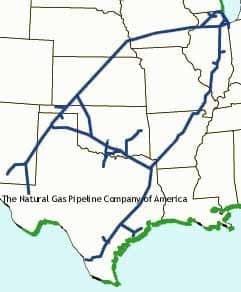 The Natural Gas Pipeline Company of America (NGPL), a Kinder Morgan pipeline subsidiary, flows Marcellus and Utica molecules. While the pipeline’s primary footprint is in the Midcontinent and Gulf Coast, it is a critical takeaway path for Appalachian gas through key interconnections. NGPL’s recent tariff announcement reaffirmed its commitment to offering negotiated rate arrangements for pipeline transportation services, maintaining continuity in its commercial practices. These options allow shippers to develop customized pricing based on factors like contract duration, gas volume, and specific operating needs, providing greater flexibility than standard maximum recourse rates.
  Last week, RBN Energy held its GasCon 2026 conference in Houston, Texas. Among the heavy hitters who attended and spoke at the event were Sital Mody, President of Natural Gas Pipelines at Kinder Morgan, and Dan Brouillette, the 15th Secretary of the U.S. Department of Energy. Mody had this to say during his talk: “When I take a step back and reflect on the natural gas industry, the one thing that comes to mind for me is all gas, no brakes.”
  We’ve recently begun actively tracking flow restrictions on pipelines that carry Marcellus/Utica molecules. Current pipeline flow data for February 2026 show that the Marcellus/Utica (M-U) region is experiencing significant, albeit weather-driven, volatility. While the basin remains a production powerhouse, a combination of recent Arctic weather and localized maintenance has triggered several flow restrictions, including a restriction along the Tennessee Gas Pipeline.
  Last September, MDN told you that two major Kinder Morgan pipeline projects that will flow Marcellus/Utica molecules in the southeastern U.S. took a big step forward at the Federal Energy Regulatory Commission (FERC) with FERC actively working on an environmental impact statement (EIS) for both projects (see