Energy Services | Industrywide Issues | Iroquois Gas Transmission | New York | Pipelines | Statewide NY
Due to Cuomo Pipeline Ban, Iroquois Imports Canadian Gas for NY
 Andrew Cuomo’s blockade of important pipeline projects like the Williams Constitution Pipeline (from northeast PA into NY) continues to keep the price of natural gas high in the Empire State. The Constitution, which was supposed to be built years ago, is supposed to connect to two other interstate pipelines, one of them the Iroquois (see Iroquois Announces Interconnect for Constitution Pipeline in NY). That never happened, and because of it, the Iroquois must import Canadian natural gas *every single day* in order to meet demand–gas that costs much more than the cheap, abundant and clean-burning gas from a few miles away in the PA Marcellus.
Read More “Due to Cuomo Pipeline Ban, Iroquois Imports Canadian Gas for NY”
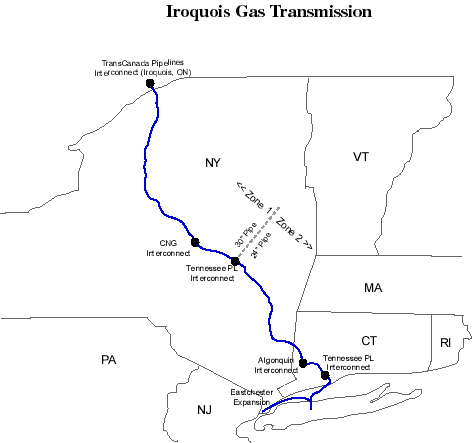
 Iroquois Gas Transmission System is a natural gas pipeline that brings gas from eastern Canada to the New York City area. It is owned by TransCanada Corporation, Dominion Resources, KeySpan Corporation, New Jersey Resources Corporation, and Energy East Corporation. There have been plans, for years, to connect the Constitution Pipeline to the Iroquois and flow Marcellus/Utica gas to Canada by converting Iroquois to be bidirectional. As we all know, the Constitution has been stalled since 2014 because of the corrupt State of New York blocking it. There’s still hope that Constitution will get built. In October they asked the Federal Energy Regulatory Commission to override the New York and allow the project to proceed (see
  Last week TransCanada announced they are “selling” their interest in the Iroquois Gas Transmission pipeline and a second pipeline, Portland Natural Gas Transmission System (PNGTS), to a subsidiary of TransCanada for $765 million. Every now and again big energy companies transfer some of their assets to different subsidiary companies, on paper. We say “on paper” because nothing really changes with the management of the assets–in this case two pipelines. However, money does change hands because usually there are different sets of investors for the different subsidiaries. So TransCanada “sold” themselves (different set of investors) these two pipeline systems. Iroquois is majority owned by TransCanada–in two pieces. After the drop down sale, TC PipeLines will own both pieces, representing 61.1% of the Iroquois system. Iroquois is a 416-mile interstate natural gas pipeline extending from the U.S.-Canadian border at Waddington, NY, through New York State and western Connecticut to its terminus in Commack, NY, and from Huntington to the Bronx, NY. The second pipeline part of the transfer deal is PNGTS–an interstate natural gas pipeline company providing natural gas transportation service for gas utilities, paper mills, and electric generation plants throughout New England. Here’s info about the deal, and an overview for each pipeline system…
  Companies in the oil and gas space, in particular midstream (pipeline) companies, have complicated ownership structures on paper. There are usually a number of subsidiary companies. Sometimes these companies have a “mother ship” which is owned by stockholders, and a subsidiary that is a master limited partnership (MLP), which is a different kind of corporate structure. MLPs don’t have shares of stock but instead issue units (about the same thing as shares of stock). MLPs give the unitholders certain tax advantages not offered to stockholders. Yes, its complicated. The important thing to know is that often these large pipeline companies have layers within layers. Which is the setup for this story. TransCanada, which purchased Columbia Pipeline Group last year for $10 billion (see
  In January of this year, the Federal Energy Regulatory Commission (FERC) launched five investigations into four pipelines, three of which operate in the northeast, to determine whether or not those pipelines have been “substantially” overcharging their customers with the excuse of “we have to recover our costs” (see
 Good news! The Federal Energy Regulatory Commission (FERC) have approved Dominion’s $165 million New Market Project, a project that expands Dominion’s transmission pipeline from western New York across the state to the Capital Region of the state, near Albany. As with any fossil fuel-related project, radical environmentalists objected (see