
NY Budget Commission Says More NatGas, Nukes Needed to Lower GHG
 In a new report titled “Getting Greener: Cost-Effective Options for Achieving New York State’s Greenhouse Gas Goals,” the Citizens Budget Commission (of New York) attributes the 13% greenhouse gas (GHG) emissions drop New York State saw between 1990 and 2016 to an increased usage of natural gas and nuclear power. According to the nonpartisan Commission, New York is “already green” and if it wants to stay that way, it needs MORE natural gas, not less!
Read More “NY Budget Commission Says More NatGas, Nukes Needed to Lower GHG”
 The rig count in the Marcellus/Utica region is crashing–down to its lowest level for a December since the M-U became a “thing.” It’s now lower than the levels reached in 2014, which was the advent of the first “crash” in rig counts. BUT (and this is a big BUT), lower rig counts do not necessarily mean less drilling or less production. How can that be?
 Once upon a time Carnegie Mellon University used to conduct real research and publish real scientific studies with respect to the PA Marcellus Shale (see
  Yesterday the Pennsylvania Independent Fiscal Office (IFO) released their latest quarterly Natural Gas Production Report for July through September 2019 (full copy below). It shows natgas production in PA rose 9.1% compared to the same period last year–to yet another new all-time high of 1,715 billion cubic feet (Bcf) of natural gas. Put another way, that’s 1.7 TRILLION cubic feet of gas produced over a three-month period. There has now been an unbroken chain of quarter-over-quarter increases in horizontal shale gas production in PA for 13 consecutive quarters (more than three years running).
 The International Gas Union (IGU) recently released its Global Gas Report 2019 (full copy below). According to the report, “The past year has been exceptional for natural gas. Prices at key regional natural gas hubs have reached multi-year lows. Both natural gas production and consumption have grown at record rates. And international trade infrastructure – in the form of LNG and pipeline capacity – is growing at the fastest rate in a decade.” What else does the report say? Plenty…
 For years (maybe a generation) we’ve heard the refrain that America needs to become “energy independent.” But what does that phrase actually mean? It means we produce enough of our own energy (oil, natural gas, nuclear, renewable, etc.) that if push comes to shove, we could actually survive if the rest of the world decided to cut us off from all sources of outside energy. Can you actually measure such an amorphous concept? Turns out you can.
 Pennsylvania Gov. Tom Wolf, a liberal Democrat who sometimes supports the shale gas industry (as long as he can tax it) has caved to demands from the Pittsburgh Post-Gazette to launch a “study” in a bid to “prove” cases of childhood cancer in southwestern PA can be tied to shale drilling in the region. A pair of studies, actually. The studies won’t be completed for three years, after Wolf is out of office, so he gets credit for caring, but he won’t be around for the fallout when it happens.
 JobsOhio, a private, nonprofit corporation that works works on behalf of the state to drive job creation and new capital investment in Ohio by attracting business, contracts out economic research to Cleveland State University (CSU)–to keep tabs on the Utica Shale industry. Last year CSU researchers found that from 2011-2017 the Utica Shale had attracted an amazing $70 billion in new private sector energy investments (see
  As we pointed out in our post yesterday about the U.S. EIA’s latest Drilling Productivity Report, natural gas production in the U.S. is slowing down (see EIA Nov ’19 Drilling Report: Permian Gas Grows More than M-U). No surprise in that bit of news as we’ve been reporting for months about various drillers in the Marcellus/Utica (and other plays) announcing their intent to spend less on drilling both this year and next. Production in the M-U is expected to grow 8-9% this year over last year. But what about next year?
 Each year the International Energy Agency (IEA) issues a special World Energy Outlook report. The 2019 edition was released last week. In this year’s Stated Policies Scenario, the share of natural gas in global primary energy demand grows to about 25% by 2040, and in the Sustainable Development Scenario, gas retains a critical role by supplying a projected one fifth of the world’s primary energy in 2050. Shale production growth is now slowing as investors lose interest, but IEA says: “the shale race is not yet run; many of the most profound impacts of the shale revolution still lie ahead.” Cool!
 It looks like we may be almost at a peak–the day we knew would come (but secretly hoped never would) where not only the Marcellus/Utica, but all of the major shale plays in the country stop producing more natural gas each month than they did the month before. Yesterday the EIA (U.S. Energy Information Administration, our favorite government agency) issued its monthly Drilling Productivity Report. It shows the M-U will end up producing 33,674 million cubic feet per day (MMcf/d) of natural gas in November, and their forecast is the M-U will produce 33,720 MMcf/d in December, a gain of 46 MMcf/d (one-tenth of one percent). In other words, statistically we’re at a standstill (not growing) and in the near future we expect to see *less* monthly production. We’re just about cresting the top the hill.
 The U.S. Energy Information Administration (EIA) recently released its “Natural Gas Annual 2018” report which shows the U.S. set new records in natural gas production, consumption, and exports in 2018. In 2018, dry natural gas production increased by 12%, reaching a record-high average of 83.8 billion cubic feet per day (Bcf/d). That’s the largest percentage increase since 1951, and the largest volumetric increase in the history of the series, dating back to 1930! Behold the miracle of shale.
 The smart folks at IHS Markit, a global analytics company that tracks data in the oil and gas industry, are predicting a major slowdown in shale oil production in 2020, and essentially no growth in production for 2021. Although this prediction, based on evidence and the intuition of people who study this stuff is about shale oil, the prediction *does* relate to the Marcellus/Utica as well.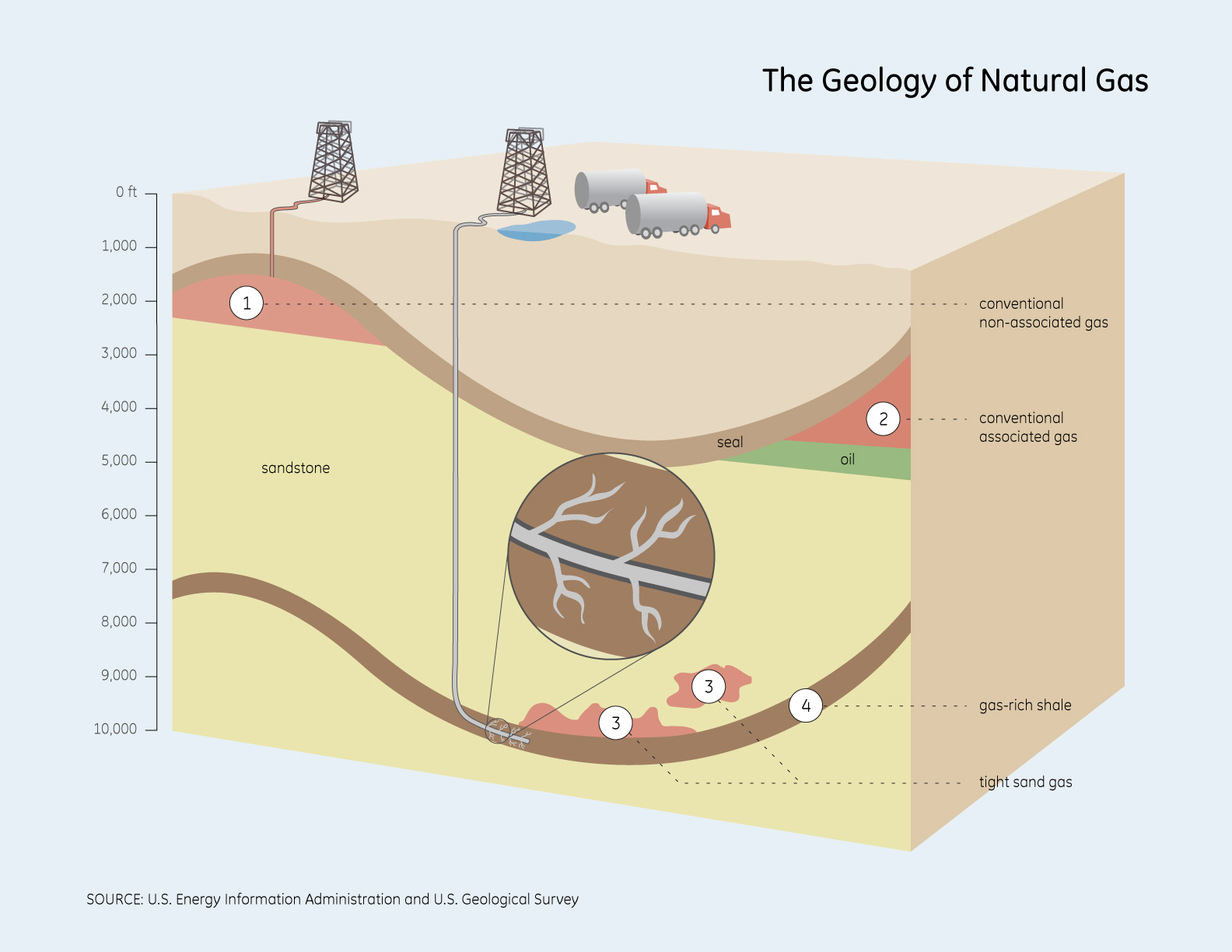
 Natural gas end-users, which include American households, businesses, manufacturers, and electric power generators, have realized $1.1 trillion in savings since 2008 as a result of increased natural gas production in the Marcellus/Utica region, according to a new report released yesterday. You read that right! Folks across the country have benefited by using M-U gas to the tune of $1.1 trillion in savings. Astonishing! The new report (full copy below) says the total savings works out to be an average of $4,000 per household. Thank God for fracking and horizontal drilling in the Marcellus/Utica.
 According to the EIA (U.S. Energy Information Administration, our favorite government agency), in the coming month of November, the U.S.’s seven major shale plays will produce a combined 84 billion cubic feet per day (Bcf/d) of natural gas, and 8.9 million barrels of oil per day–a brand new record high for each. The real eye-opener is that while the M-U will produce 132 million cubic feet per day (MMcf/d) of additional shale gas, the Permian Basin in West Texas and New Mexico will produce an additional 210 MMcf/d of shale gas!