
Beaver County | Energy Companies | Ethane | Industrywide Issues | Pennsylvania | Processing Plants | Shell
Shell Cracker Construction “in the Home Stretch” – Ready in 2022
 It’s been a long road, but we’re nearing the end. Shell’s $6 billion ethane cracker plant, officially called the Pennsylvania Petrochemicals Complex (PPC), is close to being done. It’s likely the PPC, located in Beaver County, PA, will be up and running sometime next year. When it is, the market for Marcellus/Utica NGLs will profoundly change. PPC will use an average of 85,000 barrels per day of M-U ethane. Our ethane will no longer be a waste product that many drillers pay to get rid of, but rather a profitable product they sell.
Read More “Shell Cracker Construction “in the Home Stretch” – Ready in 2022″
 Anti-fossil fuel zealots sent a letter to Pennsylvania Gov. Tom Wolf two days ago asking him to use dictatorial powers to overturn a permit issued by the Dept. of Environmental Protection (DEP) that allows a wastewater injection well to be built in Penn Township. The radical group ProtectPT (funded by Heinz Endowments and Google’s former CEO Eric Schmidt), along with a number of other oddball groups, lobbed a Hail Mary, asking Wolf to exercise his “supreme executive power” to stop the project. Perhaps they’re confusing Wolf with the North Korean dictator Kim Jong-un?
 Over the past week, the Enverus U.S. rig count jumped by a big 18 additional active rigs. The Permian play in Texas and New Mexico saw the biggest increase, adding 14 new rigs (the most since before the pandemic). The Marcellus added two more rigs, bringing the combined Marcellus/Utica rig count to 42, the highest we’ve seen in months–maybe more than a year.
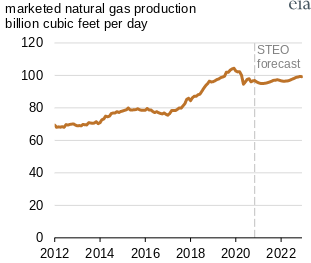 In its January 2021 Short-Term Energy Outlook (STEO) just released, the U.S. Energy Information Administration (EIA) forecasts annual average production of U.S. oil will fall to 11.1 million barrels per day (b/d) in 2021 before rising to 11.5 million b/d in 2022. As for natural gas, EIA says U.S. marketed natural gas production will decline by 2% to an average of 95.9 billion cubic feet per day (Bcf/d) in 2021. Like oil, EIA predicts the fall in natgas production will reverse in 2022 and will rise by 2% to 97.6 Bcf/d.
 Researchers at the University of Illinois Chicago have developed a cutting edge catalyst made up of 10 different elements–each of which on its own has the ability to reduce the combustion temperature of methane–plus oxygen. This unique catalyst brings the combustion temperature of methane down by about half, from above 1400 degrees Kelvin down to 600 to 700 degrees Kelvin. What it means is that natural gas can burn cleaner and emit far less carbon dioxide.