
Rover Pipeline to FERC: Please OK the Project NOW, by Dec. 31
 Rover Pipeline is turning up the heat on the Federal Energy Regulatory Commission (FERC). Rover is a $3.7 billion, 711-mile Marcellus/Utica natural gas pipeline that will run from PA, WV and eastern OH through OH into Michigan and eventually into Canada. It is a critical piece of sorely needed infrastructure for the Marcellus/Utica industry. In July, FERC issued a favorable final Environmental Impact Statement (EIS) for the project (see Big News: FERC Grants Final EIS for ET Rover Pipeline). The only thing left is for FERC to issue the certificate that allows the project to commence. Here’s the problem for Rover: If they don’t begin clearing trees in January, they won’t be able to have the tree-clearing done in time for bat season–when federally-protected Indiana and northern long-eared bats begin to roost in those trees. Rover (indeed all pipeline and drilling companies) can’t harvest trees after March 31. The moratorium on tree-cutting lasts until Oct. 31. So Rover has three months to clear trees, and if they don’t get it done then, the project will get delayed by another full year. So Rover sent a letter to FERC on Friday asking/cajoling/pleading with FERC to issue the certificate. However, Rover is currently on the excrement list at FERC over demolishing an historic house in Ohio without getting “Mother May I?” permission first (see Rover Pipeline in Hot Water Over Demolishing Historic House in OH). We wonder if perhaps that’s one reason why FERC is dragging its feet…
Read More “Rover Pipeline to FERC: Please OK the Project NOW, by Dec. 31”
 In one final, breathtaking rejection of the rule of law and poke in the eye of those who support fossil fuels, the U.S. Army Corps of Engineers, doing Lord Obama’s bidding, has rejected granting Energy Transfer (ET) an easement to complete the final leg of the Dakota Access Pipeline that crosses federal land. The out-of-state/paid protesters who have assembled at Standing Rock, ND were orgasmic with delight. Their euphoria, however, will be short-lived as ET expects the incoming Trump Administration to quickly reverse the policy and grant permission to complete the pipeline along its original route. Although this conflict is happening far outside the Marcellus/Utica, it is important for us nonetheless as this group of paid, out-of-state protesters, backed by Big Green money (using money from California billionaire and nut Tom Steyer, among others), has promised to leverage a win against the Keystone XL Pipeline and now the Dakota Access Pipeline by coming to the Marcellus/Utica in an attempt to defeat important pipeline projects in our region. Here’s the latest in the dust-up over the Dakota Access Pipeline…
 FERC (the Federal Energy Regulatory Commission) is not happy with Energy Transfer and their Rover Pipeline. There are two major pipeline projects planned for Ohio: NEXUS and Rover. NEXUS got some FERC love today (see today’s lead story). Rover, on the other hand, is getting the cold shoulder from FERC, from a self-inflicted wound. Let us explain. As a reminder, Rover (an Energy Transfer project) is a $3.7 billion, 711-mile Marcellus/Utica natural gas pipeline that will run from PA, WV and eastern OH through OH into Michigan and eventually into Canada. The short version of what happened is that in May 2015 Rover purchased a house in Carroll County, OH, located near where the pipeline, and a compressor station for that pipeline, is due to run. Rover bought the house to use for offices for several Rover affiliate companies. After buying it, they determined it was “ill-suited for its intended purpose” and decided to demolish the house. Problem was/is, that house was under consideration to be added to the National Register of Historic Places. The house was not yet on the list of Historic Places, but was on a list of properties under consideration. Rover should have reported their decision to demolish the house to FERC but didn’t, which has Rover in hot water with FERC and the Advisory Council on Historic Preservation. Will Rover’s action kill the project? No. Will it slow down Rover and end up costing the company boatloads of money? Most likely, although Rover disputes that interpretation of events…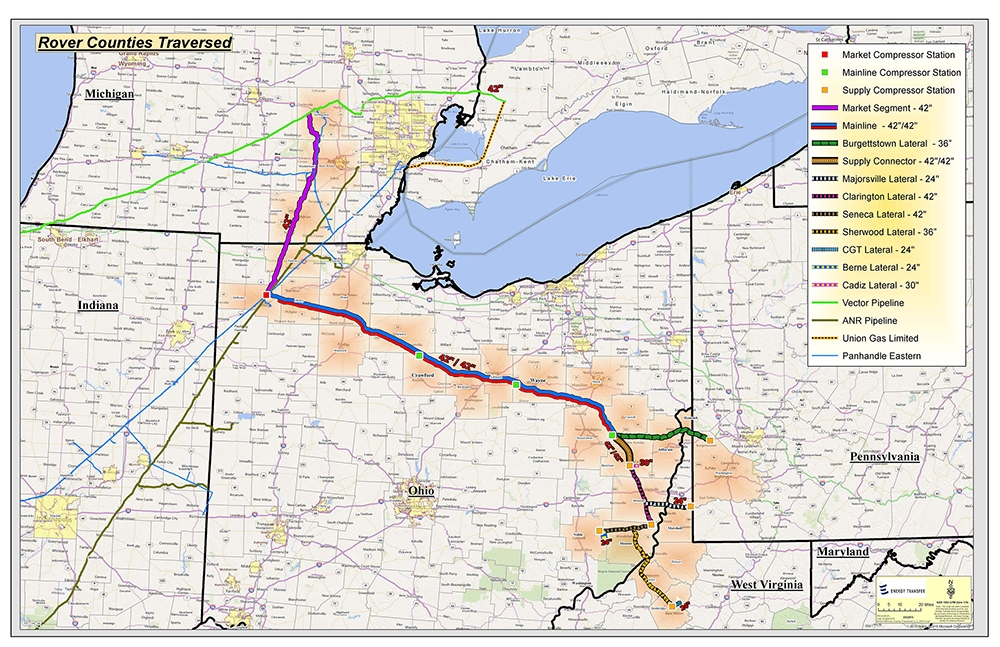

 Somehow or other MDN wound up on the distribution list for Deutsche Bank’s Equity Research (North America) updates. Which we like! Germany-based Deutsche Bank (DB) is the world’s 11th largest bank. They have some sharp analysts who keep tabs on multiple industries, one of those industries being oil and gas. Given the recent happenings with the Dakota Access Pipeline (DAPL), and the happenings with the Ohio Rover pipeline–both pipelines projects of Energy Transfer Equity–DB decided to do a quick update on both projects, giving us the investor/trader view of what will happen over the next 2-3 months. We found the update interesting and think you will too…
 Yesterday MDN told you that a war of words has broken out between the Obama U.S. Army Corps of Politicized Engineers and Energy Transfer Equity (ETE) over the Dakota Access Pipeline (see
  Two weeks ago MDN told you that TransCanada is attempting to block Marcellus/Utica gas from entering the eastern Canadian market by lowballing pipeline transportation costs from western Canada (see
 This is how it works with adults, those who wear “big boy pants.” A few weeks ago the Federal Energy Regulatory Commission (FERC) told Energy Transfer that their Rover pipeline, a $3.7 billion, 711-mile Marcellus/Utica natural gas pipeline that will run from PA, WV and eastern OH through OH into Michigan and eventually into Canada, and Columbia Pipeline that their Leach XPress pipeline, running from Marshall County, WV through Ohio to Leach, KY, that a small section where the pipelines cross must be reworked or it’s a “no go” for both projects (see
  Finally Williams has admitted, in writing, that the attempted buyout/merger by Energy Transfer Equity (ETE) is, as we said yesterday, dead (see
 As we previously reported, last Friday a Delaware court ruled that Energy Transfer Equity (ETE) has the right to terminate its merger agreement with Williams (see