
TransCanada Says Plan to Lowball M-U Gas Worked, Shippers Sign Up
 TransCanada, one of Canada’s leading midstream/pipeline companies, cooked up a deal last year to pipe natural gas from Canada’s West Coast to the East Coast in order to fend off cheap supplies of Marcellus/Utica gas that will flow into Canada when/if the NEXUS and Rover pipelines get built (see TransCanada Pipe Drops Price 42% to Compete with Marcellus/Utica). TransCanada dropped their pipeline price to lure drillers by (theoretically) making it less expensive to get gas from Western Canada, some 2,400 miles away, than from the Marcellus, just 400 miles away. In October, TransCanada launched an open season to lock up customers for the new, lower-priced option. The open season was a bust because TransCanada insists on a 10-year commitment (see TransCanada Plan to Lowball M-U Gas Using Canada Pipeline a Bust). TransCanada revived their plan in February. The original deal required a 10-year term with a long-term tolling rate between C$0.75/GJ to C$0.82/GJ. In February, the advertised deal was for a 10-year term and a simplified single rate of C$0.77/GJ (see TransCanada Revives Plan to Lowball M-U Gas Using Canada Pipeline). Although it looked almost like the same deal all over again with the same 10-year term and about the same price, TransCanada dropped a minimum amount to be shipped and is letting shippers opt out after five years under certain conditions. The changes worked…
Read More “TransCanada Says Plan to Lowball M-U Gas Worked, Shippers Sign Up”
 Companies in the oil and gas space, in particular midstream (pipeline) companies, have complicated ownership structures on paper. There are usually a number of subsidiary companies. Sometimes these companies have a “mother ship” which is owned by stockholders, and a subsidiary that is a master limited partnership (MLP), which is a different kind of corporate structure. MLPs don’t have shares of stock but instead issue units (about the same thing as shares of stock). MLPs give the unitholders certain tax advantages not offered to stockholders. Yes, its complicated. The important thing to know is that often these large pipeline companies have layers within layers. Which is the setup for this story. TransCanada, which purchased Columbia Pipeline Group last year for $10 billion (see
  In December, the Federal Energy Regulatory Commission (FERC) threw a little cold water on two important pipeline upgrades to carry more Marcellus/Utica gas to southern markets. A final environmental impact statement (EIS) was due from FERC for both the Mountaineer XPress and Gulf XPress projects no later than April 28, 2017. FERC said that the deadline would slip by three months due to reroutes and additional environment information requested (see
  You may recall that TransCanada, one of Canada’s leading midstream/pipeline companies, cooked up a deal last year to pipe natural gas from Canada’s West Coast to the East Coast in order to fend off cheap supplies of Marcellus/Utica gas that will flow into Canada when/if the NEXUS and Rover pipelines get built (see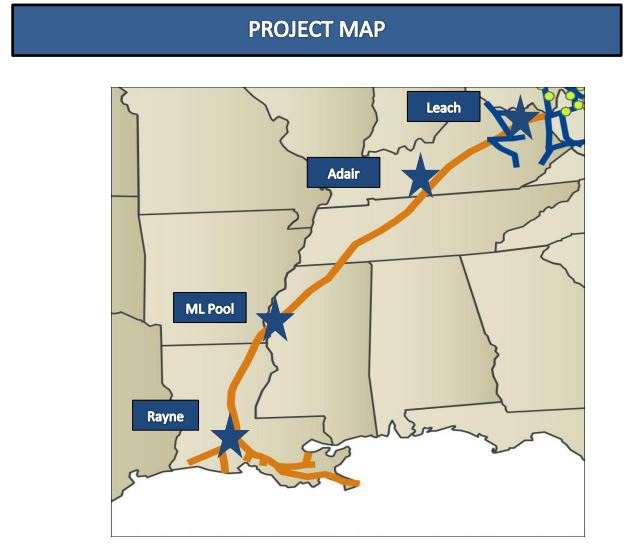
 Last week the Federal Energy Regulatory Commission (FERC) approved Columbia Pipeine’s Leach XPress and Rayne XPress pipeline projects (see
  Yesterday the Federal Energy Regulatory Commission (FERC) voted to approve and issue a certificate to Columbia Pipeine’s Leach XPress and Rayne XPress pipeline projects. This is fantastic news for the Marcellus/Utica region. MDN has covered these projects from their beginning. In August 2014 Columbia, then a subsidiary of Nisource, committed to building the two projects that will flow Marcellus/Utica gas to the Gulf Coast (see
  In early November Canadian midstream giant TransCanada announced they were going on a fundraising bender to get money to pay for their recent $10 billion acquisition of Columbia Pipeline (see
  Earlier this week we ran the news that Canadian pipeline giant TransCanada’s plan to radically lower the cost to pipe natural gas from the western regions of Canada to the eastern part of the country, in an effort to undercut Marcellus/Utica gas from flooding into the region, failed (see
  You may recall that TransCanada, one of Canada’s leading midstream/pipeline companies, cooked up a deal to pipe natural gas from Canada’s West Coast to the East Coast in order to fend off cheap supplies of Marcellus/Utica gas that will flow into Canada when/if the NEXUS and Rover pipelines get built (see
  Two weeks ago MDN told you that TransCanada is attempting to block Marcellus/Utica gas from entering the eastern Canadian market by lowballing pipeline transportation costs from western Canada (see
  Last July Canadian-based TransCanada, famously known for wanting to build the Keystone XL oil pipeline from Canada to the Gulf Coast (a plan that Obama obliterated), didn’t want to be left out of the most important midstream story of the century, so they bought Columbia Pipeline Group this year, closing on the sale in July (see
  You may recall that TransCanada, one of Canada’s leading midstream/pipeline companies, cooked up a deal to pipe natural gas from Canada’s West Coast to the East Coast in order to fend off cheap supplies of Marcellus/Utica gas that will flow into Canada when/if the NEXUS and Rover pipelines get built (see