
Canadians Approve TransCanada Pipe Lowball Plan to Compete with M-U
 Looks like begging works. TransCanada, one of Canada’s leading midstream/pipeline companies, cooked up a deal last year to pipe natural gas from Canada’s West Coast to the East Coast in order to fend off cheap supplies of Marcellus/Utica gas that will flow into Canada when/if the NEXUS and Rover pipelines get built (see TransCanada Pipe Drops Price 42% to Compete with Marcellus/Utica). TransCanada dropped their pipeline price to lure drillers by (theoretically) making it less expensive to get gas from Western Canada, some 2,400 miles away, than from the Marcellus, just 400 miles away. The original open season last year was a bust because TransCanada insists on a 10-year commitment (see TransCanada Plan to Lowball M-U Gas Using Canada Pipeline a Bust). TransCanada revived their plan in February. Although it looked almost like the same deal all over again with the same 10-year term and about the same price, TransCanada dropped a minimum amount to be shipped and is letting shippers opt out after five years under certain conditions. The changes worked (see TransCanada Says Plan to Lowball M-U Gas Worked, Shippers Sign Up). The plan needs a bevy of regulatory approvals, the main one being the Canadian National Energy Board (NEB). In hearings before the NEB two weeks ago, the Canadian Association of Petroleum Producers pleaded their case that the plan get approved (see Canadian Drillers Beg NEB to Approve Pipe Plan to Compete with M-U). Without it, western Canadian gas simply can’t compete with cheap, abundant Marcellus/Utica Shale gas flowing north. In somewhat dramatic terms, Canadian drillers claimed the “future of western Canada’s natural gas industry could depend on pipeline company TransCanada winning regulatory approval” of their lowball plan. The NEB bought it, and has just approved the lower rates…
Read More “Canadians Approve TransCanada Pipe Lowball Plan to Compete with M-U”
 Jefferson County, WV has been working for the last 30 years to get natural gas piped into the community. Jefferson is on the cusp of seeing that long-time dream turn into reality–if anti fossil-fuelers in Maryland don’t screw it all up. In April, MDN brought you the news that Columbia Pipeline (now owned by TransCanada) has filed an application with the Federal Energy Regulatory Commission (FERC) to build a 3.5 mile, 8-inch pipeline that will carry natural gas from Pennsylvania to connect the Mountaineer Gas system in the Eastern Panhandle of West Virginia with the Columbia Gas Pipeline in Pennsylvania (see
  TransCanada’s WP XPress pipeline project has just scored an important permit from the U.S. Dept. of Agriculture (USDA) Forest Service that allows the project to move forward in the Monongahela National Forest. In Jan. 2016, Columbia Pipeline Group (now owned by TransCanada) filed a full, official application with the Federal Energy Regulatory Commission (FERC) for approval of the $850 million WB XPress Project (see
  Here’s a story you won’t read in mainstream news outlets–because it doesn’t fit the media’s anti-fossil fuel narrative that all pipelines are evil, and the people installing them are either misguided, or perhaps evil too. TransCanada’s Leach XPress pipeline project involves construction of approximately 160 miles of new “greenfield” natural gas pipeline and compression facilities in southeastern Ohio and West Virginia’s northern panhandle, flowing 1.5 billion cubic feet (Bcf) of gas all the way to Leach, Kentucky (hence the name). The Federal Energy Regulatory Commission (FERC) approved Leach XPress and a companion project, Rayne XPress, in January of this year (see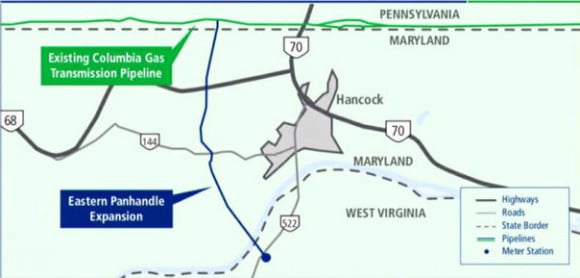
 As MDN has previously reported, Mountaineer XPress Pipeline includes 165 miles of new pipeline with approximately 2.7 billion cubic feet (Bcf) per day of transportation capacity from existing and future points of receipt along or near the Columbia pipeline system–most of it located in West Virginia (see
  In February the Federal Energy Regulatory Commission (FERC) issued a draft final environmental impact statement (DEIS) for two important pipeline upgrades to carry more Marcellus/Utica gas to southern markets–Mountaineer XPress and Gulf XPress (see

 TransCanada, one of Canada’s leading midstream/pipeline companies, cooked up a deal last year to pipe natural gas from Canada’s West Coast to the East Coast in order to fend off cheap supplies of Marcellus/Utica gas that will flow into Canada when/if the NEXUS and Rover pipelines get built (see
  Canadian-based TransCanada, famously known for wanting to build the Keystone XL oil pipeline from Canada to the Gulf Coast, didn’t want to be left out of the most important midstream story of the century (the Marcellus/Utica), so they bought Columbia Pipeline Group–closing on the sale in July 2016 (see
  Last week TransCanada announced they are “selling” their interest in the Iroquois Gas Transmission pipeline and a second pipeline, Portland Natural Gas Transmission System (PNGTS), to a subsidiary of TransCanada for $765 million. Every now and again big energy companies transfer some of their assets to different subsidiary companies, on paper. We say “on paper” because nothing really changes with the management of the assets–in this case two pipelines. However, money does change hands because usually there are different sets of investors for the different subsidiaries. So TransCanada “sold” themselves (different set of investors) these two pipeline systems. Iroquois is majority owned by TransCanada–in two pieces. After the drop down sale, TC PipeLines will own both pieces, representing 61.1% of the Iroquois system. Iroquois is a 416-mile interstate natural gas pipeline extending from the U.S.-Canadian border at Waddington, NY, through New York State and western Connecticut to its terminus in Commack, NY, and from Huntington to the Bronx, NY. The second pipeline part of the transfer deal is PNGTS–an interstate natural gas pipeline company providing natural gas transportation service for gas utilities, paper mills, and electric generation plants throughout New England. Here’s info about the deal, and an overview for each pipeline system…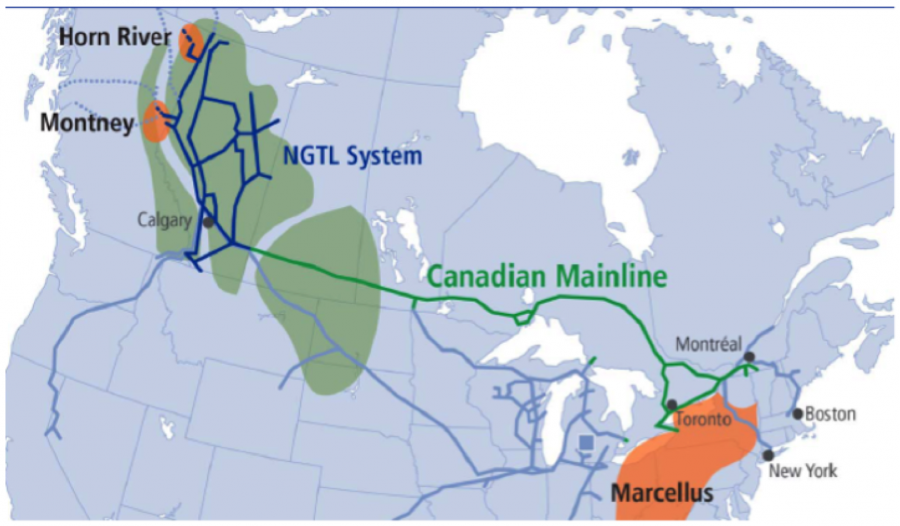
 TransCanada, one of Canada’s leading midstream/pipeline companies, cooked up a deal last year to pipe natural gas from Canada’s West Coast to the East Coast in order to fend off cheap supplies of Marcellus/Utica gas that will flow into Canada when/if the NEXUS and Rover pipelines get built (see