
EOG 2026 Utica Program: 3 Rigs, 3 Frac Crews, Drill 85 Wells
 Last week, EOG Resources reported strong full-year 2025 results, earning $5.0 billion in net income and returning $4.7 billion in free cash flow to shareholders. For 2026, EOG announced a $6.5 billion capital plan targeting 13% total production growth and increased operational efficiency. A central component of this strategy is EOG’s Ohio Utica play, which the company has identified as a top priority alongside the Delaware Basin and Eagle Ford. Following its transformational Encino Energy acquisition last August, the company expects significantly higher activity in the Utica throughout 2026. Read More “EOG 2026 Utica Program: 3 Rigs, 3 Frac Crews, Drill 85 Wells”
 Two radical environmental groups, the Southern Environmental Law Center and Sierra Club, have sued Georgia regulators over the approval of four clean-burning natural gas turbines at Georgia Power’s Plant Bowen. The radicals claim that the expansion at Bowen (in Taylorsville, Bartow County, Georgia) will release hundreds of tons of smog-forming volatile organic compounds (VOCs) and nitrogen oxides (NOx) annually, thereby worsening air quality in the Atlanta region (Taylorsville is about 40 miles from Atlanta as the crow flies). The lawsuit claims the Georgia Environmental Protection Division bypassed stricter permitting requirements intended for areas with high ozone levels. Typical lawfare tactic.
  Last week, RBN Energy held its GasCon 2026 conference in Houston, Texas. Among the heavy hitters who attended and spoke at the event were Sital Mody, President of Natural Gas Pipelines at Kinder Morgan, and Dan Brouillette, the 15th Secretary of the U.S. Department of Energy. Mody had this to say during his talk: “When I take a step back and reflect on the natural gas industry, the one thing that comes to mind for me is all gas, no brakes.”
  Although the Iran war has caused shipping, including oil shipping, to temporarily stop through the Strait of Hormuz, the bigger story is how the war currently is, and will continue to, affect the price of natural gas around the globe. Yesterday, QatarEnergy announced it is suspending production at the world’s largest LNG export facility following attacks by Iran. Qatar accounts for 20% of global LNG capacity, so its decision removes 20% of the market’s LNG supply for now. It represents the most significant market shock since Russia’s invasion of Ukraine in 2022. Dutch TTF Natural Gas Futures (the European benchmark, like our own Henry Hub) for April 2026 have surged 85% since Friday, trading near €59.62 following a 33.97% jump earlier today.
  U.S. LNG exporters are scrambling to capitalize on a 50+ percent price surge in European and Asian markets following an Iranian drone attack that halted production at Qatar’s massive Ras Laffan plant. Leading U.S. exporters like Venture Global and Cheniere Energy are maximizing output (squeezing every extra molecule out they can from existing plants) and rerouting cargoes to meet global shortages. While the U.S.’s flexible export contracts provide critical market stability, experts warn that American capacity cannot fully replace Qatar’s lost volumes, which account for 20% of global supply. Unless production resumes shortly, the world faces a more severe energy crisis than the 2022 Russian gas shock.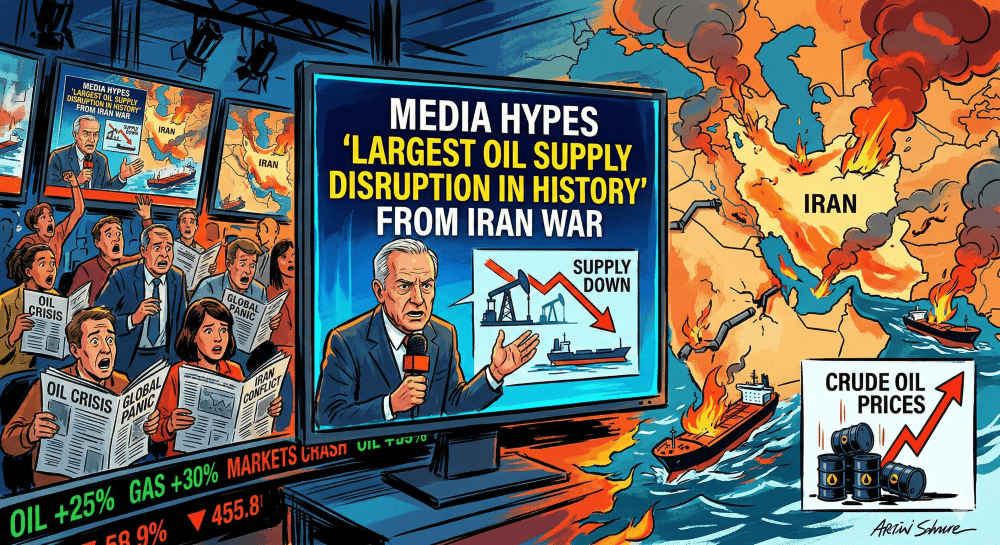
 OTHER U.S. REGIONS: Venture Global announces LNG purchase agreement with Trafigura; NATIONAL: U.S. natural gas futures post moderate gains; Science demands we overturn the ‘Endangerment Finding’; U.S. NGLs hit record 7.5 MMb/d production on ethane-driven gains; INTERNATIONAL: Crude jumps on Iran war escalation; Hopes for Suez Canal revival dashed; Saudis pulled deeper into war after new Iranian strikes; Nuclear reactor restart in Japan will likely displace natgas powergen; Naftogaz to import US LNG via Lithuanian terminal; The gas price shock will expose Britain’s catastrophic energy misjudgment; For oil prices, it’s the fear not the barrels.