
PA DCED Announces $501K Grant to Build NatGas Pipe to Greenhouse

Pennsylvania’s Pipeline Investment Program (PIPE) issues grants covering part of the cost for building new natural gas pipelines to connect homes and businesses, typically in rural parts of the state, to homegrown Marcellus Shale gas supplies. We’ve written about many PIPE grant projects in the past (see our PIPE stories here). Another PIPE grant was announced yesterday by the Pennsylvania Dept. of Community and Economic Development (DCED). This latest grant is for half a million dollars to help build a 3,000-foot pipe to help feed more Marcellus gas to a greenhouse operation that wants to expand.
Read More “PA DCED Announces $501K Grant to Build NatGas Pipe to Greenhouse”

 This is a rarity here on MDN. We’re awarding an MDN “attaboy” to northeastern Pennsylvania State Sen. John Yudichak–a Democrat! Yudichak has just stuck his neck waaaaay out by (a) voicing strong support for the Marcellus Shale gas industry, and (b) bashing New York Gov. Andrew Cuomo for his stance in blocking new gas pipelines.
 It certainly seems as if the deck has been stacked against the PennEast Pipeline project, a $1 billion, 120-mile natgas pipeline that will stretch from northeast PA to the Trenton area of New Jersey. As we pointed out in November, DTE Energy’s NEXUS Pipeline, a 255-mile pipeline from Columbia County in Ohio to Southern Michigan, received its Federal Energy Regulatory Commission (FERC) approval around the same time PennEast did, about a year ago. NEXUS is already built and flowing, PennEast hasn’t turned the first shovelful of dirt yet. It’s been a real battle for PennEast (see
  Let’s be right up front about how we feel about the innocent-sounding Trout Unlimited (TU). Four years ago the organization was outed as a radical, far-left environmentalist group–hellbent on opposing fossil fuels (see
  PennEast Pipeline has just achieved yet another milestone on its way to getting built. At a meeting last Thursday, the Board of Supervisors for Kidder Township (Carbon County, PA) voted 5-0 in favor of issuing a permit to PennEast to site the one-and-only compressor station the 120-mile pipeline will need. Proving yet again that most Pennsylvanians are in favor of this project, contrary to the mainstream/leftist media drumbeat against it. PennEast is a $1 billion primarily 36-inch pipeline from Dallas (Luzerne County), PA to Transco’s pipeline interconnection near Pennington (Mercer County), NJ. The company expects final Federal Energy Regulatory Commission (FERC) approval any week now. There are still a few hurdles left–mostly in New Jersey. But those hurdles are certainly surmountable. The radical Sierra Club and THE Delaware Riverkeeper are adamantly opposed and continue to try and throw up legal (and regulatory) roadblocks. No matter. This important pipeline will get built–and this compressor station approval is one more bit of evidence that it will get built…
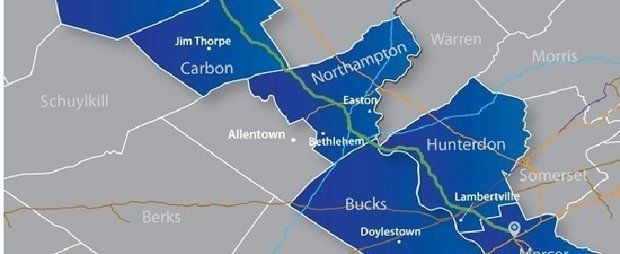 PennEast Pipeline is a $1 billion, 118-mile pipeline from Luzerne County, PA to Mercer County, NJ. Along the entire length of the pipeline, there will only be one compressor station–located in Carbon County, PA. This past Wednesday the PA Dept. of Environmental Protection (DEP) conducted a public hearing on the compressor station plan. Nominally the hearing is to elicit feedback from the public. However, as is so often the case, these are not really hearings but theatrical performances where anti-drilling kooks put on the equivalent of a circus act. But antis weren’t the only ones who showed up for the hearing. Plenty of supporters were there too…
 A little good news to share about the PennEast Pipeline project–a $1 billion, 118-mile, primarily 36-inch pipeline that will get built from Dallas (Luzerne County), PA to Transco’s pipeline interconnection near Pennington (Mercer County), NJ. Last month PennEast got some bad news–a further delay from the Federal Energy Regulatory Commission (FERC) in delivering a final environmental review. The review was supposed to be done last August, but got pushed to this December. Then in November, FERC announced it would be next February before the final review is delivered (see