
Mountain Valley Pipe (MVP) Buys Favor with Appalachian Trail Groups
 The Appalachian Trail Conservancy, The Conservation Fund, and Mountain Valley Pipeline (MVP) yesterday issued a joint announcement that MVP is paying $19.5 million to the Conservancy to “conserve land along the Trail corridor and support outdoor recreation-based economies in Virginia and West Virginia.” It is the largest “funding package” in the Conservancy’s history to advance conservation efforts in a single geography.
Read More “Mountain Valley Pipe (MVP) Buys Favor with Appalachian Trail Groups”
 Democrat governors across the country are now mimicking the example set by the dictator of New York, Gov. Andrew Cuomo. Cuomo abuses state power to reject fossil fuel projects (unconstitutional in our opinion), telling NY’s state environmental agency to reject all new pipelines. Roy Cooper, governor of North Carolina, is the latest Cuomo wannabe. Cooper instructed his state’s environmental agency, the Dept. of Environmental Quality (DEQ), to reject permits for Equitrans’ proposed Mountain Valley Pipeline (MVP) Southgate project. Which the DEQ did yesterday. The agency tried to disguise the rejection using lame excuses, but the reason for the rejection was politics, plain and simple.
 We have some significant news coming out of yesterday’s 2Q update from Equitrans about the company’s Mountain Valley Pipeline (MVP) project. Equitrans is seriously considering expanding compression along MVP to flow an extra 500 million cubic feet per day (MMcf/d) of natural gas along the pipeline after it’s up and running.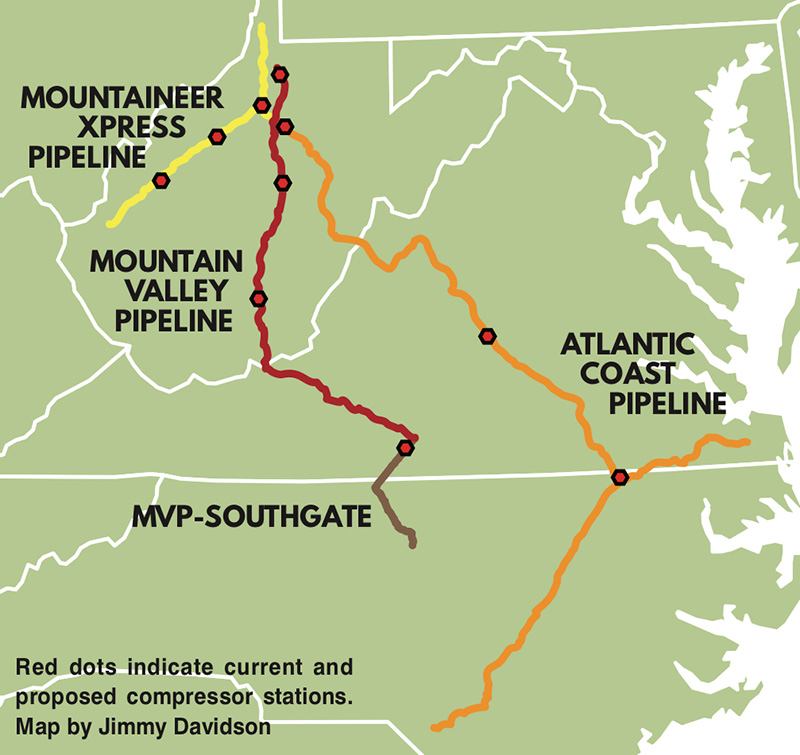

 In May a Montana federal judge appointed by Barack Obama capriciously blocked the use of U.S. Army Corps of Engineers Nationwide Permit (NP) 12 for all pipeline projects across the country (see
  Brian Lego, research assistant professor in the West Virginia University (WVU) Bureau of Business and Economic Research, says while canceling the $8 billion Atlantic Coast Pipeline (ACP) project is a blow to WV because of lost jobs, the even bigger impact will be less new markets for Marcellus/Utica gas, meaning growth in M-U drilling will be stunted.
 Coincidentally we have a second story today about pipe welding inspectors. In another post, we tell you about a pipeline welding inspector who falsified records (see ME2 Pipe Worker in SWPA Admits Falsifying Welding Records 77 Times), which is very much the exception and not the rule. In this second story, an inspector who worked for Equitrans Midstream has filed what he hopes will become a class action lawsuit against the Equitrans, claiming he and others were jilted out of overtime pay.
 Equitrans Midstream’s 303-mile Mountain Valley Pipeline (MVP) project is now 92% complete and will be done and online in early 2021 (see
  Equitrans, formerly EQT Midstream, separated from EQT in November 2018. Equitrans, via its EQM Midstream affiliate, gathers, processes, and flows most of EQT’s natural gas production, getting it to market. In February Equitrans announced it will absorb EQM, a limited partnership, into the fold (see
  Equitrans’ 303-mile Mountain Valley Pipeline (MVP) project from West Virginia to southern Virginia is now 92% in the ground and complete. That final 8% is frustratingly delayed because of lawsuits and regulatory actions brought on by Big Green groups. But have no fear. In an announcement released yesterday by the builder Equitrans Midstream, MVP will be 100% done and operational in “early 2021.” The end is in sight.
 Amid all of the frivolous lawsuits and regulatory actions brought by Big Green, aimed at blocking progress on important projects like the 303-mile Mountain Valley Pipeline (MVP) that runs from West Virginia to southern Virginia (90% complete), progress is still happening for new pipeline projects. One of those new projects is MVP Southgate, a 75-mile extension of MVP that will run from southern Virginia into North Carolina.
 The nation’s largest natural gas producer, EQT Corporation, is temporarily curtailing or shutting in roughly one-third of its natural gas production in Pennsylvania and Ohio. So says EQT’s main midstream (pipeline) provider, Equitrans (formerly EQT Midstream).