
Energy Services | Industrywide Issues | PennEast Pipeline | Pennsylvania | Pipelines | Statewide PA | Transco | Williams
Williams Announces Transco Competitor to PennEast Pipe in NEPA
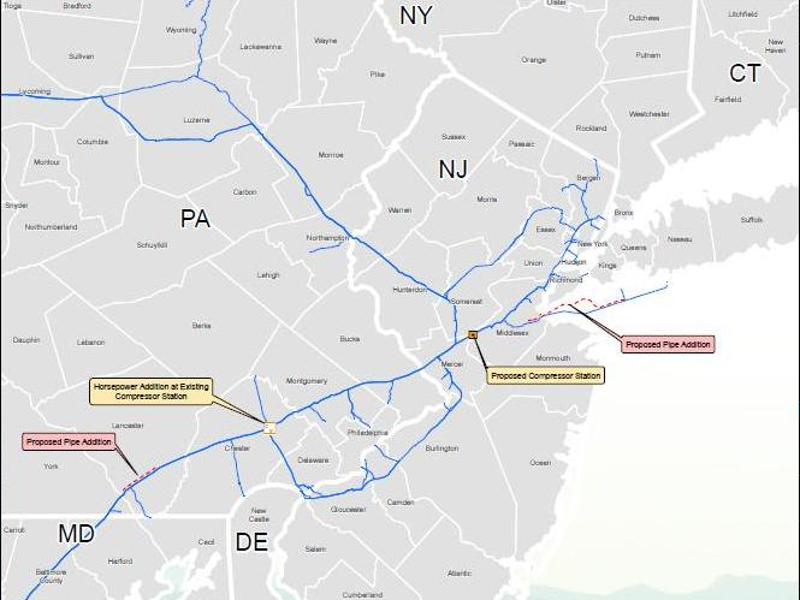
 Did Williams just float an alternative/competitive pipeline to PennEast? Sure looks that way to us. On Friday Williams announced a binding open season to add 34 miles of looping pipeline next to existing Transco pipeline along with beefing up some of it’s compressor stations, in a bid to increase flows along the Transco from Luzerne County, PA (where PennEast would originate) to Mercer County, NJ (where PennEast would terminate).
Read More “Williams Announces Transco Competitor to PennEast Pipe in NEPA”
 Williams is in the process of conducting open houses for a series of compressor station projects part of it’s recently announced Leidy South Project. The project will expand capacity along the Transco Pipeline system, including the newly minted Atlantic Sunrise Pipeline portion of Transco, adding another 582 million cubic feet per day (MMcf/d) of capacity to the Transco in northeast PA.
 The Sisters of the Corn (our name for the a group of leftist nuns in Lancaster County, PA) asked the U.S. Supreme Court to hear a case in which they claim their religious freedom has been trampled by Williams running a pipeline (Atlantic Sunrise) across their property. The case came up for consideration with the Supremes and they declined to hear it, meaning it’s the end of the road for the Sisters and the green group backing them.
 It’s no secret that getting a gas pipeline project of any kind approved in New York State is an uphill battle because our governor, Andrew Cuomo, blocks all new pipelines in a bid to keep his left wing supporters happy. An important project from Williams, the Northeast Supply Enhancement (NESE) which would beef up capacity along the Transco pipeline system going into New York City, is about to get two hearings with the state Dept. of Environmental Conservation.
 Ole Andrew Cuomo (pronounced Coo-moh by many people we know) is facing a classic Catch-22 situation. He has long promoted and earnestly wants a new arena as the home for the New York Islanders hockey team, but unless he allows a new natural gas pipeline under New York bay, he’s not going to get it.
 By a vote of 2-1, the Federal Energy Regulatory Commission (FERC) yesterday issued a final approval for Williams’ $85 million project called the Transco “Gateway Expansion Project,” which will flow an extra 65,000 dekatherms per day (65 million cubic feet) of natural gas to a couple of utility companies in New Jersey that have already signed on the dotted line as customers. The upgrades include a new compressor unit at Transco’s existing Compressor Station 303 in Essex County, NJ, a new valve and electric transformer also in Essex County, and equipment upgrades at a metering station in Passaic County, NJ. PSEG Power and UGI Energy Services have signed up to receive the extra gas–to be distributed to their customers in the region. Once again the two Democrat FERC commissioners, Cheryl LaFleur and Dick Glick, expressed overpowering, debilitating concern over how the project will “contribute” to mythical man-made global warming.
 It’s the birth of a brand new pipeline expansion project. Several weeks ago Williams pre-filed with the Federal Energy Regulatory Commission (FERC) to make certain upgrades (all of them in Pennsylvania) to its mighty Transco Pipeline. The upgrades include replacing smaller pipeline with larger pipeline in some areas, adding “looping” in other areas, and upgrading four compressor stations. The changes will flow an extra 582 million cubic feet per day (MMcf/d) of Marcellus gas from northeast and southwest PA to “growing demand centers along the Atlantic Seaboard.” Williams is holding two (of four) open houses next week to discuss the project. Below are details about the project and a copy of Williams’ FERC pre-filing application.
 Transcontinental Gas Pipe Line Co. (Transco) is the crown jewel of Williams. Transco is a 10,200-mile pipeline system with 53 compressor stations extending from South Texas to New York City. The recent Atlantic Sunrise Pipeline project in northeast PA that went online Oct. 6 is part of Transco, feeding more Marcellus gas into the Transco system to flow that gas south. During yesterday’s Williams third quarter update, CEO Alan Armstrong hinted that yet another new Transco project, “Project #1,” is in the works and will be announced during 4Q18. Project #1 will expand Transco’s capacity in Zones 3-6, allowing more Marcellus/Utica gas to flow south–perhaps all the way to the Gulf Coast.
 Williams’ Transco Pipeline has just won a major eminent domain court case for its Atlantic Sunrise Pipeline project that will have implications for all pipelines. Yes, Atlantic Sunrise is now in the ground and flowing natural gas (see
  Williams is expanding its mighty, 10,500-mile Transcontinental Gas Pipe Line Co (Transco), again. Sometime this month Williams will prefile a request with the Federal Energy Regulatory Commission for the Leidy South expansion project. The new project will bump up “compression” (either build new compressors or refit existing compressors) and build new “looping” pipeline in Pennsylvania, in order to increase capacity of Transco in the northeast Marcellus region by another 580 million cubic feet per day (MMcf/d).
 Yesterday the Federal Energy Regulatory Commission (FERC) finally (finally!) granted Williams permission to open the taps up and let natural gas flow along the Atlantic Sunrise Pipeline, a 200-mile greenfield pipeline from northeastern to southeastern PA. Startup was delayed two months from Williams’ original estimate (due to Williams, not FERC). But that’s all behind us now. Beginning tomorrow, Marcellus molecules from Cabot Oil & Gas, Chief Oil & Gas, and Seneca Resources will begin flowing along the pipeline, heading out of our region where those molecules will fetch higher prices.
 Marcellus/Utica gas is powering natural gas-fired plants in Southeast Florida?! Yep. How? Through a series of pipelines. First the gas goes south from our region by hitching a ride through the mighty Williams Transcontinental Gas Pipeline (Transco)–all the way to Alabama. Then, the Sabal Trail Pipeline, a 1.1 billion cubic feet per day (Bcf/d) pipeline, runs more than 500 miles from an interconnect with Transco in west-central Alabama to the Orlando, FL-area gas hub. Finally, a pipeline related to Sabal Trail called the Florida Southeast Connection delivers gas from the Orlando hub into South Florida. It’s a beautiful thing to behold. Our gas going all the way to the Sunshine State. The experts at RBN Energy do a deep dive to connect the dots and identify the gas-fired plants using our gas…
 Sometime this week we expect to blow the trumpets and wave the flags that finally (finally!) the Atlantic Sunrise Pipeline in Pennsylvania has begun flowing Marcellus gas south. Typically pipelines like Williams’ Atlantic Sunrise do a good job of working with landowners and municipalities to address concerns and tweak the route. We’ve heard some legitimate complaints over the past few years when a pipeline company seemed to turn a deaf ear to concerns by landowners. But usually those complaints were from other builders, not Williams. This time we have a story to share that (for us) is atypical. When building Atlantic Sunrise in Lancaster County, Williams said it was necessary to “temporarily” remove a stormwater basin (small pond to catch runoff) near two dozen mobile homes in Rapho Township. Over the objections of the local town, Williams went ahead (with state Dept. of Environmental Protection blessing) and completely removed the stormwater basin. Then a series of unfortunate events happened. Some 10 inches of rain fell–quite unheard of, supposedly a 1,000-year event. And the mobile home park got flooded. Would the nearby stormwater basin have helped prevent the flood if it were still there? Maybe, but (according to town officials), probably not. Not with 10 inches of rain. Still, it does raise a question. Was the flooding of the park made worse because the basin was gone? And if so, how much worse?…