
“Cool Down Cargo” Arrives at Golden Pass LNG, Startup Coming

The arrival of a “cool down” liquefied natural gas (LNG) cargo from Qatar at the Golden Pass LNG terminal marks a pivotal step toward the facility’s first production. This delivery supports the $10 billion project’s commissioning phase by providing necessary LNG to pre-cool storage tanks and equipment. Signaling significant progress for the Sabine Pass facility, Golden Pass LNG projects that exports from Train 1 will officially commence early next year. Read More ““Cool Down Cargo” Arrives at Golden Pass LNG, Startup Coming”
 A commentator writing for Reuters warns that soaring U.S. natural gas prices and falling global values are squeezing profit margins for American LNG exporters, threatening future exports. The narrowing price gap between U.S. and European markets, driven by high domestic demand and global oversupply, has reached its lowest point since 2021. The prognosticator postulates that while immediate production cuts are unlikely, a surge in new global capacity by 2027 could force reductions in U.S. LNG exports. Furthermore, rising domestic prices pose a political challenge for President Trump, as his promise to lower consumer energy costs conflicts with market tightening driven by increased LNG exports and energy-intensive data centers.
  This story has nothing to do with the Marcellus/Utica (apologies in advance), other than the companies involved have operations in or purchase molecules from the M-U region. We decided to launch an occasional “Bizarre Files” to call attention to energy news that is, well, bizarre. How about this: France-based TotalEnergies, along with Netherlands-based TES and several Japanese utility companies, are collaborating to produce what is called electric natural gas (e-NG), also known as e-methane, in Nebraska. The e-NG will be exported to Japan. Here’s where it gets interesting, and bizarre…
  According to Reuters, U.S. liquefied natural gas (LNG) exports hit a new all-time monthly high in November for the second straight month, driven by cooler weather and robust output from the country’s two largest producers. Even so, the Trump administration is considering further steps to speed up the buildout of LNG export infrastructure. For example, the Federal Energy Regulatory Commission (FERC) is considering a blanket permit rather than assessing each new project individually before approving its construction.
  UGI, a diversified energy company with midstream (pipeline) operations and one of PA’s largest utility companies, held a ribbon-cutting ceremony at its newest LNG peak shaver facility in Carlisle (Cumberland County), PA, yesterday. In November 2020, UGI launched the operation of a new 2-million-gallon LNG peak shaver in Bethlehem, PA (see
  This is really rich. Venture Global (VG), now the second-largest LNG (liquefied natural gas) exporter in the U.S., is accusing Shell of waging a “three-year campaign” to damage VG’s LNG business. VG’s Calcasieu Pass (CP) LNG export facility in Louisiana began operations in March 2022. Typically, a new LNG facility will load and ship several (maybe two or three) cargoes to “work out the kinks” and ensure everything is working as advertised. VG, using loopholes in its signed contracts, maintained that it was working out the kinks long after it began shipping. After *hundreds of cargoes* were shipped, CP’s customers were still not receiving their contracted (at lower prices) shipments. Shell, along with several other customers, sued (see
  Yesterday, LNG exporter Venture Global announced that Tokyo Gas has signed a 20-year contract to purchase 1 million tonnes per annum (MTPA) of LNG from VG. Not many details were shared. We don’t know which facility (current or planned) the gas will come from. Financial terms were not disclosed. What we do know is that contracted shipments will begin sometime in 2030. As with all of these deals, our interest is in whether more Marcellus/Utica molecules will feed the plant doing the liquefying. It’s a good bet they will.
  Freeport LNG has become something of a punchline for the frequent outages at the facility. Except, it’s no laughing matter. Outages at Freeport have happened so frequently that we’ve lost count. Last Thursday, one of the three LNG trains at the facility was offline again, affecting gas flows to (and from) the facility. According to a Reuters report, the gas restarted flowing to the affected train on Friday. Freeport refused to comment on this latest outage.
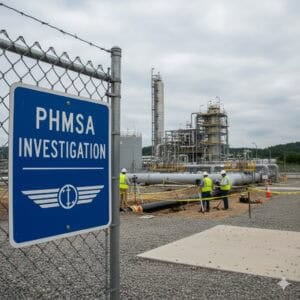 Federal safety officials are investigating leaks of ethane near two small underground storage tanks at the Cove Point LNG export terminal in Maryland and have requested that they be taken out of service immediately, citing potential safety concerns. The cause of the leak appears to be related to the tanks or their piping. However, Cove Point LNG, a facility owned and operated by a Berkshire Hathaway Energy subsidiary, maintains that the 40-gallon tanks are “safe to operate under the current conditions” and that the leaks have never posed an unsafe condition for employees or the community. The Pipeline and Hazardous Materials Safety Administration (PHMSA) issued a proposed safety order in mid-October, and the company has requested an informal consultation to discuss it.
  Venture Global’s Calcasieu Pass (CP) LNG export facility in Louisiana began operations in March 2022 (see
  In April, we told you that Energy Transfer’s (ET) Lake Charles LNG project had landed a new partner to help pay for the project, MidOcean Energy, which will cover 30% of the cost of building the plant (see
  The mystery may have been solved by MDN… In September 2022, the Delaware River Basin Commission (DRBC) voted to extend a permit to build a special LNG export dock along the shoreline of the Delaware River in New Jersey by an extra three years (see
  Yesterday, the Pennsylvania House Environmental and Natural Resource Protection Committee (the House has a one-Democrat majority) held a hearing on a proposal by Penn America to locate a 1 Bcf/d (billion cubic feet a day) LNG natural gas export facility in the City of Chester, Delaware County. The hearing was hosted by Rep. Carol Kazeeme (D-Delaware) and was exclusively attended by Democrats who were there to bash the project. There was no “How can we make this better?” There was only, “No way, no how, go to hell.” That’s the new Democrat Party and its political “leaders.”
  The NYMEX futures price for natural gas was a rocket ship over the past two weeks. The NYMEX price closed at $4.1240/MMBtu on Friday, breaking the $4 barrier barely a month after we struggled to break the $3 barrier. In October, the NYMEX front-month contract rose an astounding 82.10 cents per MMBtu, or 25%. In one month! October was the largest one-month gain since August 2022, and the largest one-month percentage gain since February 2025. Zooming out a bit, the NYMEX price was up $1.127 or 38% over the last two months. However, spot prices (at least in the Marcellus/Utica) are more of a mixed bag.