
President Trump Issues 60-Day Waiver of Jones Act, Includes LNG
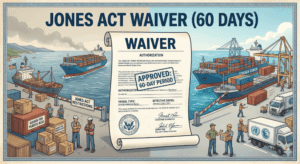 We lead with this story about a government regulatory action because of just how important we see this development. For *years* we have railed against the 106-year-old Jones Act and its requirement that any goods (like LNG) that are transported from one U.S. port to another be on a ship manufactured in the U.S., owned by a U.S. company, and crewed by a U.S. crew. The effect of this law in the modern age is to ban LNG (and other shipments, like gasoline, propane, coal, and other products manufactured in the U.S.) from being shipped cheaply from port to port. The U.S. foolishly allowed its ship manufacturing to slip away years ago to South Korea and other countries. We no longer make cargo carriers for LNG and other energy products. We haven’t made them in decades. Yesterday, President Trump signed a 60-day waiver of the Jones Act, allowing certain goods (such as LNG, fertilizer, and coal) to be transported from U.S. port to U.S. port on foreign-owned, foreign-flagged and crewed ships. Read More “President Trump Issues 60-Day Waiver of Jones Act, Includes LNG”
 Last summer, Venture Global announced a final investment decision (FID) for “Phase 1” of its Calcasieu Pass 2 (CP2) LNG project (see
 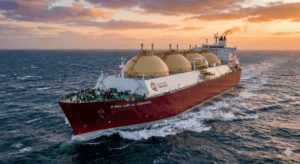 The Golden Pass LNG terminal is a liquefied natural gas terminal and regasification facility in Sabine Pass (Port Arthur), Texas. It is among the largest LNG facilities in the world. It can accommodate up to 15.6 million metric tons (MT) of LNG per year, the equivalent of approximately 2 billion cubic feet of natural gas per day (Bcf/d). QatarEnergy, Qatar’s state-owned petroleum company, owns 70% of the Golden Pass LNG project. ExxonMobil owns the other 30%. Sabine Pass sees a tremendous amount of Marcellus/Utica molecules flowing to the region via a couple of pipelines, namely Transco (which flows M-U molecules). Hence, our interest in this major natural gas user’s start-up. We have good news…
  Venture Global’s Calcasieu Pass (CP) LNG export facility in Louisiana began operations in March 2022 (see
  As the conflict with Iran and the halt in LNG production in Qatar triggered a 100% spike in European natural gas prices, U.S. liquefied natural gas (LNG) has solidified its role as a critical global energy stabilizer. Following the 2022 invasion of Ukraine, the U.S. became Europe’s primary supplier, a shift highlighted at a recent Pittsburgh energy conference. EQT CEO Toby Rice and other Pennsylvania producers argue that expanding Marcellus Shale exports is essential for allied security. Despite infrastructure bottlenecks, U.S. LNG exports are projected to grow significantly by 2030, offering a reliable alternative to volatile Middle Eastern and Russian energy supplies.
  Last week, RBN Energy held its GasCon 2026 conference in Houston, Texas. Among the heavy hitters who attended and spoke at the event were Sital Mody, President of Natural Gas Pipelines at Kinder Morgan, and Dan Brouillette, the 15th Secretary of the U.S. Department of Energy. Mody had this to say during his talk: “When I take a step back and reflect on the natural gas industry, the one thing that comes to mind for me is all gas, no brakes.”
  Although the Iran war has caused shipping, including oil shipping, to temporarily stop through the Strait of Hormuz, the bigger story is how the war currently is, and will continue to, affect the price of natural gas around the globe. Yesterday, QatarEnergy announced it is suspending production at the world’s largest LNG export facility following attacks by Iran. Qatar accounts for 20% of global LNG capacity, so its decision removes 20% of the market’s LNG supply for now. It represents the most significant market shock since Russia’s invasion of Ukraine in 2022. Dutch TTF Natural Gas Futures (the European benchmark, like our own Henry Hub) for April 2026 have surged 85% since Friday, trading near €59.62 following a 33.97% jump earlier today.
  U.S. LNG exporters are scrambling to capitalize on a 50+ percent price surge in European and Asian markets following an Iranian drone attack that halted production at Qatar’s massive Ras Laffan plant. Leading U.S. exporters like Venture Global and Cheniere Energy are maximizing output (squeezing every extra molecule out they can from existing plants) and rerouting cargoes to meet global shortages. While the U.S.’s flexible export contracts provide critical market stability, experts warn that American capacity cannot fully replace Qatar’s lost volumes, which account for 20% of global supply. Unless production resumes shortly, the world faces a more severe energy crisis than the 2022 Russian gas shock.
 METLEN (Greek energy company) and Shell have signed a memorandum of understanding to cooperate on liquefied natural gas (LNG) supply and trading between 2027 and 2031. This partnership allows the Greek company to secure up to one billion cubic meters of LNG annually, leveraging domestic terminals and the Vertical Gas Corridor to supply Central Europe and Ukraine. The agreement highlights Greece’s growing importance as a strategic energy hub designed to replace Russian gas with U.S.-produced alternatives. This shift is further reinforced by increased Mediterranean exploration by major U.S. firms such as Chevron and ExxonMobil, solidifying the region’s role in European energy security. Believe it or not, there are implications for the Marcellus/Utica region.
  In early 2024, we reported that Penn America Energy CEO Franc James, the potential builder of the proposed Penn LNG export facility in the Philadelphia area, said that he “pumped the brakes” on the project but that it wasn’t dead yet (see
  According to an E&E News – Energywire article, U.S. natural gas exporters are bracing for a “global glut” in LNG. While the Trump administration champions LNG exports for “energy dominance,” lefty analysts warn that diverting one-fifth of domestic production abroad could inflate American utility bills (a long-disproven canard). These analysts expect a temporary price lull in 2026, followed by a significant spike in 2027. On the one hand, analysts say the U.S. will flood the global market with LNG, and the world won’t be able to “absorb” all of that energy, crashing prices. On the other hand, the same analysts say exporting “one-fifth” of our production will cause price spikes here at home. So, we’ll crash the price for everyone else, but cause a price increase here? You see the contradiction.