
Texas LNG Secures Bank Group for $5.7B Debt Financing, FID Soon
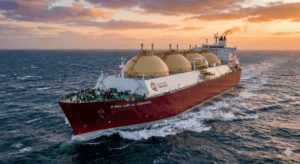 Glenfarne’s Texas LNG facility in Brownsville, Texas, will have a capacity of 4 MTPA. EQT Corporation, the largest natural gas producer in the Marcellus/Utica, signed two agreements with Glenfarne to liquefy 2.0 million tons per annum (MTPA) of EQT-extracted shale gas at the facility when it’s built (see EQT Signs Contract to Ship 264 MMcf/d to LNG Export Plant in Texas). That works out to be roughly 264 million cubic feet per day (MMcf/d) of EQT’s M-U molecules hitching a ride to South Texas. Good news: Glenfarne has raised $5.7 billion in debt financing to build it. The company actually had people raise their hands, representing $10 billion on offer. Read More “Texas LNG Secures Bank Group for $5.7B Debt Financing, FID Soon”
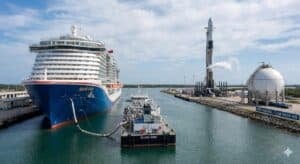 In December, representatives from Chesapeake Utilities and BHE GT&S, a subsidiary of Berkshire Hathaway Energy, presented a proposal to the Port Canaveral Authority to construct a new liquid natural gas (LNG) liquefaction facility in Brevard County, FL (see
  Here’s an unusual turn of events. During the recent cold snap and winter storm, the Cove Point LNG export facility (in Maryland) and Elba Island (in Georgia) stopped exporting LNG and instead *imported* LNG—from Trinidad and Tobago. They aren’t the only ones. The Everett LNG import facility off the coast of Boston and Canaport in New Brunswick, Canada, also imported Trinidad LNG cargoes. What the heck is going on here? We’ll explain.
  Winter Storm Fern triggered a sharp decline in U.S. LNG feedgas demand, which plummeted to 11.5 Bcf/d on Sunday from a previous weekly average of 17.2 Bcf/d. The storm caused production freeze-offs and price spikes, forcing Elba Island to shut down, and Cove Point inflows fell below 0.2 Bcf/d. Sabine Pass and Freeport (along the Gulf Coast) were down 50% and 30%, respectively.
  An Arctic blast in the U.S. has sent natural gas prices soaring to their highest levels since 2022, fueled by surging heating demand and production “freeze-offs” in major shale basins. As the world’s leading LNG exporter, supply disruptions in the U.S. now trigger global price hikes, particularly in Europe, which relies heavily on American gas following the loss of Russian pipeline flows. While increased global liquefaction capacity and floating inventories help manage volatility in LNG prices, the market has become structurally more interconnected. Consequently, when the U.S. freezes, the global LNG market catches a cold.
 Natural gas markets have experienced plenty of changes over the past few years. Some of those changes include rising associated gas production in the Permian, new pipeline and storage capacity, new LNG demand, and gyrations in prices. However, an RBN Energy blog article argues that all this was merely a prelude. RBN says the “main event” — a veritable transformation of gas markets, especially along the Gulf Coast — is about to begin. Buckle up! What’s coming? A doubling of LNG demand (to 32 Bcf/d!). Another 10 Bcf/d of new pipelines out of West Texas, plus at least 15 Bcf/d more along the coast. Production revivals in various shale plays. And don’t forget soaring demand for gas-fired power generation.
  In 2025, the United States became the first nation to exceed 100 million metric tons (mmt) of liquefied natural gas (LNG) exports annually, reaching a record 111 mmt. This 24% year-on-year growth, fueled by high terminal utilization and the rapid ramp-up of facilities like Venture Global’s Plaquemines plant, solidified the U.S. as the world’s leading exporter over Qatar. Europe remains the primary market as it shifts away from Russian energy, while shipments to Turkey and Egypt also stayed strong. Experts anticipate further growth in 2026 as new projects, including the Golden Pass LNG venture, begin production.
  This is sad and unexpected. Five weeks ago, MDN reported that Energy Transfer was holding off on a final investment decision (FID) for its Lake Charles LNG export project until 80% of the project had been sold to equity partners (see
  U.S. Secretary of Energy Chris Wright yesterday signed an amendment order granting an additional 44 months for Woodside Energy to commence LNG exports to non-FTA countries from the Woodside Louisiana LNG Project under construction in Calcasieu Parish, LA. The project was formerly called Driftwood. Once fully constructed, the project will be capable of exporting up to 3.88 billion cubic feet per day (Bcf/d) of natural gas as LNG.
  The European Union is simplifying compliance with its methane emissions law for oil and gas imports, a decision expected to aid U.S. exporters following pressure from the Trump administration. Recognizing that the commingled nature of U.S. liquefied natural gas (LNG) makes tracing difficult, the European Commission proposed two streamlined reporting options: utilizing third-party verification certificates or a digital “trace and claim” system. While the core regulation remains intact with stricter standards scheduled for 2027, these adjustments aim to prevent supply disruptions by offering more flexible monitoring solutions for the fragmented U.S. energy industry. To which we say, tell Europe to bugger off.
  A month ago, MDN reported that Energy Transfer was holding off on a final investment decision (FID) for its Lake Charles LNG export project until 80% of the project had been sold to equity partners (see