Marcellus & Utica Shale Story Links: Tuesday, Oct 4, 2011
The “best of the rest” – stories that caught MDN’s eye that you may be interested in reading:
Read More “Marcellus & Utica Shale Story Links: Tuesday, Oct 4, 2011”

The “best of the rest” – stories that caught MDN’s eye that you may be interested in reading:
Read More “Marcellus & Utica Shale Story Links: Tuesday, Oct 4, 2011”
 If you’ve been around the shale gas drilling debate for long, you know that most of the opposition to drilling focuses on a little-understood, decades-old technology called hydraulic fracturing, or “fracking” for short. If you’re a science fiction fan, you may also recognize the word fracking from the Battlestar Galactica television series. The word is used as a curse word substitute for another “f” word to avoid being censored.
Fracking’s closeness in spelling, and sound, to the other “f” word has not gone unnoticed by those who oppose drilling. They’ve used the word fracking in all sorts of double entendres with signs like like “Don’t Frack Me” and hundreds of other variations. Just attend a protest meeting and you’ll see what we mean.
Who are the biggest producers of Marcellus shale gas in Pennsylvania so far this year? Below is the list of the top seven as compiled from production numbers by the Pittsburgh Business Times.
The following are production numbers for January to June 2011 in Pennsylvania.
You can add Ohio to both Pennsylvania and West Virginia on the official list of eastern states actively courting the investment of Shell and others who seek to build an multi-billion dollar ethane cracker plant.
Gov. Tom Corbett is a man in motion. He’s only been in office for nine months, but he’s already fixed a huge budget deficit, a nice gift left to him by the departing Ed Rendell, and he appointed a special commission that has already met and provided him with 96 recommendations for changes that should be made to the Marcellus drilling industry in the state. It seems today may be the day when Gov. Corbett announces which of those recommendations he plans to adopt.
Read More “PA Gov. Corbett Set to Announce New Shale Drilling Rules”
A school district in Washington County, PA (in western PA) just signed a five-year lease for school district property with Range Resources:
Read More “Canon-McMillan School Signs Gas Lease with Range Resources”
The joint venture situation continues to heat up as energy companies look to develop the Utica Shale in eastern Ohio and western Pennsylvania. This time, it’s Carrizo Oil and Avista Capital Partners. Avista is an investment firm with deep pockets, deep enough to float Carrizo up to $200 million.
Read More “Carrizo Gets Big Cash Infusion to Develop Utica Shale”
Yet more proof that Marcellus gas drilling is a jobs-creating machine in Pennsylvania, this time in western PA’s Butler and Washington counties:
The “best of the rest” – stories that caught MDN’s eye that you may be interested in reading:
Read More “Marcellus & Utica Shale Story Links: Monday, Oct 3, 2011”
 Below are the results of last week’s poll on whether or not so-called “vandalism” against drilling sites should be considered an act of domestic terrorism. Seems the MDN audience is split almost evenly on this one.
Should vandalism at drilling sites be considered an act of terrorism?
Yes (51%, 129 Votes)
No (46%, 116 Votes)
Not sure (3%, 9 Votes)
Total Voters: 254
Do you believe in man-caused global warming?
A theme MDN returns to from time to time, because it is so obvious, is that those who oppose natural gas drilling often do so because they have an ideological view that all fossil fuels, including natural gas, are “evil.” The thinking goes that fossil fuels create carbon dioxide (CO2) when burned, and that CO2 levels are increasing to dangerous levels in the earth’s atmosphere. The argument is: more humans on the planet using more energy = more burning of fossil fuels = more CO2 in the atmosphere AND more CO2 in the atmosphere causes a rise in the earth’s temperature. Conclusion: man causes global warming. Solution? Don’t burn fossil fuels but instead use renewable energy sources like wind and solar. A simplistic description of the argument, but, I believe, an accurate one.
There are many problems with the theory of man-made global warming, not least of them that there is no evidence that an increase in CO2 levels causes a greenhouse effect of temperatures rising significantly. And also no evidence that even if more CO2 is being released and trapped in the atmosphere, that ole Mother Earth can’t somehow cope with it. The planet is not as fragile as some would have us believe. Global warmists ignore the biggest influencer of weather and temperature on planet earth: the sun. The sun has decades-long cycles of radiation and sunspots which arguably do more to increase or decrease temperatures on earth than any other cause. But that’s conveniently left out of Al Gore’s and other warmists’ equations.
 And don’t get me started on where, exactly, do we go to take the “temperature” of the earth? And how is that temperature measured? How is it averaged? What geographies are included and excluded? And how can the warmists claim we have rising temps compared with the temps from thousands of years ago when accurate and consistent methods of measuring temperature (with scientific instruments) have been around for maybe 150 years—a relative blink of an eye?
I have pointed out the connection between those who oppose drilling and their ideology of “we all must dump fossil fuels and convert to renewables now to save the planet before it’s too late.” And when I make my comments that I’m a skeptic of the underlying argument of man-made global warming—that the planet doesn’t need saving, that the threat is not actually there—I inevitably get called an ignorant git, a mass-polluter, an industry shill, someone only interested in the almighty buck.
So, for the sake of argument, let’s assume that I am dead wrong. Let’s assume that man is causing global warming because he’s burning fossil fuels and pumping too much CO2 into the atmosphere. Would it not make sense to burn the fossil fuel that puts the least amount of CO2 into the atmosphere, at least for now? Of course it would. Burning a fossil fuel with the least amount of CO2 contribution would mean we could slow the process of global warming down, perhaps even stop it. In that case, global warmists should fully embrace the least-polluting kind of fossil fuel, right? Well, there you would be wrong.
Instead of embracing natural gas for what it is—the cleanest burning and least polluting fossil fuel—warmists have to concoct pretend reasons for why why we shouldn’t use it anyway. Their ideology of forcing everyone to convert to alternative non-fossil fuel forms of energy has so blinded them, they lie even to themselves and gin up faux scientific studies to show that natural gas is “just as bad—even worse!” than coal and oil. Sad that otherwise smart people are not so smart because of their own biases.
Honest folks will honestly disagree on the topic of man-caused global warming, I’m well aware. If my skeptical views make you think I’m a nut job, well, go read someone else’s blog. I’m not hiding who I am and what I think.
What I would like to know with this week’s poll is how many in the MDN audience believe (or not) that man causes a significant amount of global warming. How many of you are my fellow gits?
Be sure to register your view (anonymously of course) on the right side of any page on the site. And feel free to leave a comment on this post with your thoughts if you’re so inclined.
Below are the most recent “top 5” lists and the calendar of Marcellus related events for the next two weeks.
Happy reading,
Jim Willis, Editor
Read More “MDN Weekly Update – Oct 2, 2011: Global Warming Debate”
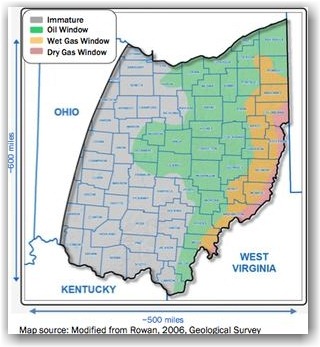 Yesterday, Chesapeake Energy reported initial horizontal well drilling results in the wet gas and dry gas phases of the Utica Shale play in eastern Ohio and western Pennsylvania and CEO Aubrey McClendon said the early results are “very strong.”
Chesapeake says they currently have five drilling rigs in the Utica Shale play and will double that to ten by the end of this year. Further, they plan to have 20 rigs running by the end of 2012, and up to 40 drilling rigs running in the Utica Shale by the end of 2014—truly a massive buildup.
From the Chesapeake press release:
Read More “Chesapeake’s New Utica Shale Wells Producing “Very Strong””
You’ve heard of the Marcellus Shale. You’ve also heard of the Utica Shale. Now get ready to hear about another geologic formation that may “rock” the energy world: the Upper Devonian, a group of shale and sandstone layers that sit above the Marcellus and the Utica. Range Resources said on Tuesday there’s a lot of natural gas trapped in the Upper Devonian layers—so much so that in Pennsylvania, the Upper Devonian may contain as much gas as the Marcellus.
In the ongoing saga of the Morgantown, WV ban on hydraulic fracturing, a ban both within and up to one mile outside of city borders (see here for a list of MDN articles on the topic), the leaders of Morgantown missed the deadline to file an appeal to the West Virginia State Supreme Court. So there will be no appeals and the fracking ban is officially overturned and done.
Read More “Morgantown Misses Appeal Deadline – Fracking Ban Now Over”
The full version of New York’s new proposed drilling guidelines, known as the Supplemental Generic Environmental Impact Statement (SGEIS) has been out in its full and “final” form for about three weeks (see this MDN story). At the time of the final release, the Department of Environmental Conservation (DEC) said the actual language of the regulations, the changes to existing oil and gas drilling regulations for New York, would come out “in early October.” The new language has just been released by the DEC, so, after criticizing Joe Martens (Commissioner of the DEC) for many things, MDN grants him an “at-a-boy” for releasing the language earlier than expected. The early release of the new regulation language further diffuses the argument by critics that they don’t have enough time to read and understand what’s coming.
The new regulatory language is important because it carries the weight of law once it’s adopted. Here are links to the sections that are either changed, or where new sections have been added:
Read More “NY Proposed Regulation Changes for Drilling Now Available”
Not long ago, MDN wrote about Norse Energy’s layoff of half of its employees since the beginning of 2011 (see MDN story here). One of MDN’s readers (“BinFranklin”) left a comment stating that “Norse Energy is a company on life support.” It seems it was a perceptive comment. He also said Norse has been selling off assets to keep going—again, accurate.
A new press release issued from the company today talks about Norse’s ongoing efforts to convert some of it’s debt into equity (convert bonds into stocks, handing over bits and pieces of ownership) because they will soon not be able to pay bond holders the payments due on the money they’ve borrowed. The press release, reprinted below in its entirety, basically says, “We’re still working on it but we haven’t done a deal yet.”
Read More “Norse Energy in Trouble, Wants Bondholders to Become Stockholders”
The “best of the rest” – stories that caught MDN’s eye that you may be interested in reading:
Read More “Marcellus & Utica Shale Story Links: Thursday, Sep 29, 2011”