
PA PUC Votes 3-2 to Levy New Taxes & Regs on AI Data Centers
 Last week, the Pennsylvania Public Utility Commission (PUC) approved a Tentative Order by a 3-2 vote, proposing a statewide model tariff (tax) to manage the growing impact of large-load customers, such as AI data centers, on the electric grid. The goal is to encourage investment and job growth while protecting existing ratepayers from cost-shifts and ensuring reliability. The PUC failed. The proposed order was passed on a partisan basis, with the three Democrat commissioners voting to make it harder and more expensive for data centers to locate in the Keystone State, potentially jeopardizing $92 billion of investments promised to the state related to data centers (see Pittsburgh Energy Event Truly Mind-Blowing, $92B+ Investments for PA). Read More “PA PUC Votes 3-2 to Levy New Taxes & Regs on AI Data Centers”
 We may finally, after seven long years of torture, have a resolution to the issue of forcing Pennsylvania to join the Regional Greenhouse Gas Initiative (RGGI) carbon tax scheme. The rumors are swirling around Harrisburg that the Democrats (including Governor Josh Shapiro) and Republicans in the state Senate are close to a budget deal. The budget was supposed to be adopted by July 1st. It’s now over four months late, and school districts and government agencies dependent on state funding are hurting. The rumor is that the budget deal includes a provision to dump PA’s participation in RGGI. Lefty environmentalists are having a CO2-emitting cow at the news.
  The Regional Greenhouse Gas Initiative (RGGI) is a carbon tax scheme. The RGGI tax is supposed to reduce the amount of carbon dioxide (CO2) produced by gas- and coal-fired power generators. The intent is to force fossil fuel power generators out of business. That’s what RGGI is designed to do, all in the name of reducing CO2. However, the only thing it accomplishes is to drive electricity prices higher. A new study from the Lawrence Berkeley National Laboratory (full copy below) finds that every state that belongs to RGGI has higher electricity prices than Pennsylvania. And each of those RGGI states saw their prices jump more over the past five years than the national average.
 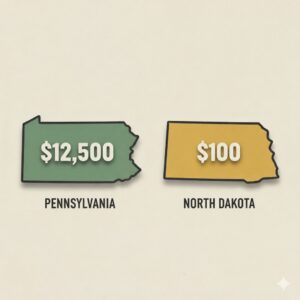 North Dakota’s regulatory framework is a model of simplicity. Companies pay a modest $100 fee for drilling permits, compared to $12,500 in Pennsylvania, and typically receive approval in 20 to 30 days. That efficiency has proven pivotal since 2010, when horizontal drilling and hydraulic fracturing significantly expanded the Bakken Formation’s potential for commercial-scale production. Of course, there’s a big difference between PA and ND—companies drill for oil in ND and natural gas in PA. So it’s not like a driller would say, “Screw it, we’ll leave PA and go drill in ND where it’s easier, faster, and cheaper.” However, drillers can/are leaving PA for Ohio and West Virginia, where it’s easier, faster, and cheaper. We bring you this masterclass on how ND makes drilling better, so perhaps, just perhaps, someone at the PA DEP (and the politicians involved in approving permit fees) will wake up and improve the experience in the Keystone State.
 Representatives from Clean Air Council, Earthworks, Environmental Health Project, Environmental Integrity Project (EIP), and Protect PT, some of the worst of the worst radical “green” groups in the Keystone State, rallied at the Pennsylvania State Capitol yesterday to demand (they always demand) that Pennsylvania’s Environmental Quality Board (EQB) accept their petition to consider drafting a new setback regulation in the state that would effectively ban all new shale drilling.
  The Penn State Extension has developed a helpful reference guide listing common water testing parameters for well owners. This resource helps owners determine if contamination from oil and gas drilling, pipelines, and related infrastructure is affecting their water quality. Key parameters include: alkalinity, arsenic, barium, bromide, BTEX (benzene, toluene, ethylbenzene, xylene), chloride, gross alpha radiation, methane/ethane, and strontium. The reference also provides sources for additional information.
  The current king of U.S. data centers is Virginia. As we wrote about earlier this month, Pennsylvania has the opportunity to grab that title away from Virginia, IF PA doesn’t screw it up (see
  Pennsylvania Governor Josh Shapiro oscillates between acting like an adult and a petulant child regarding rising electricity costs in his state, costs that are due in part to his own policies (see
  The Pennsylvania Independent Oil & Gas Association (PIOGA) has approved a resolution to become the sole, controlling member of the Pennsylvania Independent Petroleum Producers Association, Inc. (PIPP), effectively making PIPP a subsidiary. This unification, approved by both boards in October, aims to strengthen the unified voice of the state’s oil and natural gas industry. According to PIOGA Board Chairman Michael Hillebrand and PIOGA President Dan Weaver, the move ensures independent producers speak with “one voice, one vision, and one future,” allowing the associations to operate more efficiently and amplify their advocacy efforts in Harrisburg and beyond.
 The Pennsylvania Energy Ecosystem Conference was held yesterday at Washington & Jefferson College’s Center for Energy Policy and Management in conjunction with the Central Appalachian Partnership for Carbon Storage Deployment. The event featured industry leaders, policymakers, and other experts. We’re not sure what the focus of the event was last year, but the star of this year’s conference was natural gas, and, to a lesser extent, coal. In other words, fossil fuels took center stage.
  In two weeks, all Pennsylvania voters will have the opportunity to vote on whether to “retain” (elect for another 10 years) three radical-left Democrat State Supreme Court justices. Justices Christine Donohue, Kevin Dougherty, and David Wecht were all elected as Democrats in 2015, and their party has held a majority on the state’s high court since. They have made many decisions that are activist and favor the Democrat Party at the expense of ordinary residents of the state. It’s time for them to go. We have a couple of very good reasons why you (if you live in PA) should vote “no” on retention: Their votes in two cases have fundamentally damaged the Marcellus industry in the state.
  How many articles have we written about the connection between Pennsylvania’s ill-advised quest to become a member of the Regional Greenhouse Gas Initiative (RGGI) and the high cost of electricity? Dozens of articles, for sure. Former PA Governor Tom Wolf attempted to force the state to join the RGGI carbon tax scheme unilaterally. Republicans in the Senate sued to block it, as the legislature is the proper branch of government with the power to tax, not the executive. Wolf’s successor, Josh Shapiro, appealed a Commonwealth Court decision in favor of the Republicans to the PA Supreme Court, where the case now sits, waiting for a decision (after the election).
  On September 29, some 105 Democrat state legislators from 10 states across the PJM Interconnection region released a joint letter urging PJM to take immediate action to accelerate the deployment of unreliable renewable energy projects—to favor unreliable renewables over fossil fuels. The letter, organized by the partisan left-wing National Caucus of Environmental Legislators (NCEL), highlights urgent concerns about grid reliability, rising energy costs, and recent federal actions against renewable energy. A group of Pennsylvania Republican legislators responded with their own letter asking PJM to disregard the lunatic letter from NCEL.