
Lights Out for All O&G Production in Quebec, Including Utica Shale
 For years Canadian company Questerre Energy patiently waited to begin drilling on their extensive Utica Shale acreage in the St. Lawrence Lowlands of Quebec, Canada. Quebec has been like New York–completely closed to the oil and gas industry, particularly shale and fracking (see Quebec to Ban Utica Shale Drilling, Most Other Drilling Too). And yet Questerre kept trying. As recently as March of this year the company touted hydrogen (from natural gas) as the reason they should be allowed to drill in the Utica Shale (see Questerre Still Trying to Convince Quebec to Let Them Drill Utica). All hope is now gone. Three weeks ago Quebec announced it will expropriate all of the rights for all oil and gas companies in the province to drill and extract oil and natural gas. It’s all being shut down–including actively producing wells.
Read More “Lights Out for All O&G Production in Quebec, Including Utica Shale”


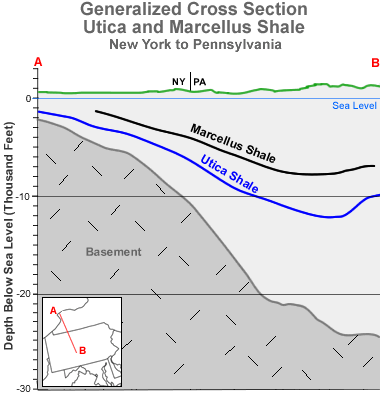
 The Utica Shale is starting to get more love. No, not in Ohio where the play is already well-loved, but in Pennsylvania and West Virginia. Although it’s always been known that the Utica underlies the Marcellus and in fact covers a larger geography than the Marcellus, drillers have not targeted the Utica nearly as much outside of OH. Why? Because it’s nearly twice as deep as the Marcellus and costs more to tap it. The Marcellus is roughly a mile below the surface, and the Utica roughly two miles below. However, there is renewed interest in the Utica in PA and WV in 2018. Most of the Utica wells drilled in PA have, so far, been drilled by Hilcorp. JKLM is targeting the Utica in Potter County. SWEPI (Shell) has drilled a few Utica test wells, as has EQT, CNX and others. Most recently CNX and Seneca Resources mentioned targeting the Utica in their quarterly updates. Throw it all in the mix and what it spells is more Utica drilling on the way in what has, until now, been largely Marcellus country…
 In early April of this year the 2017 AAPG (American Association of Petroleum Geologists) Annual Convention & Exhibition was held in Houston, TX. During one of the sessions, William Zagorski and Taylor McClain delivered a talk called “Discovery of the Utica Shale: Update on an Evolving Giant.” The interesting thing is that Zagorski and McClain work for Range Resources–the first driller in the Marcellus, not the Utica. We don’t have a transcript of that talk, but we do have an abstract and the slide deck used during the talk (below). The slide deck is fascinating. It begins with a history of the Utica. Did you know that the earliest Utica discoveries were in Ontario, Canada? And that the earliest drilling done in the play here in the U.S. was done in Upstate New York–near the Watertown area? No, we didn’t realize that either. In fact, a large swath of the Utica Shale layer underlies New York State–what a pity we can’t explore it because of a corrupt dictator by the name of Andrew Cuomo. At any rate, below is the slide deck, with slides outlining where the “wet gas” and “dry gas” zones are in the Utica. And exploring how Ohio became synonymous with the term Utica Shale…
 A comprehensive study by Cleveland State University researchers shows just how mind-blowing the economic investment in Ohio has been from the Utica Shale. The just-published study, titled “Shale Investment Dashboard in Ohio” (full copy below), finds that between upstream ($39 billion), midstream ($8 billion) and downstream ($3 billion), all related to the Utica Shale, there has been an incredible $50 billion invested in Ohio since Utica drilling began in 2011. It’s really hard to overstate just how big a deal this is. Can you image a $50 billion economic stimulus from the government? No way! It would never happen. And if it did, the money would come out of YOUR pocket–from taxpayers. But this $50 billion ALL came from the private sector. Good ole capitalism. Free enterprise. Private ownership. Private property. Love it! It’s what our great country was built on. Let’s dig into the numbers and relish this fantastic news…
 Going all the way back to 2012, MDN has chronicled, from time to time, the myriad press releases issued by a small driller headquartered in Denver called 1st NRG Corp. They’ve been saying since that time that they really really really really want to drill in the Utica Shale–on a small 7,000 acre leasehold they own (
 Last week MDN told you about Gulfport Energy’s deal to buy 85,000 acres of leases with 48 horizontal wells in Oklahoma’s SCOOP shale play in a $1.85 billion deal (see
  EQT is feeling bullish about natural gas drilling in the northeast for 2017. The company has just released its 2017 operational forecast. What do we notice? First off, they plan to spend $1.5 billion next year, most of which ($1.3 billion) will be used to drill and complete new wells. That’s a whopping 50% increase from spending $1 billion this year. The next thing we notice is what type of wells they intend to drill: 119 Marcellus wells (76 in PA and 43 in WV); 81 Upper Devonian wells, which will be drilled on the same pads as deeper Marcellus wells, but only in PA; and 7 “deep Utica” exploratory wells. EQT also reworked a midstream deal with Williams in the Ohio Valley. Below are the exciting details of what’s ahead for EQT in 2017, including a second announcement from EQT Midstream about what’s ahead for the pipeline subsidiary, including details on how much they plan to spend on the Mountain Valley pipeline project in the coming year…
 Little known fact: There is a Utica Shale layer in Canada–along the St. Lawrence River Valley–in the Province of Quebec. On and off over the years we’ve mentioned it, largely in connection with an ongoing moratorium on shale drilling in Quebec (
 When Aubrey McClendon first trumpeted his find in the Ohio Utica Shale, he famously said the Utica Shale could be worth $500 billion, and the “biggest thing economically to hit Ohio, since maybe the plow.” Not quite as famous, but on the same day at the same event, McClendon also said the Utica “is likely most analogous, but economically superior to, the Eagle Ford Shale in South Texas.” That one turned heads and got tongues flapping. McClendon made those remarks five years ago this month at the Ohio Governor’s 21st Century Energy & Economic Summit in Columbus, OH. The reason Aubrey was so excited was because of the oil potential in the Utica. But fate is a funny thing. As it turns out, it is natural gas that’s turned out to be the big story in the Utica. Last Friday the U.S. Energy Information Administration (EIA) published an article that chronicles the development of the Utica and illustrates, with charts and graphs, how the Utica has turned out to be a gas rather than an oil play–at least so far…
 Last week MDN reported researchers from Ohio State University had discovered a new form of microorganism in fracked Utica Shale wells–something they call “Frackibacter” (we call it Frackenstein). As researchers continue to pour over the research, they’ve hit upon a stunning new revelation. Those little critters may actually INCREASE natural gas output from the well. Now that is exciting news! OSU is on the case, promising to further examine Frackibacter’s origin and “more of its applications”…
 Although there’s less new drilling for oil and gas (at least there’s less if you believe press reports), and although DUCs (drilled but uncompleted wells) are decreasing, overall production in the lower 48 states is actually increasing. IHS Markit says natgas production in August increased month over month for the second month in a row–something that hasn’t happened in a year. Markit says the main reason is an increase in production in the northeast–specifically an increase in production in the Utica Shale. However, there were also increases in other plays. Here’s the full update…