
AEP Sells 2 Ohio NatGas-Fired Electric Plants to Blackstone JV
 American Electric Power is selling four electric generating plants to a newly formed joint venture of Blackstone and ArcLight Capital Partners. Three of the plants are natural gas-fired–two of them in Ohio and one in Indiana. One of the plants is coal-fired, located in Ohio. Total sale price for all four: $2.17 billion. While the announcement doesn’t say, we expect at least the gas-fired plants in Ohio, and perhaps the one in Indiana, are fed in part by Utica/Marcellus natural gas. Which is why the story caught our eye. The plants are already up and running–this is simply a transfer of ownership and (we presume) management of the plants. The larger story is just how important these types of plants are in the Marcellus/Utica ecosystem–because they use a huge amount of gas. Here’s the details of the deal…
Read More “AEP Sells 2 Ohio NatGas-Fired Electric Plants to Blackstone JV”
 MDN previously partnered with the ShaleNavigator online mapping service to produce a popular research report called the Marcellus and Utica Shale Databook. MDN editor Jim Willis did the data research and partnered with ShaleNavigator for the maps displaying that data. ShaleNavigator’s founder and owner has accepted a new job in another industry–a position that occupies most of his time–so he is looking to sell the service. Below are the details…
 The “best of the rest” – stories that caught MDN’s eye that you may be interested in reading. In today’s lineup: REX sees new signups for East-to-West capacity; ODNR issues 7 new Utica permits; Philly Energy Solutions ends bid to go public; developer tells Maine regulators to look at LNG storage instead of pipelines; Saudis keep buying America’s oil assets; Europe’s biggest natgas producer is running out of gas; and more!
 Anti-fossil fuel zealots in Athens, Meigs and Portage counties in Ohio are spitting and sputtering after the Ohio Supreme Court on Tuesday once again shut down their childish frack ban ballot measures–ruling that Secretary of State Jon Husted and the election boards of those counties did not violate the law in tossing out the ballot measures. The radical Pennsylvania-based Community Environmental Legal Defense Fund (CELDF) is particularly torqued off. It’s not the first time the Supremes have slapped them down. Their frack ban ballot measures were also tossed last year by the Supremes (see
  For some time now MDN has highlighted the ongoing internal division among the ranks between Pennsylvania landowners and drillers over the issue of royalty checks. PA landowners are supporting House Bill (HB) 1391 which would guarantee landowners receive a minimum 12.5% royalty check regardless of post-production costs (see
  Spectra Energy’s NEXUS Pipeline, a $2 billion, 255-mile interstate pipeline that will run from Ohio through Michigan and eventually to the Dawn Hub in Ontario, Canada, continues to build support and a good head of steam. In July the Federal Energy Regulatory Commission (FERC) issued a favorable draft Environmental Impact Statement for the project, a sure sign that FERC intends to approve it (see
  Various government agencies populated with liberal Democrats, including the Obama Environmental Protection Agency, the Obama National Park Service, the Obama Fish & Wildlife Service, and the New Jersey Environmental Protection Agency, filed negative comments about the PennEast Pipeline with the Federal Energy Regulatory Commission (FERC) on Monday. The last day to file public comments on PennEast was this past Monday, Sept. 12. In what almost seems like a coordinated attack, various agencies all filed their highly inflammatory and negative comments at the eleventh hour. The Obama EPA’s comments were particular egregious, making fantastically wild claims like building PennEast “may” end up causing arsenic in groundwater supplies. Talk about bogus B.S. (Barbara Streisand). The question is, will this unwarranted assault by federal and state agencies cause further delays in the already-delayed PennEast project?…
 Duke Energy Ohio, an LDC or “local distribution company” serves some half a million customers with natural gas in Ohio. The company has a ~12 mile pipeline to flow gas it needs to move from one point to another in Hamilton County, the southwest corner of the state. The Duke pipeline has been around and in service since the 1950s. Duke needs to replace that pipe or some of the half million Duke customers won’t get natural gas any more. Because anything to do with “fracking” or “pipelines” has been so thoroughly bastardized by the media and anti-drilling whack jobs, there was, of course, opposition to Duke’s plan. So Duke “listened” and has scaled back their plans. Instead of building a 30-inch gas pipeline running at 600 psi (pounds per square inch), the revised plan calls for a 20-inch pipeline running at 400 psi. Duke has proposed two potential routes (see the map below). Here’s the lowdown on Duke’s scaled-back, tiny pipeline project in Hamilton County called the Central Corridor Pipeline Extension Project…
 The longer we write MDN, the easier it gets–because the stories just keep repeating themselves. That’s how we felt when we spotted a story about the adults in Youngstown, OH pushing back against the temper tantrums of anti-fracking, childish nutters in the city who have, now for the sixth time, put a frack ban measure on the ballot for the November election. Five previous times the same group of rabid anti-fossil fuel haters have done this–and five times they have gone down to defeat (see
  Dominion launched a $4 billion, 25-year Pipeline Infrastructure Replacement (PIR) program in mid-2008. The program involves replacing over 5,500 miles of Dominion’s 22,000-mile pipeline system. Most of the pipeline to be replaced was installed in the first half of the 1900s. Some of the pipeline (much?) is being done in Ohio. The pipelines Dominion wants to replace in Ohio are regulated by the Public Utilities Commission of Ohio (PUCO). If Dominion wants to do anything with or for the pipelines in Ohio, they first need PUCO permission. Dominion has sought, and now received, PUCO permission to expand the program in Ohio. Dominion currently spends $160 million per year on the program in Ohio. PUCO gave them permission to up that amount to $170 million next year and $200 in 2018. Why is that important? Because Dominion gets to “recover” the costs (i.e. charge the costs) to utility customers. Dominion customers in Ohio can expect to see a rate increase…
 In February MDN told you that Dominion, with a major presence in the Marcellus/Utica region, had floated a takover offer to Questar Corporation, offering to buy the company for $4.4 billion (see
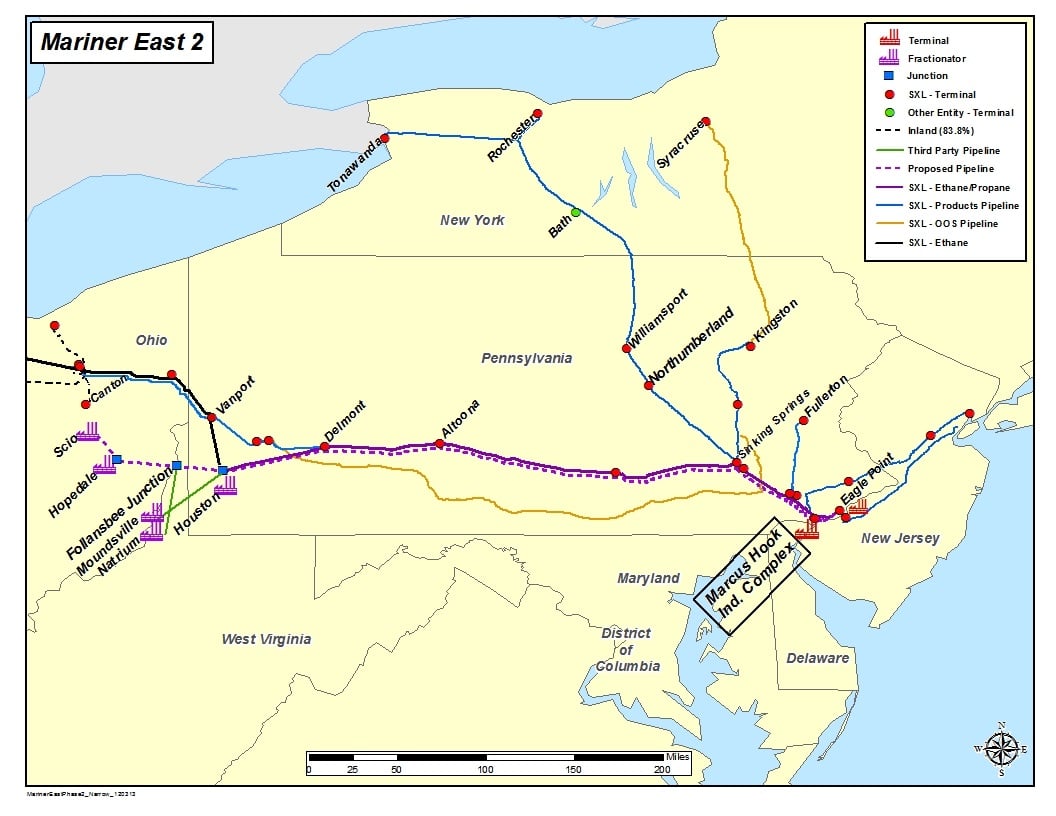
 There is no doubt Sunoco Logistics Partners has been pushing a boulder up a hill when it comes to the Mariner East 2 pipeline project–a $2.5 billion, 350-mile natural gas liquids (NGL) pipeline that will run from eastern Ohio through the state of Pennsylvania to the Marcus Hook refinery near Philadelphia, carting ethane, butane and propane to the facility from both the Utica and Marcellus region. For over a year the project was mired in legal challenges of whether or not it can claim public utility status, with a right to use eminent domain. In July, PA’s Commonwealth Court ruled it is a public utility with a right to use eminent domain (see