
Epsilon Energy 1Q: Still Partners with Chesapeake in NEPA
 From time to time we check in on Epsilon Energy, which concentrates most of its effort on the Marcellus in Susquehanna County, PA. Does Epsilon actually do any of its own drilling? No. They partner with (give money to) other companies, like Chesapeake Energy, and the other companies do the actual drilling. Epsilon, according to its website, owns ~4,000 net acres in the PA Marcellus. Epsilon issued its first-quarter 2020 update yesterday.
Read More “Epsilon Energy 1Q: Still Partners with Chesapeake in NEPA”
 A leftist anti-fossil group calling itself Protect PT, in Penn Township (Westmoreland County), PA, backed with big money from Big Green groups, has for years challenged Penn Township ordinances that allow Apex Energy and Huntley & Huntley (now Olympus Energy) to drill and operate shale wells. Protect PT has finally struck out, permanently, at the Pennsylvania Supreme Court.
 ECA Marcellus Trust I announced yesterday that there will be no distribution (dividend) paid for investors for first-quarter 2020 because expenses exceeded net revenues. Who is ECA Marcellus?
 Have Marcellus/Utica drillers learned their lesson about growth at any cost? It seems the answer to that is, YES! The price of natural gas has been low for a long time due to overproduction. You’ve often read here on MDN that gas prices will be “lower for longer.” And yet with the coronavirus pandemic and the crash in oil prices, the price of natgas has been (mostly) inching up–getting close to $2/Mcf (although it was down again yesterday, to $1.62/Mcf). Estimates for gas prices next year are trending to the $2.50-$2.75 range. Everyone is watching–will M-U and other gas-focused drillers restart big spending and more drilling?
 MARCELLUS/UTICA REGION: Methane leaks much worse than previously thought, study says; Range Resources shareholders OK compensation plan at annual meeting; OTHER U.S. REGIONS: Bakken gas supplies plunge as oil production pulls back; NATIONAL: EIA expects energy-related carbon dioxide emissions to fall 11% this year; Republicans urge Trump to bar banks from shunning fossil fuel loans, investments; FERC picks first-ever chief of LNG division.
 Diversified Gas & Oil (DGO) continues its program of buying up mostly older conventional oil and gas wells in Appalachia. In April DGO cut a deal to buy 6,500 conventional wells spread across West Virginia, Kentucky, and Tennessee, along with a 4,700-mile gathering pipeline system located in WV, for $110 million (see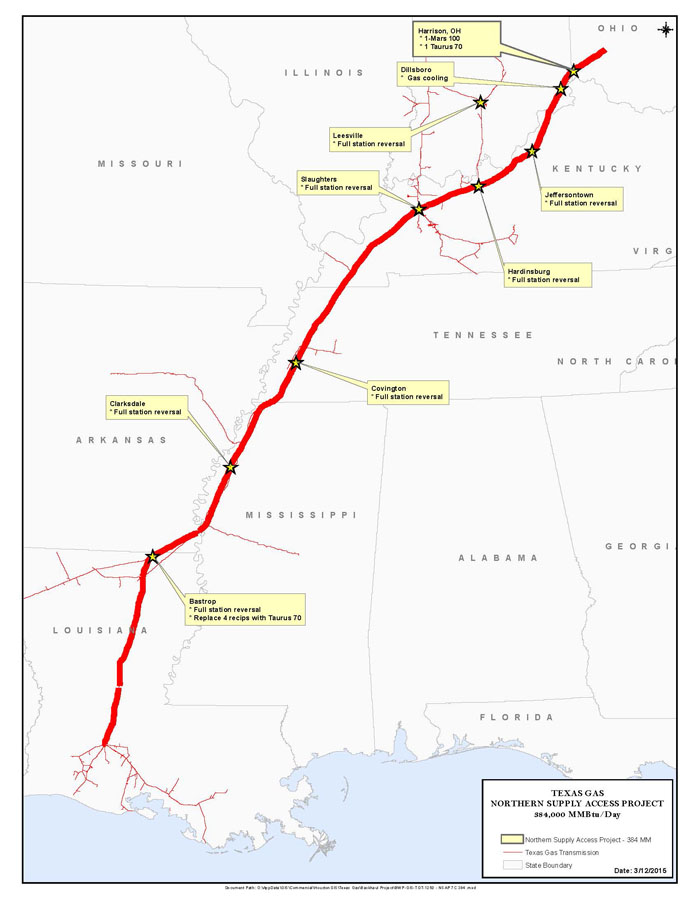
 A relatively short pipeline project to flow water from the Susquehanna River in Tunkhannock (Wyoming County), PA to a water impoundment about seven miles away, began construction in February 2019 (see
  In May 2016, a landowner in Wayne County, PA filed a lawsuit against the Delaware River Basin Commission (DRBC) asking a judge to declare that the DRBC does not have jurisdiction to prevent the construction of a natural gas well (see
  A tiny 2.1-mile pipeline looping project in western Massachusetts has been fought tooth and nail for over two years by anti-fossil fuel zealots. The Federal Energy Regulatory Commission (FERC) approved the project, subsequently refused to “rehear” its decision, and now Big Green groups (with loads of money) have colluded to sue FERC in federal court in an attempt to emasculate the agency because it won’t consider mythical man-made global warming when approving projects like this one.
 For the past two weeks, MDN has brought you a new shale drilling permits issued report on Wednesdays. We fully intended to do so again today–except the Ohio Dept. of Natural Resources (ODNR) website is down with no estimates for when it will be back online. We have PA and WV numbers, but are holding the report back until we can get OH numbers too. In lieu of the report today, we have an article we spotted comparing PA’s permits issued in April of this year compared to last year–noting new permits have decreased by 46% year over year.
 It becomes more obvious every day that the rank and file (even the leaders) of trade unions are breaking with their Democrat Party bosses over issues like insane taxes on natural gas. The divide is particularly acute in blue states like Pennsylvania, which voted for Donald Trump in 2016 and likely will again in 2020 because the Dems keep shooting themselves in the head with stupid taxes and regulations that kill jobs. The PA AFL-CIO issued a statement yesterday thanking the PA Air Quality Technical Advisory Committee, part of the Dept. of Environmental Protection, for listening to the union’s concerns about Gov. Wolf’s proposed carbon tax at a recent hearing.
 Chesapeake Energy issued its first-quarter 2020 update yesterday–but not in the typical fashion. They filed the required Form 10-Q with the Securities and Exchange Commission and announced they will not hold a conference call or webcast to discuss anything with anyone. No wonder. The financials for the company are dreadful. Chesapeake lost (on paper) $8.3 billion in 1Q20 due to the writedown of assets (called an impairment). It was not an out-of-pocket-cash loss, thank God. Still, it was bad enough. The 10-Q said “management has concluded that there is substantial doubt about the Company’s ability to continue as a going concern” and there is a “likelihood of a restructuring or reorganization.”
 Energy Transfer (ET), one of the largest midstream (pipeline) companies in the U.S., is making another major cut in its 2020 capital budget. The company released its first-quarter update yesterday indicating it will cut spending this year by “at least” another $400 million, with a potential extra $300-$400 million cut later in the year. So spending may dip by most of billion dollars extra during 2020.
 Ascent Resources, originally founded as American Energy Partners by gas legend Aubrey McClendon, is a privately-held company that focuses 100% on the Ohio Utica Shale. Ascent is Ohio’s largest natural gas producer and the 7th largest natural gas producer in the U.S. The company issued its first-quarter 2020 update last Friday. The company flew by producing 2 billion cubic feet equivalent per day (Bcfe/d) in 1Q, a new high.