FERC Approves $1.1B Boardwalk Pipe to Flow M-U Gas to Southeast
 Boardwalk Pipelines’ Kosciusko Junction Pipeline Project, a 111-mile, 36-inch pipe across Mississippi that will carry Marcellus/Utica gas (and gas from other plays) to Southeast markets, now has all the federal permits it needs. FERC voted to approve the project at its Sept. 10 open meeting. On Sept. 23, the Federal Permitting Council announced that all federal permitting was finished. What’s next? Shovels. Boardwalk’s plan on file with FERC calls for construction to begin in December, about 10 weeks from now, with first gas flowing as early as April 2028. Read More “FERC Approves $1.1B Boardwalk Pipe to Flow M-U Gas to Southeast”
 In April, we brought you the news that the Federal Energy Regulatory Commission (FERC) had issued a Draft Environmental Impact Statement (DEIS) for the Kosciusko Junction Pipeline Project (see
 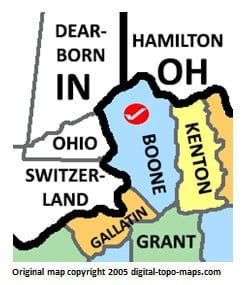 Texas Gas Transmission, LLC, a subsidiary of Boardwalk Pipelines, LP, wants to build the Dearborn County Lateral Project — roughly 12 miles of new 20-inch natural gas pipeline that begins at Texas Gas’s existing system in Dearborn County, Indiana, dips south across the Ohio River into Boone County, Kentucky, then hops back over the river into Hamilton County, Ohio. The destination is Vistra Corp.’s Miami Fort Power Plant, a coal-fired station slated for shutdown until someone had the good sense to convert it to natural gas instead. The lateral would move 265,000 dekatherms per day (Dth/d) of firm transportation service. A dekatherm is roughly one thousand cubic feet of gas, so call it about 265 MMcf/d (million cubic feet per day). Texas Gas filed with FERC in late May. Boone County leaders are not thrilled.
  In early April, the Federal Energy Regulatory Commission (FERC) issued a Draft Environmental Impact Statement (DEIS) for the Kosciusko Junction Pipeline Project in Mississippi (see
  Owensboro (KY) Municipal Utilities (OMU) is studying a proposed 545-megawatt natural gas power plant on roughly 30 acres at the former Elmer Smith Station site along the Ohio River, where coal generation ended in 2020. The developer, Green River East GenCo, holds an option to lease and has filed a grid interconnection application. OMU hired GDS Associates for a six-month study funded by the developer. OMU General Manager Tim Lyons stressed that the early-stage project isn’t guaranteed and that OMU won’t own the roughly $1 billion plant, citing customer risk. Instead, the plant may pursue power purchase agreements ahead of joining the MISO market in 2027. The plant will employ 15–20 workers.
  Gulf South Pipeline Company, a subsidiary of Boardwalk Pipelines, announced the launch of an open season for new natural gas storage capacity at its flagship Petal Gas Storage complex in Mississippi. In addition to the Petal open season, Boardwalk also highlighted significant expansion potential across two cornerstone assets: Choctaw Storage in Louisiana and the Midland Storage Complex in Kentucky. All three storage facilities are used to store Marcellus/Utica molecules.
  It’s always fun for us to discover a new pipeline project that has the potential to flow more Marcellus/Utica molecules to other markets—particularly the Southeast and Gulf Coast markets. Here is one such project that (until now) had escaped our notice. On Dec. 29, the Federal Energy Regulatory Commission (FERC) issued an Environmental Assessment (EA) for the Southeast Compression for Utility Reliability Expansion (SECURE) Project, a compressor-focused expansion project designed to enhance compression infrastructure across Mississippi and Louisiana for the Gulf South Pipeline Company. The project will expand the Gulf South Pipeline system to provide an extra 280,000 dekatherms per day (Dth/d) of firm natural gas transportation service (280 MMcf/d) to markets in the Southeast, including support for power generation customers.
  Regional and national indicators are driving optimism in the Marcellus/Utica Basin, which currently supplies 31% of U.S. natural gas. Despite recent constraints from low prices and limited pipeline capacity, drillers like Infinity Natural Resources and Expand Energy now predict significant output growth coming in the new year. This resurgence is fueled by surging in-basin demand from AI data centers, major power plant conversions in Pennsylvania, and improved takeaway prospects, such as Boardwalk’s proposed Borealis pipeline to the Gulf Coast (see
  We’ve pointed out (for years) the relative success the anti-drilling left has had in blocking new pipeline projects to carry Marcellus/Utica molecules to other regions, stifling new drilling in our area as a result. Although it has been and will continue to be a challenge to build new pipeline projects, the Trump administration is making it easier. Trump’s policies encourage new pipelines and more access to natural gas. We spotted an article from Reuters that provides an overview of eight pipeline projects that are actively being pursued to carry M-U molecules to other regions. We’ve covered all of these projects in previous posts. The Reuters article compiles the most likely candidates for new pipeline projects into a single, convenient article.
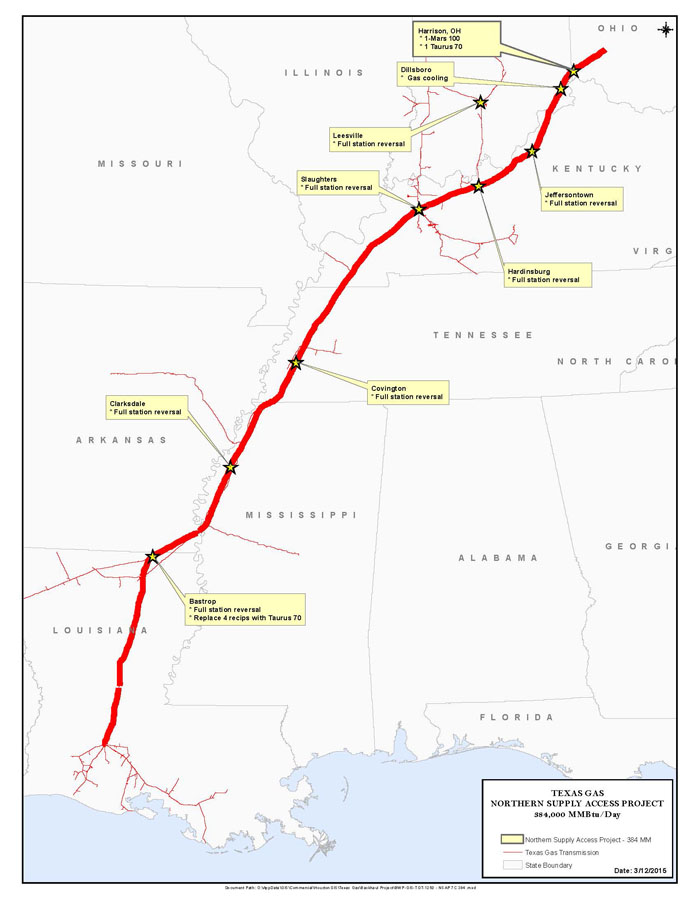
  Last week MDN brought you the great news that Boardwalk Pipeline Partners launched an open season to offer an extra 2 billion cubic feet per day (Bcf/d) of capacity along its 5,975-mile Texas Gas Transmission pipeline network that stretches from Ohio to Louisiana, running through Indiana, Illinois, Kentucky, Mississippi, and Arkansas along the way (see
  This is VERY exciting news! Boardwalk Pipeline Partners announced yesterday an open season to offer an extra 2 billion cubic feet per day (Bcf/d) of capacity along its 5,975-mile Texas Gas Transmission pipeline network that stretches from Ohio to Louisiana, running through Indiana, Illinois, Kentucky, Mississippi, and Arkansas along the way. According to the announcement, the expanded capacity’s express purpose is to connect Marcellus/Utica gas supplies with growing demand from electric utilities, LNG exporters, industrial users, and data centers in the Midwest and Gulf Coast.

 The Kosciusko Junction Pipeline Project, led by Gulf South Pipeline Company, LLC (a subsidiary of Boardwalk Pipelines), involves constructing approximately 110 miles of 36-inch natural gas pipeline. The project has an estimated cost of $1 billion and is supported by a 20-year agreement with an anchor customer. It is designed to transport up to 1.16 billion cubic feet per day (Bcf/d) initially, with potential for expansion to 1.58 Bcf/d. The pipeline aims to connect gas supplies from key basins, including the Marcellus/Utica, Haynesville, and Fayetteville, to power markets in the Southeastern United States. Last week, Boardwalk pulled the trigger and made a final investment decision (FID) to move forward with the Kosciusko Junction project.